Customers are no longer discovering businesses through one search box. A potential client may search Google, read an AI Overview, compare several providers through Claude, ask a follow-up question and then visit only one or two websites. That changes what search visibility means.
Introduction
A business can rank reasonably well in traditional search and still be difficult for an AI system to understand, retrieve or cite. This is where the idea behind Claude SEO Agency Melbourne becomes relevant.
“Claude SEO” is not an official Anthropic product or a separate published ranking system. It is a practical term for improving how clearly a business can be discovered and understood when people use Claude and other AI-assisted research tools. Claude can use live web search when the feature is enabled. Anthropic states that web search retrieves current information from multiple sources and includes citations in its responses. That makes public website accessibility, source quality and clear information increasingly important for businesses that want to be discoverable during AI-assisted research. For Melbourne businesses, the opportunity is broader than “ranking in Claude”. The real objective is to create a website that can be understood by people, traditional search engines and AI systems without sacrificing accuracy or user experience.
A useful way to think about the process is:
Technical access → Clear entities → Useful answers → Evidence → Authority → AI discovery → Business action
The following nine strategies explain how to build that foundation.
What Is Claude SEO?
Claude SEO is the process of improving website content and technical accessibility, so a business is easier to discover, understand and evaluate when people use Claude for research. It overlaps heavily with traditional SEO. A technically broken website does not become strong simply because the content has been rewritten for AI. Likewise, a well-indexed site with thin or generic information may still give an AI system little reason to treat it as a useful source. Anthropic currently uses different web robots for different purposes. Its documentation identifies Claude-User for user-directed website retrieval and Claude-SearchBot for improving web search results. Anthropic also states that blocking these bots can reduce a site’s visibility in user-directed search experiences. This makes one principle especially important: AI visibility begins with being accessible before it becomes a content problem. A strong strategy therefore combines technical SEO, useful content, local relevance, entity clarity, internal linking and credible evidence. Businesses that need the traditional foundation first can review SEO services for Australian businesses.
Why Claude SEO Matters for Melbourne Businesses
Melbourne businesses compete for attention across increasingly fragmented search journeys. A prospective client might search for a provider by suburb, compare several firms through an AI assistant and then ask a much more specific question such as: “Which Melbourne provider handles this service for medium-sized businesses?” That type of query is different from a short traditional keyword.
It contains location, service type, customer profile, and commercial intent at the same time. AI systems can break complex questions into several information needs. This means businesses need more than one optimised service page. Their websites should provide enough connected information for users and retrieval systems to understand what the company does, who it serves, and where those services apply. Local visibility still matters as part of that process. A Melbourne business should make service areas clear without repeating “Melbourne” unnaturally across every paragraph. Accurate business details, consistent company information, and useful location-specific content provide a stronger context than keyword repetition.
The local SEO guide for Australian businesses provides additional guidance on building local-search foundations. Google’s current guidance for generative AI search also reinforces an important point: existing SEO fundamentals remain relevant. Google specifically recommends crawlable pages, useful people-first content, internal links and strong page experience. It also states that businesses do not need special AI-only schema or a special writing format merely to appear in generative AI search. The same principle is useful when approaching Claude visibility. Do not optimise for a mythical AI loophole. Build a website that makes good information easy to retrieve and verify.
Traditional SEO vs Claude SEO
Traditional SEO and AI search optimisation should work together rather than compete for the same budget.
The difference is mainly in emphasis.
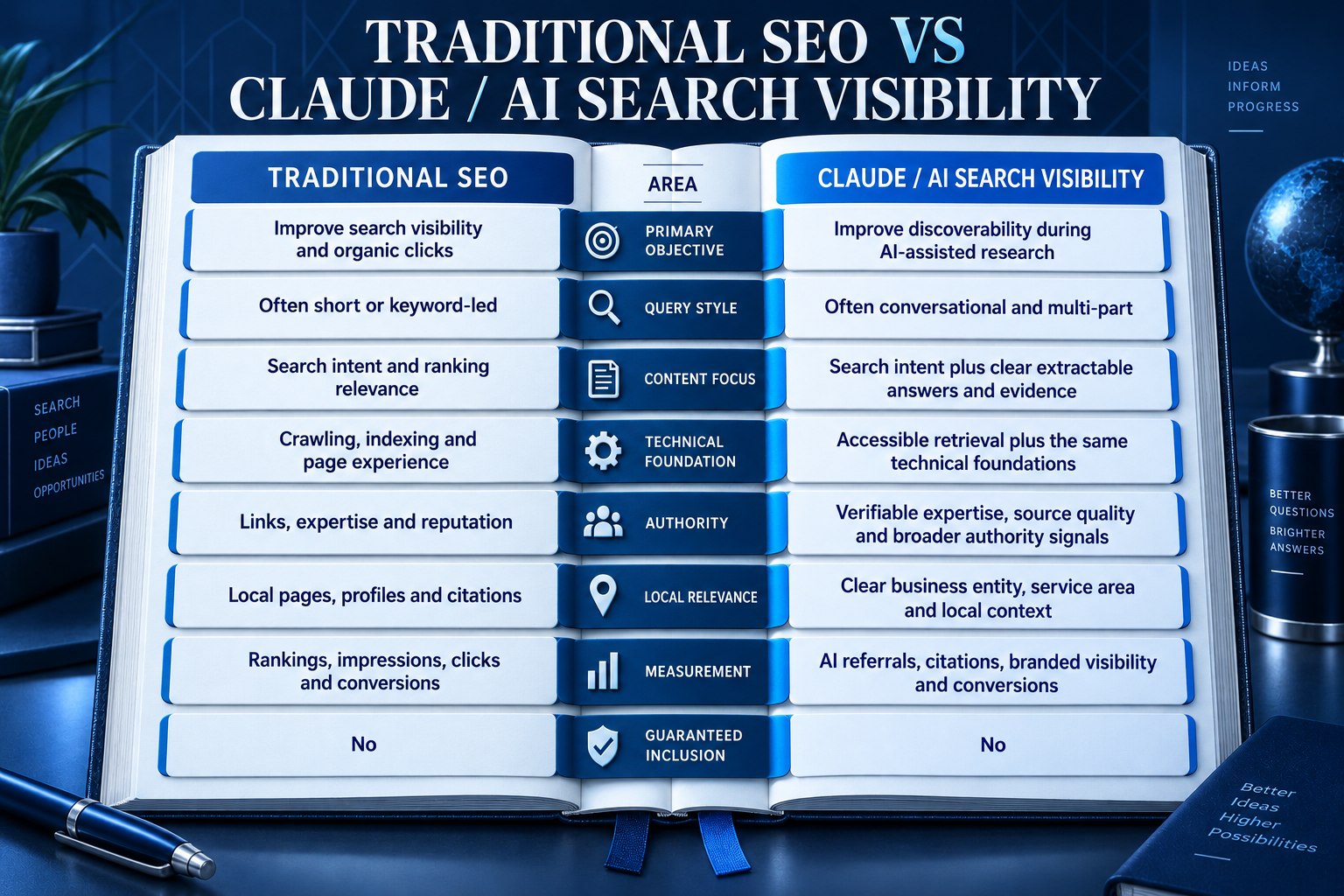
The important takeaway is that Claude SEO should extend a strong SEO strategy rather than replace it. IT Company Australia’s 2026 SEO services guide provides broader context on how search optimisation is evolving alongside generative AI.
9 Ways to Improve AI Search Visibility
Make Sure Claude Can Reach the Content
A sophisticated content strategy cannot help if important information cannot be retrieved. Start with the technical foundation. Important service pages should be publicly accessible. Links should work. Canonicals should point to the correct versions of pages. Valuable content should not be hidden behind unnecessary scripts or blocked by access rules.
Anthropic’s current crawler documentation is particularly relevant here. Claude-User supports retrieval requested by Claude users, while Claude-SearchBot supports search results in quality. Anthropic states that blocking can reduce visibility in related search activity. This does not mean every website must allow every crawler. Businesses may have privacy, security or intellectual-property reasons to restrict content. The important point is to make that decision deliberately. Public marketing pages intended for discovery should not accidentally be inaccessible. Technical issues can also be addressed through ongoing website maintenance and a stable web hosting environment.
Build Content Around Real Customer Questions
AI assistants are conversational. Users often ask full questions instead of entering two or three keywords.
A traditional search might be SEO agency Melbourne
An AI-assisted query could be: “Which SEO approach would suit a Melbourne accounting firm that wants to appear in Google and AI-generated answers?”
The second question contains more context. Content should anticipate that depth. A useful service page can explain what the service does, who it suits, what is included, what is not included, what implementation involves, and how customers should evaluate alternatives. The goal is not to write hundreds of tiny FAQ answers. Google’s 2026 generative search guidance specifically notes that there is no requirement to break every page into tiny chunks for AI systems. Content should be structured for the reader first. Use clear sections because they improve comprehension, not because of an invented AI word-count rule.
Create Information Worth Citing
Generic information is easy to reproduce. Original information is harder to replace. A page becomes more useful when it contains evidence that another source cannot simply copy from general knowledge. That might include an original comparison, a documented process, a case study, product data, implementation experience or a carefully explained Australian example. For instance, an article saying “SEO requires good content” adds very little. A stronger article may explain exactly how a technical audit identified duplicate service pages, what was changed, and which measurements were monitored afterwards. Google’s current AI search guidance emphasises valuable, unique, and non-commodity content. The same editorial principle is sensible for Claude. Give the system something genuinely useful to retrieve.
Make Your Business Entity Easy to Understand
An AI system should not need to guess whether two differently written business names refer to the same organisation. Keep company information consistent. The business name, service description, location information, and relevant organisational details should be agreed across core website pages. This becomes especially important for local businesses.
A Melbourne organisation should clearly explain whether it serves Melbourne only, Victoria more broadly or customers throughout Australia. Local pages should contain useful location context rather than simply changing the city name in a duplicated copy. Businesses working on that foundation can review local SEO services. Entity clarity also extends beyond the website. Consistent brand presentation through appropriate channels can help users recognise the business when they encounter it elsewhere. Where that forms part of the marketing strategy, social media management can support consistent public messaging. It should not be treated as a shortcut for earning AI citations.
Put Evidence Close to Important Claims
Trust becomes weaker when claims and evidence are separated. If a business states that it has a certification, partnership or documented capability, readers should be able to understand what the claim actually covers.
Dates matter too. A pricing page last updated three years ago may be technically accessible but commercially unreliable. The same applies to statistics. Do not write “most Australian businesses now use AI search” unless a reliable source supports that statement and the population and date are clear. A stronger content process distinguishes: Fact → Evidence → Context → Limitation
This style is valuable for human readers because it reduces ambiguity. It also gives retrieval systems cleaner information to interpret. Where expert review is appropriate, include a real author or reviewer rather than creating a fictional authority signal.
Improve the Technical and Page Experience Foundation
AI visibility does not remove the need for a usable website. A page should load reliably, work on mobile devices, and provide clear navigation. HTML should expose important content in a readable way. Internal links should be crawlable. Canonicals should be accurate. Broken links and redirect chains should be corrected.
Google explicitly says its generative AI features still depend on foundational SEO and recommends crawlability, internal linking, page experience and accessible text. This is where professional website design and technical SEO often overlap. A visually attractive site can still make information difficult to discover if important content is buried in interactive components or poorly structured pages. Likewise, technically perfect HTML cannot rescue content that fails to answer the user’s question. Both sides matter. The website design services guide provides additional context on how design, mobile experience and SEO structure work together.
Strengthen Internal Linking and Topic Relationships
Internal links help readers move from a broad topic to a more specific one. They also show relationships between pages. Imagine a Melbourne IT provider with separate pages covering managed IT, cloud backup, cyber security and Microsoft 365. A broad “IT services” article can introduce the categories, while contextual internal links guide readers toward the relevant detailed service. The same model works for an SEO topic cluster. A primary SEO service page can connect to local SEO guidance, technical SEO articles, AI-search content and conversion-focused website resources. Avoid adding links to reach a numerical target. The anchor should describe the destination naturally.
A page about technical visibility might link to website maintenance. A section about organic acquisition should link to SEO services. A discussion about landing-page usability can link to website design. This creates a coherent information network rather than a collection of isolated articles.
Use Structured Data for Meaning, Not as an AI Hack
Structured data can give search engines explicit information about page content. It can identify elements such as an article, organisation or breadcrumb structure. However, structured data should match what the visitor can actually see. Google states that there is no special schema required for generative AI search and warns against over-focusing on structured data as if it were an AI-visibility shortcut. That is an important distinction. Use structured data because it accurately describes the page. Do not add unsupported ratings, fake FAQs or invented business information because it looks machine-readable.
The same caution applies to llms.txt. Google’s current documentation says maintaining such a file will neither help nor harm visibility in Google Search because Google ignores it. Other systems may use different approaches, so businesses should evaluate each implementation on evidence rather than trend-driven claims.
Measure AI Visibility as a Business Channel
AI search visibility needs measurement. However, “Claude mentioned to us once” is not a meaningful performance strategy. Track several layers.
- First, monitor whether important pages remain technically accessible and indexed in the search systems that feed discovery.
- Second, observe referral traffic from AI platforms where analytics makes that possible.
- Third, run controlled prompt tests around important customer questions. Record the prompt, date and result instead of relying on memory.
- Fourth, measure what happens after visitors arrive.
A citation is useful only if it contributes to awareness, engagement, or a commercial journey. For Google’s own AI experiences, Search Console now provides dedicated generative AI performance reporting. Google says the reports were rolled out worldwide by 31 August 2026 and include information such as impressions, pages, countries, devices, and dates. Claude does not provide an equivalent public website-owner dashboard for organic web visibility. That makes consistent internal measurement particularly important.
In-House vs Agency-Managed Claude SEO
Some organisations can manage AI-search optimisation internally. Others may need external support because the work crosses technical SEO, content, analytics and local-search management. Neither approach is automatically stronger.
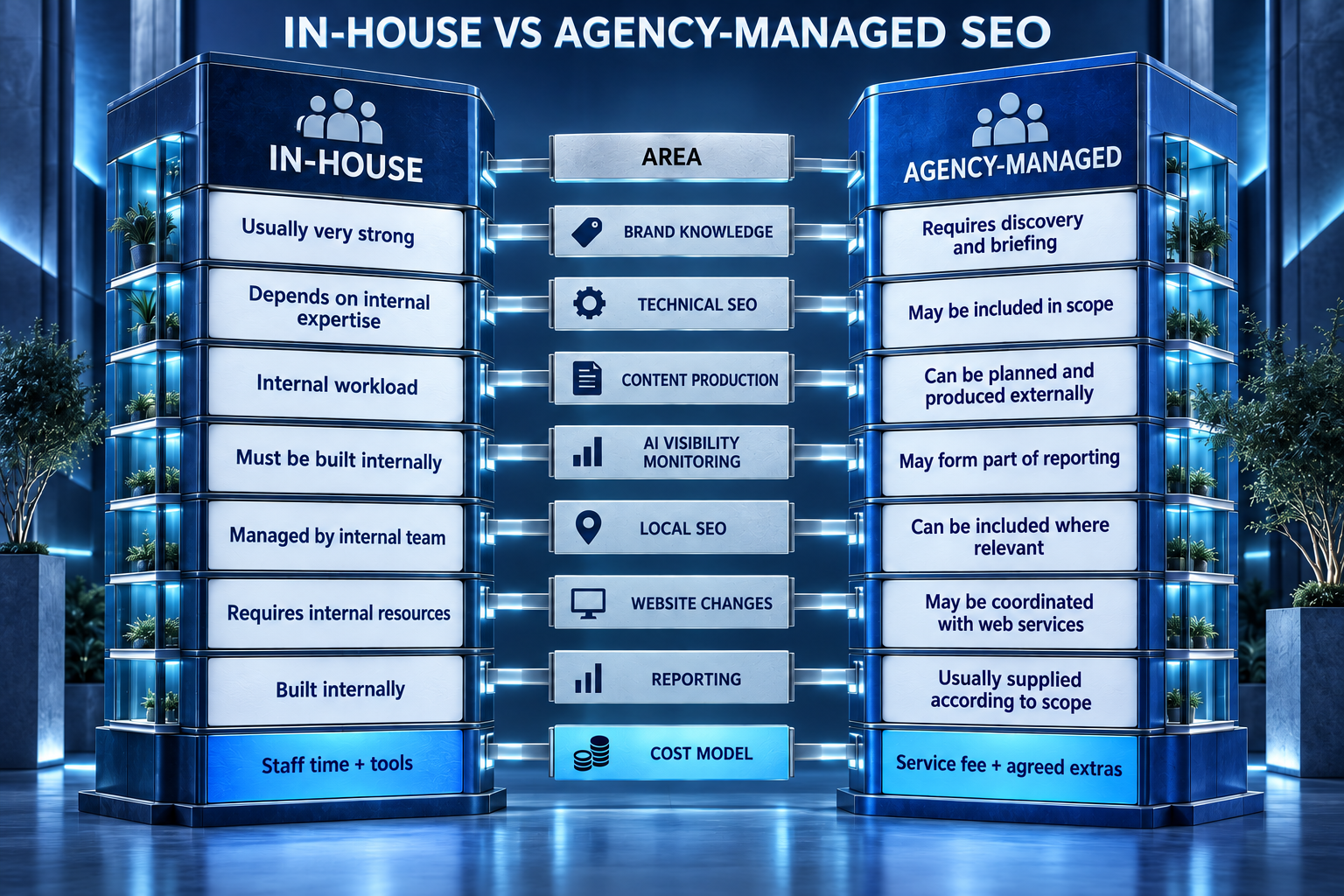
A hybrid approach can also work. An internal team may retain subject expertise and approvals while an agency manages technical audits, content planning and reporting.
How Much Does Claude SEO Agency Melbourne Cost
There is no reliable universal price for Claude SEO Agency Melbourne services. The work is not a single software licence. A small Melbourne business with ten established pages may require a very different scope from a national company with thousands of URLs, multiple locations and several content teams. Cost can be influenced by the technical audit, number of pages, content gaps, local SEO requirements, website changes, structured data, competitor research, reporting depth, and frequency of new content.
It is also important to separate one-off work from ongoing optimisation. A technical and content audit may be a project. Publishing new content, monitoring AI visibility, refreshing older pages, and reviewing competitors are continuing activities. IT Company Australia’s current SEO services page lists Standard, Business and Premium scopes but uses a Request a Quote model rather than publishing a fixed monthly amount for each SEO package. A quote should therefore explain exactly what is included. Before comparing costs, confirm whether the proposal covers technical SEO, content writing, local SEO, website changes, reporting and AI-search monitoring. Also confirm whether GST is included or excluded.
The useful comparison is not: Which agency has the lowest monthly figure?
It is: Which scope addresses the problems our website actually has?
How to Compare Claude SEO Agencies
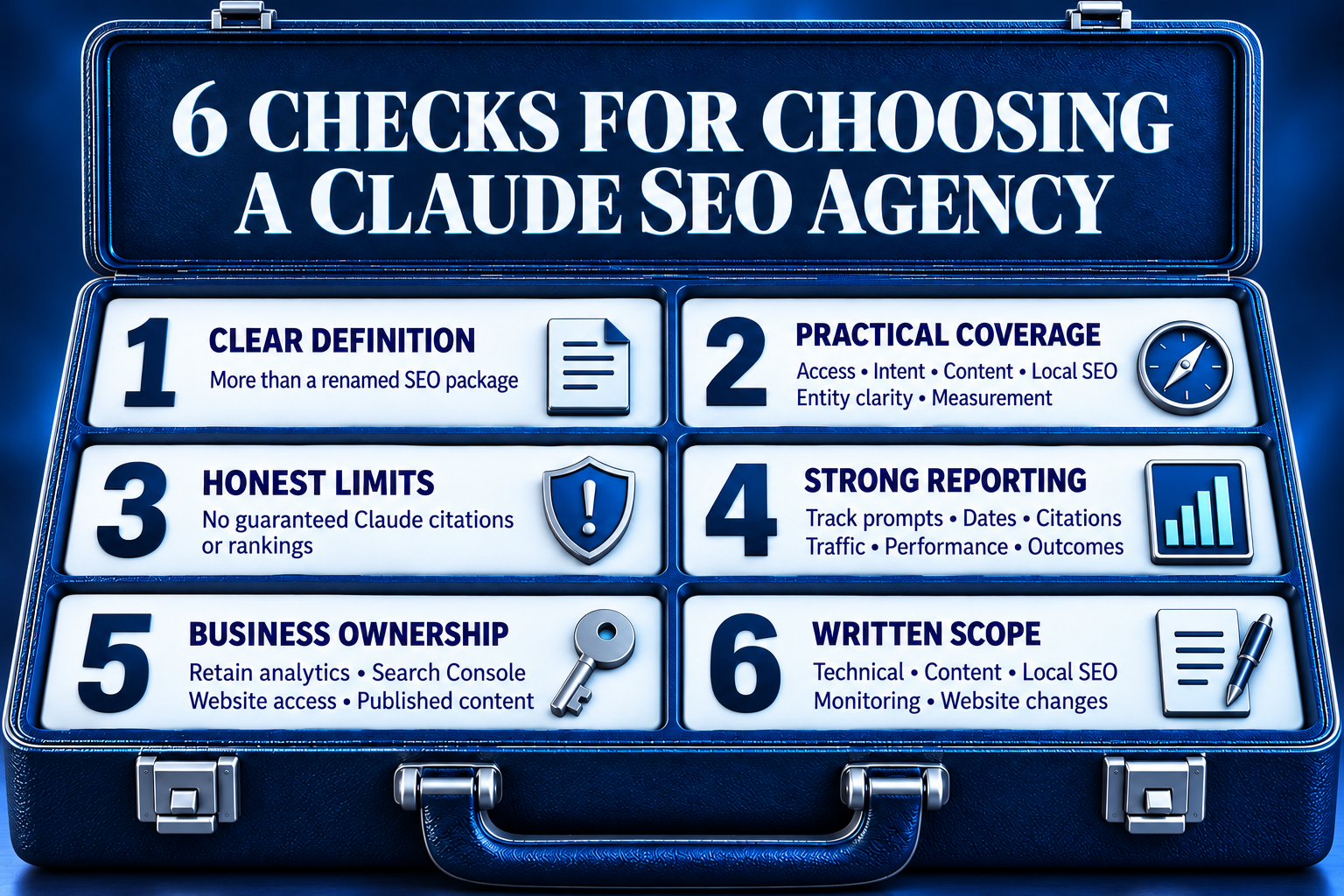
Where IT Company Australia Fit
IT Company Australia currently provides SEO, local SEO, website design and other digital services that can support different parts of an AI-search visibility strategy. Its current SEO page covers areas such as on-page SEO, local targeting, content optimisation, competitor analysis, backlinks and reporting. The company also has separate website-design and maintenance services that may be relevant where search problems are technical rather than purely editorial.
The important point is scope. A Melbourne business should determine whether it needs content optimisation, technical repairs, local SEO or a combination of those services before comparing providers. IT Company Australia’s current About page states that its information security management system is certified to ISO/IEC 27001:2022. Customers should still assess the certification scope, contracted services, and their own requirements. Certification does not guarantee search visibility or AI citations.
For Australian contact pathways, ITCompany Sydney can be viewed through the supplied map directions page. Enquiries relating to ITCompany Melbourne, ITCompany Brisbane and ITCompany Perth can be made through the company contact page. Location-specific availability, response arrangements, and onsite services should be confirmed directly. The current contact page lists all four locations.
Businesses comparing providers can request a documented SEO and AI-visibility scope before deciding which work should be prioritised.
Frequently Asked Questions
What Does a Claude SEO Agency Melbourne Do?
A Claude SEO agency helps businesses improve the technical, content and authority signals that support discoverability during AI-assisted research. The work can include technical SEO, content optimisation, local SEO, internal linking, entity clarity and visibility monitoring.
Is Claude SEO Different From Traditional SEO?
Yes, but the two overlap heavily. Traditional SEO focuses on search-engine discovery and organic performance. Claude-oriented optimisation adds greater attention to conversational queries, retrieval, source clarity and AI-assisted discovery.
Can a Business Guarantee That Claude Will Cite Its Website?
No. Claude decides which information to retrieve according to the search context and system behaviour. A website can improve accessibility and usefulness but cannot guarantee inclusion in a particular answer.
Does Claude Search the Live Web?
Claude can search the live web when web search is enabled. Anthropic says its web-search feature gathers current information from multiple sources and provides citations in responses.
Should I Create an llms.txt File for Claude SEO?
An llms.txt file should not be treated as a universal AI-ranking requirement. Different AI systems may use different mechanisms. Google currently states that llms.txt does not affect its Search visibility. Businesses should therefore avoid treating the file as a substitute for technical SEO and useful content.
How Important Is Local SEO for Melbourne AI Visibility?
Local SEO is important when customers need a provider in or around Melbourne. Clear service areas, consistent business information, and useful local content can make the organisation easier to understand. Businesses can review local SEO services when location-based visibility is commercially important.
How Long Does Claude SEO Take to Work?
There is no fixed timeframe. Technical fixes may take effect faster than authority building or large content programmes. Visibility also depends on crawling, indexing, competition, query context and the AI system being used.
What Should I Ask Before Hiring a Claude SEO Agency?
Ask how the agency defines AI search optimisation, what technical work is included and how success will be measured. You should also confirm content ownership, reporting, local SEO responsibilities, website access and whether AI citations are being measured systematically rather than through selected screenshots.
Final Thoughts
Claude SEO Agency Melbourne should focus on practical AI-search readiness rather than rewriting every page to sound machine-generated. The strongest foundation is still a technically sound website, useful content, clear business information, and accurate service details. Content should answer real customer questions in a way that is easy to understand. Business claims should be supported by evidence, dates, and credible sources where relevant. Internal links should connect related services and topics naturally, while structured data should reflect what is visible on the page.
Local relevance also matters. Melbourne service information should be accurate and useful without repeating location keywords unnaturally. The aim is to help both users and AI systems understand what the business does, who it serves, and where those services are available. AI search visibility should also be measured realistically. Businesses can monitor organic visibility, referral traffic from AI platforms where available, cited pages, engagement, and the quality of resulting leads. The focus should remain on business outcomes rather than simply appearing in an AI-generated answer.
In 2026, customers may move between traditional search, Claude, other AI assistants, and business websites before making a decision. The strongest long-term strategy is therefore to publish information that is accurate, useful, and easy to discover across different search environments. Melbourne businesses that want to review their technical SEO, content structure, local visibility and readiness for AI-assisted search can contact IT Company Australia to discuss their current website and priorities.
