

Your website may look polished, load properly, and contain plenty of content. Yet organic enquiries can still stay flat. The first instinct is often to publish more blogs, add more keywords, or redesign a few pages. But the real issue may already be hidden inside the website.
Introduction
Free SEO audit Australia businesses use as an initial health check can uncover problems such as indexing errors, weak pages, broken links, poor mobile usability and missed local-search opportunities.
The key is quality. A useful audit should identify meaningful issues, not simply produce a long list of automated warnings.
In 2026, SEO is shaped by technical performance, search intent, content quality, and website structure. A good audit helps businesses understand what needs attention first and where further work can make the biggest difference.
What Is a Free SEO Audit?
An SEO audit is a structured review of how well a website supports search visibility.
It examines whether search engines can discover important pages, understand their content and access a technically sound website. It also looks at whether those pages are useful for real visitors.
A free audit is normally an initial review rather than a complete SEO project.
Depending on the scope, it may examine areas such as:
- crawling and indexing;
- page titles and descriptions;
- website content;
- internal links;
- broken pages;
- mobile usability;
- page performance;
- backlinks;
- local SEO.
The audit should result in practical findings rather than simply displaying a score.
Businesses wanting a wider view of ongoing optimisation can compare an initial audit with broader SEO services for Australian businesses.
Why an SEO Audit Matters Before Making Changes
SEO problems often overlap.
A page might appear to need better keywords when the real issue is that search engines cannot index it correctly. A service page may receive traffic but fail to generate enquiries because the page does not answer the visitor’s needs.
Making changes without understanding the cause can waste time.
A useful SEO audit establishes a starting point. It helps separate urgent technical issues from longer-term improvements.
This makes prioritisation easier.
The goal is not to make every audit warning disappear. It is to identify changes that can improve search accessibility, usability and business outcomes.
Free SEO Audit vs Full Professional Audit
A free audit and a detailed professional audit usually serve different purposes.
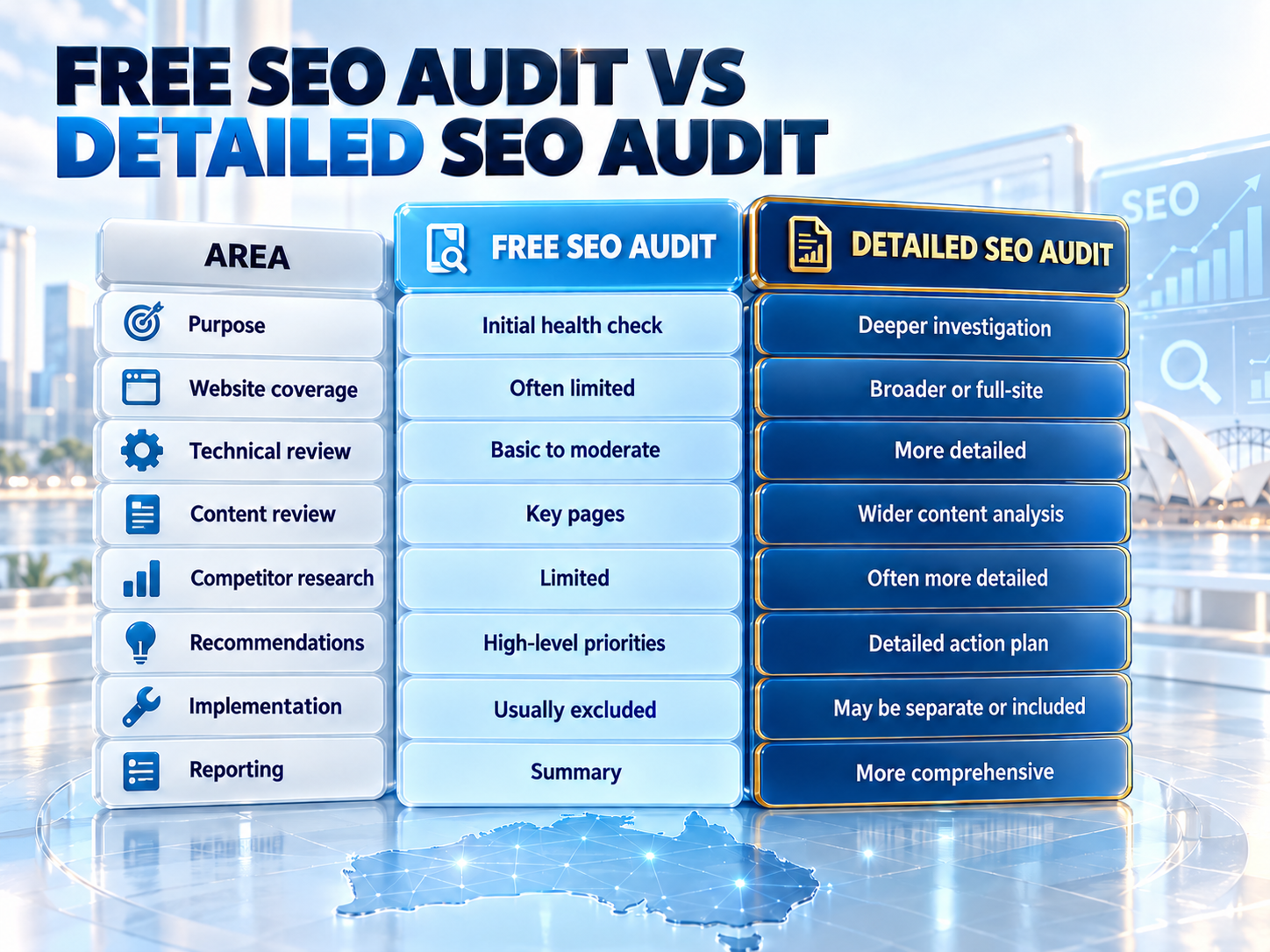
A free audit can be a good starting point for a small business. Larger ecommerce, multi-location or technically complex websites may require deeper analysis before major decisions are made.
The important question is not whether an audit is free. It is how much of the website is actually being checked.
9 Website Checks a Free SEO Audit Australia Should Cover
Check Whether Important Pages Can Be Indexed
Start with the foundation. Search engines cannot rank important pages if they cannot discover or index them properly. Review robots.txt, noindex tags, XML sitemaps, canonical tags and page status codes.
Not every URL needs to appear in search. Login pages, duplicate filters and some administrative pages may be better left out. Businesses facing indexing problems can also review this guide on fixing unwanted indexed URLs.
Review Page Titles, Headings and Search Intent
Every important page should have a clear purpose. Titles and headings should describe the topic accurately, while the content should match what the visitor is actually searching for.
Search intent is simply the reason behind a search. Avoid forcing the same keyword into every heading. Clear and useful wording usually creates a better experience.
Check Content Quality and Coverage
More content does not automatically mean better SEO. Some pages are too thin, while others repeat the same ideas without adding useful information.
An audit should identify outdated content, overlapping topics, weak service descriptions and missing customer questions. Content should also reflect current products, services and business information.
Test Website Speed and Mobile Experience
A slow or difficult website can lose visitors before they read the content. Important pages should therefore be tested on both desktop and mobile devices.
Look for large images, heavy scripts and unstable layouts. If server performance is contributing to slow loading, suitable web hosting services may also need to be reviewed.
Find Broken Links and Weak Internal Linking
Internal links help visitors move between related pages and help search engines understand website structure. An audit should find broken URLs, outdated links and important pages receiving little internal support.
A useful blog should connect naturally to relevant service pages where appropriate. Regular website maintenance can also help prevent broken links and outdated pages from building up.
Check Whether Important Pages Convert Visitors
SEO should support business outcomes, not just traffic. A page may rank well but still generate few enquiries if the next step is unclear.
Check whether visitors can understand the service, find contact details and complete forms easily. Clear navigation and strong calls to action can make the customer journey easier.
Review Local SEO Signals
Businesses serving specific locations should keep their local information accurate and consistent. Review business names, phone numbers, addresses, service areas and important online profiles.
Location pages should describe genuine services rather than simply repeat suburb names for SEO. Businesses focused on geographic visibility can also consider local SEO services as part of a wider strategy.
Review Backlinks Without Chasing Bigger Numbers
Backlinks are links from other websites to yours, but the total number is only part of the picture. A relevant industry or local reference can be more useful than many unrelated links.
An audit should look for lost links, unusual patterns and strong existing references. The focus should remain on quality and relevance rather than simply increasing backlink numbers.
Check Measurement Before Making SEO Decisions
The final step is making sure SEO performance can actually be measured. Review which pages receive organic traffic, which searches create visibility and which pages generate enquiries.
Set a clear baseline before making major changes. Then compare performance over time so the audit becomes a practical decision-making tool rather than just another checklist.
The Twist: The Highest SEO Score May Not Be the Best Website

A Simple Australian Business Example
Consider an Australian plumbing company that has been publishing two articles every month.
Organic traffic remains flat, so management decides it needs more content.
A basic audit finds a different problem.
Several important service pages have weak internal links. One page is accidentally marked no-index, while older blog articles contain broken links.
The company fixes those issues before increasing content production.
This does not guarantee higher rankings or more enquiries. It simply demonstrates why diagnosis should come before expansion.
Publishing another 20 articles would not have fixed an important page that search engines could not index.
What Does a Free SEO Audit Actually Cost?
A genuine free SEO audit should cost AU$0, but the work recommended afterwards may not be free.
The audit may identify improvements involving content, technical development, website redesign, link building or ongoing SEO management. These services can carry separate costs.
Before submitting a website, confirm what the free audit includes. Some providers offer only automated checks, while others combine software findings with a manual review and professional explanation.
Businesses should also check whether requesting the audit creates any obligation to purchase additional services.
There is nothing wrong with using a free audit as part of a provider’s lead-generation process, provided the scope, potential costs and next steps are clearly explained.
Automated SEO Audit vs Manual Review
| Area | Automated Audit Tools | Human Review |
| Main role | Scan many pages quickly | Interpret findings in context |
| Useful for | Detecting technical patterns | Deciding which issues require action |
| Common findings | Broken URLs, duplicate titles and missing metadata | Content quality, customer relevance and business impact |
| Key limitation | May flag issues without understanding purpose | Requires more time and specialist judgement |
| Example | Flags a short page for low word count | Recognises that the page already answers the customer’s question |
| Best approach | Use automation to identify patterns | Use people to prioritise meaningful improvements |
Who Owns the SEO Data and Website Access?

How to Compare Free SEO Audit Providers
Do not compare providers based only on the number of issues in their reports. A report containing 400 warnings is not automatically more useful than one containing 20 prioritised findings. Ask what parts of the website will be reviewed and whether automated tools or manual analysis are used.
The provider should also explain which problems are urgent and which are lower priority. Look for clear separation between the audit and implementation. If technical fixes, content rewriting or development work cost extra, that should be explained before work begins.
For enquiries managed through ITCompany Melbourne, businesses should still confirm what the audit covers and how recommendations are delivered.
The same applies when working with ITCompany Brisbane. Geographic availability should not replace a clearly defined scope.
For Sydney-based enquiries, ITCompany Sydney can be referenced through the approved map listing. Service availability and response arrangements should still be confirmed directly.
Businesses dealing with ITCompany Perth should likewise confirm any location-specific support, meeting arrangements and implementation responsibilities.
What Should Happen After the Audit?
Do not try to fix every issue at once. Group audit findings by urgency and business impact so the most important work is completed first.
Start with critical problems such as blocked pages, broken high-value URLs and serious crawling or indexing issues.
Next, address weak content, internal linking and mobile usability. Longer-term priorities may include creating new content, strengthening local visibility and building authority.
Measure the impact of major changes before moving to the next task. An audit provides the map; implementation turns it into progress.
Frequently Asked Questions
Is a Free SEO Audit Australia Really Free?
It can be. A provider may offer the initial website review at no charge while charging separately for implementation or ongoing SEO. Check the scope before proceeding.
What Does an SEO Audit Check?
An audit can review indexing, technical issues, page content, internal links, performance, backlinks and local SEO. The exact coverage depends on the provider and audit type.
How Long Does a Free SEO Audit Take?
The timeframe varies with the website and level of manual review. A small site may be easier to assess than a large ecommerce or multi-location website.
Can I Run an SEO Audit Myself?
Yes. Business owners can complete many basic checks using search and analytics tools. More complex indexing, migration or technical problems may require specialist review.
Will an SEO Audit Improve My Google Rankings?
The audit itself does not improve rankings. It identifies potential problems and opportunities. Results depend on which recommendations are implemented and many other search factors.
How Often Should a Website Be Audited?
There is no fixed schedule for every website. Reviews are especially useful after redesigns, migrations, major content changes or unexplained performance drops.
Should Every Audit Warning Be Fixed?
No. Some warnings have little practical impact. Prioritise issues based on search accessibility, user experience and business importance rather than trying to reach a perfect audit score.
Is a Free Audit Enough for a Large Website?
Often it is only a starting point. Large ecommerce, multi-location or technically complex websites may require deeper crawling, content analysis and technical investigation.
Final Thoughts
A free SEO audit Australia businesses use effectively should provide direction, not simply another SEO score.
Start with the fundamentals. Check indexing, content, speed, internal links, conversions, local visibility, backlinks and measurement.
Then prioritise the findings that can affect customers and important business pages.
The key lesson for 2026 is simple: do not make more SEO changes until you understand what is already holding the website back.
Businesses that need help moving from an initial audit to a broader optimisation plan can contact IT Company Australia to discuss the scope and next steps.
