

A Google Ads campaign can generate clicks every day and still leave a business wondering where the real customers are. The account may show impressions, traffic, and conversions. Yet many enquiries may fall outside the service area, ask for the wrong service, or never become genuine sales opportunities. That is the problem effective Rockhampton AdWords Management should address.
Introduction
Google AdWords is now called Google Ads, although many businesses still use the older term when searching for paid-search management. Whatever name is used, the commercial objective is more important than platform terminology.
For a Rockhampton business, paid search should connect the right searcher with the right service at the right point in their buying journey.
A qualified lead is an enquiry that matches the advertised service, service area, target customer profile, and realistic purchase criteria. Marketing and sales should agree on this definition before evaluating campaign results.
A useful campaign journey looks like this:
Search intent → Relevant advertisement → Useful landing page → Conversion → Qualified lead → Business outcome
If any part of that journey is weak, increasing the advertising budget may simply create more waste.
What Is Rockhampton AdWords Management?
Rockhampton AdWords Management is the ongoing planning, targeting, measurement and optimisation of Google Ads campaigns intended to reach relevant Rockhampton customers. Effective management focuses on qualified enquiries and customer value rather than traffic alone.
The work can include keyword research, campaign structure, geographic targeting, negative keywords, bidding, advertisement creation, conversion tracking, and performance reporting.
Strong management also looks beyond the advertising account. A campaign can target the right keyword but still underperform when the landing page does not match the advertisement or when the business has no reliable process for following up with enquiries.
Businesses evaluating Google Ads management services should therefore examine the complete journey from search query to customer outcome.
Three questions should guide that process: who should see the advertisement, what is that person trying to achieve, and how will the business know whether the click became a useful lead?
Why Google Ads Matter for Rockhampton Businesses
Search advertising can reach people when they are actively looking for a product or service.
That intent makes Google Ads different from many awareness-focused channels. A person searching for a commercial service in Rockhampton may already be comparing providers, prices or service options.
However, local visibility does not automatically create a useful enquiry. A Rockhampton business may serve only in the immediate area. Another organisation may cover the surrounding parts of Central Queensland. A professional service may serve Rockhampton customers while operating across Australia. The campaign should reflect that actual service model rather than using a broad location setting simply to maximise impressions.
Google Ads can also complement organic search. Paid campaigns provide advertising visibility while budget is active, while organic optimisation works toward longer-term search visibility. Businesses developing both channels can review the local SEO guide for Australian businesses to understand how local organic visibility differs from paid search.
Clicks vs Qualified Leads
A click shows that someone interacted with the advertisement. It does not prove that the person fits the business.
This distinction is important because a campaign with fewer clicks may still produce stronger commercial results when those visitors are more relevant.
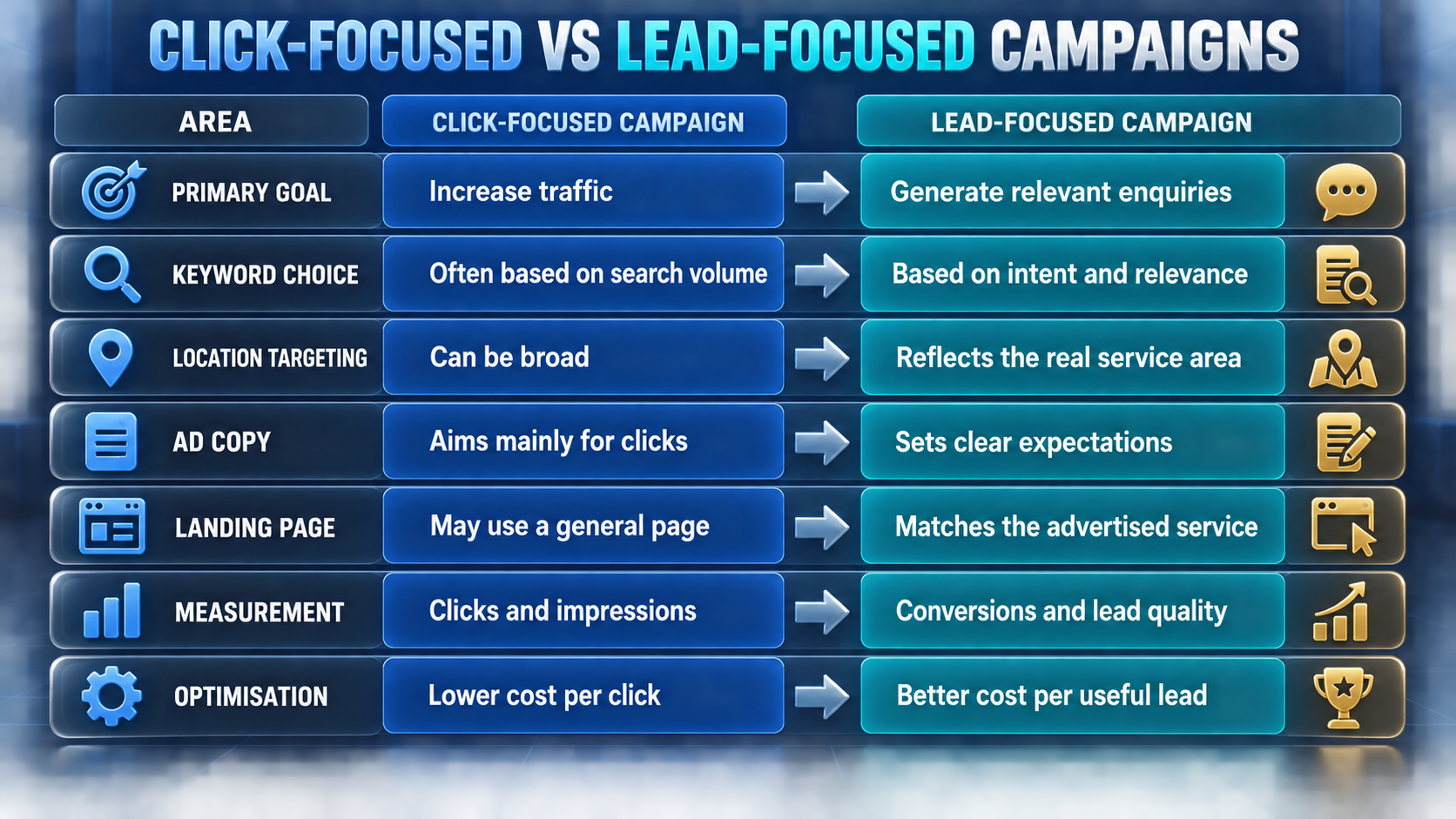
A smaller number of relevant enquiries can be more commercially useful than a large volume of casual visitors. That principle shapes the nine strategies below.
9 Lead Strategies for Local Businesses
Define the Lead Before Optimising the Campaign
Campaign optimisation becomes unreliable when nobody has agreed on what a useful lead looks like. One team may count every form of submission. The sales team may only consider enquiries relevant when they fit a particular service, location and customer type.
Those definitions need to align. For example, a local service business may need customers within a particular operating area. A business-to-business provider may care more about company size, project type or decision-making authority.
Defining the lead first gives the campaign a meaningful outcome to optimise toward.
Build Campaigns Around Search Intent
Search volume alone should not decide which keywords receive budget.
A person searching for general information may still be researching. Someone searching for a specific service with a Rockhampton location phrase may be closer to contacting a provider. The campaign should recognise that difference.
High-volume terms can produce large amounts of traffic while delivering relatively few commercially useful enquiries. Lower-volume terms may generate fewer clicks but stronger intent. Businesses developing a wider search strategy can connect paid activity with SEO services in Australia.
The goal is not to appear for every possible search. It is to appear when the searcher’s need is relevant to the service being advertised.
Separate Rockhampton, Regional and Wider Targeting
This is where a local campaign can become much more precise. Instead of treating every geographic audience as one campaign, businesses can consider whether Rockhampton customers, wider regional customers and national prospects should be targeted separately.
A service that requires physical attendance may need strict geographic limits. A remote professional service may be able to advertise much more broadly. Keeping those audiences separate can make reporting easier because performance can be assessed according to the areas the business genuinely serves.
Google states that geographic targeting relies on several signals. It also warns that location targeting is its best effort and does not guarantee 100% accuracy. Advertisers should review performance and adjust settings rather than assuming location targeting will exclude every irrelevant user.
The practical rule is simple: configure location targeting, then validate it with real campaign data.
Use Negative Keywords to Protect the Advertising Budget
Negative keywords prevent advertisements from being triggered by specified unwanted terms or phrases. This matters because apparently relevant searches can contain very different intent. A professional service provider may want to avoid searches involving employment, free services, courses or unrelated products.
For example, a campaign advertising consulting services may want one query containing “consultant Rockhampton” while excluding another query containing “consultant jobs Rockhampton”. Google describes negative keywords to exclude unwanted search terms and focus campaigns more closely on relevant searches. Negative keyword management should continue after launch. Search-term data often reveals irrelevant queries that were difficult to predict during campaign setup.
Write Advertisements That Pre-Qualify Customers
The advertisement should not try to persuade every searcher to click. It should help the right customer recognise whether the service fits their needs. If the business works only with commercial customers, that can be stated clearly. If a service is available only within a defined area or requires a consultation, the advertisement can set up that expectation. This may reduce total clicks, but that is not a problem when clearer advertising filters irrelevant enquiries. The objective is not the highest click-through rate at any cost. The objective is to create an accurate connection between the searcher’s needs and the service being offered.
Make the Landing Page Continue the Advertisement
An advertisement can create a highly relevant visit and still lose the lead. Imagine searching for a specific service and landing on a homepage with several unrelated options. The visitor now has to search again.
A focused landing page reduces friction. It should quickly explain what the service is, who it is designed for, and what the visitor should do next. The call to action should also match the advertisement rather than introducing a completely different offer.
Businesses that identify poor landing-page performance through Google Ads may benefit from reviewing them website design and conversion pathways.
The advertisement creates a visit. The landing page has to earn the enquiry.
Track What Happens After the Form Is Submitted
A completed form is useful information, but it is not the final business outcome. A more mature campaign records whether the lead was contacted, qualified, quoted and eventually won.
That information helps distinguish an easy-to-generate form submission from a genuinely valuable enquiry. Where the technical setup and privacy requirements support it, Google provides enhanced conversion capabilities for leads that can connect later customer outcomes with earlier advertising activity. Google updated this area during 2026 and now supports unified enhanced-conversion settings and Data Manager workflows for lead data. This creates a more useful measurement chain:
Form submission → Contacted → Qualified → Quoted → Customer
Without that feedback, automated optimisation may learn to favour leads that are easy to generate rather than leads that are commercially useful.
A Simple Rockhampton Lead Example
Consider two illustrative campaigns for the same local service business.
Campaign A generates 120 clicks at AU$4.50 each, creating AU$540 in advertising spend. It produces four qualified leads.
AU$540 ÷ 4 = AU$135 per qualified lead
Campaign B generates 80 clicks at AU$6 each, creating AU$480 in advertising spend. It produces eight qualified leads.
AU$480 ÷ 8 = AU$60 per qualified lead
Campaign B has fewer clicks and a higher cost per click. Yet it produces twice as many qualified leads at a lower overall spend.
Cost per qualified lead should still be considered alongside quote rate, acquisition cost, customer value and profit margin. The cheapest lead is not automatically the most valuable customer.
Allocate Budget According to Business Value
Advertising budgets do not need to remain equally distributed across every keyword or service. One campaign may produce many low-quality enquiries. Another may generate fewer leads that convert into higher-value work. The budget should respond to that difference.
This requires more than checking click cost. Campaign managers can compare search intent, conversion rates, qualified-lead rates and later sales outcomes. Automation can assist with bidding, but automation depends on the goals supplied to the platform.
Bad measurement can teach an automated campaign to optimise for the wrong outcome. Before using conversion-based bidding, businesses should confirm that primary conversion actions represent meaningful business outcomes rather than low-value page interactions.
Connect Paid Search With the Wider Customer Journey
A potential customer may interact with several channels before making contact.
Someone may first encounter the company through social content and later search for the brand. Another person may click a Google advertisement and return through email after requesting information. Paid search should therefore be measured as one part of the customer journey rather than as an isolated activity. Businesses with longer sales cycles may use email marketing and CRM services to manage opted-in prospects after the initial enquiry.
For businesses comparing paid search with paid social activity, the Facebook Management Services guide explain how Facebook can support awareness, engagement and lead generation at different stages of the funnel. A broader digital marketing strategy may be useful when several acquisition channels need to be coordinated.
The goal is not to use every available channel. It is to understand what each channel contributes.
Self-Managed vs Managed Google Ads
Some businesses can manage Google Ads internally. Others prefer external management because campaign monitoring, search-term reviews, conversion measurement and testing require ongoing time.
Neither approach is automatically better.
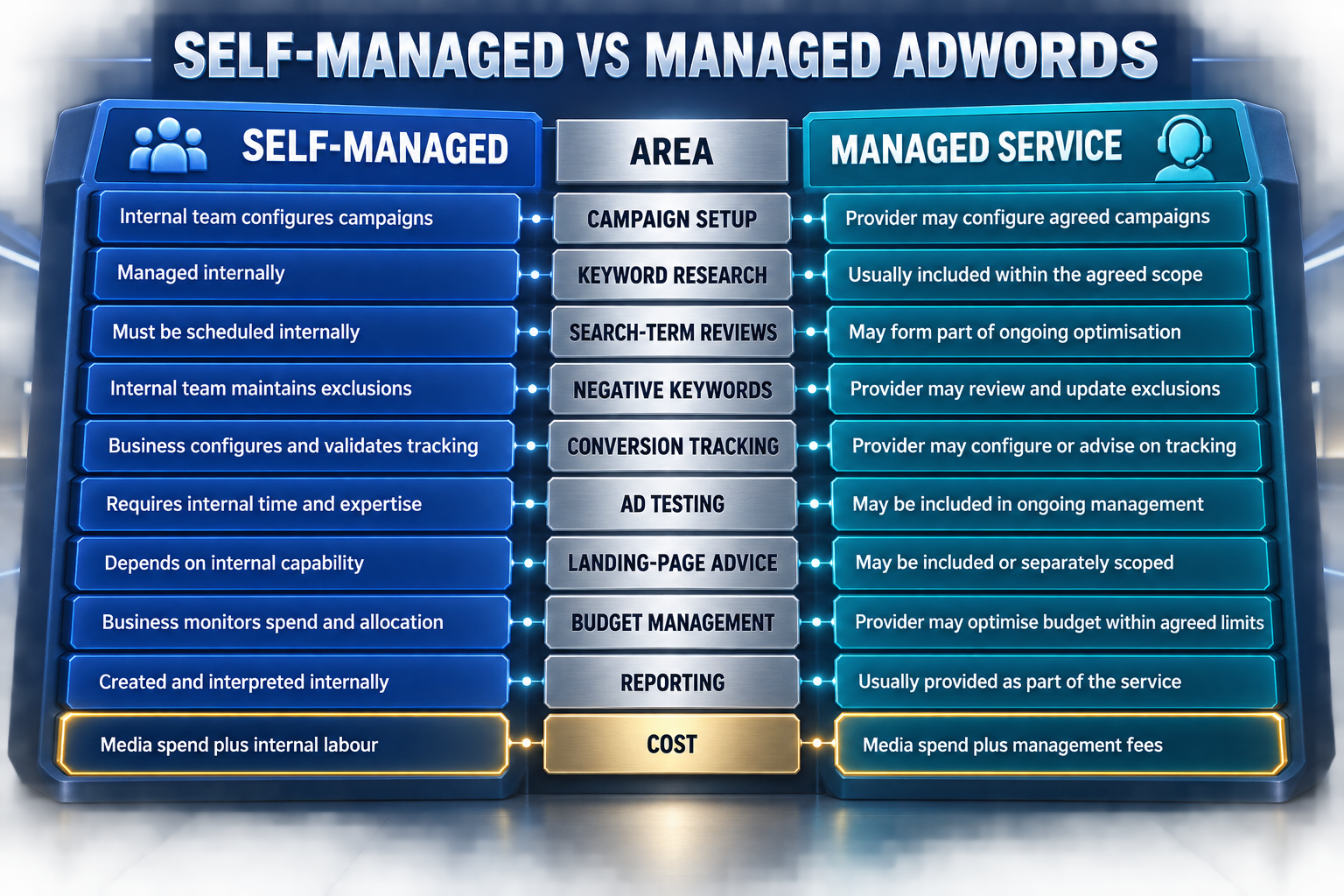
The value of a managed service depends on what the provider actually manages. Businesses should verify responsibilities before comparing monthly fees.
How Much Does Rockhampton AdWords Management Cost
Google Ads normally involves two distinct cost categories.
Media spend is the money used to run advertisements through Google Ads. Management fees pay for the work involved in setting up, monitoring, and optimising campaigns.
These costs should not be treated the same thing.
IT Company Australia’s public Google Ads service page was checked on 21 September 2026. It currently displays three advertised Google Ads management prices.
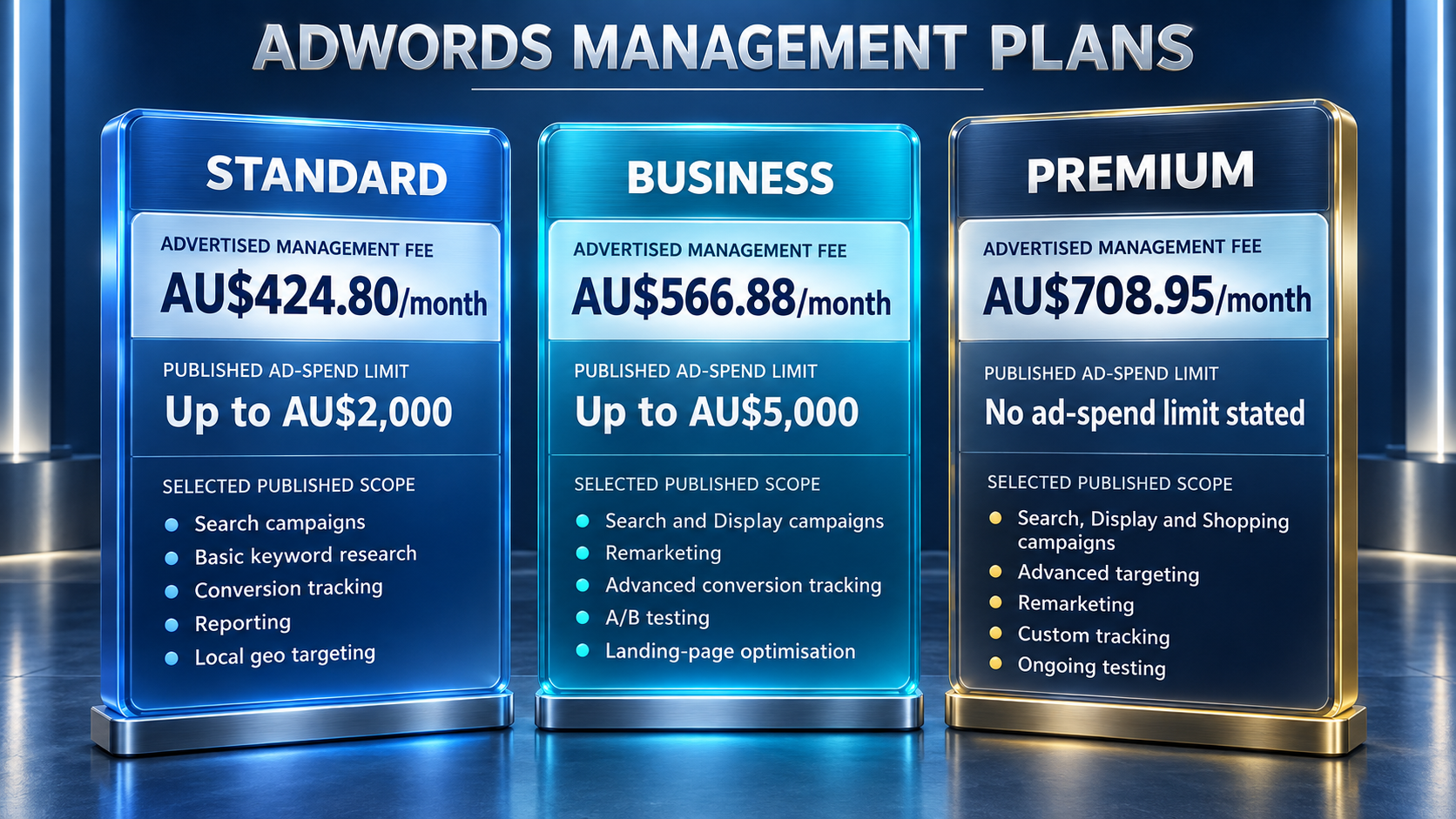
These are one provider’s advertised management fees, not Rockhampton market averages.
The same service page currently promotes a 40% saving with a three-year plan. The surfaced information does not make the GST treatment or the exact relationship between the displayed monthly prices and the three-year promotion sufficiently clear. Businesses should therefore confirm the contract term, GST treatment, media billing, and final management price before purchasing.
A realistic cost comparison should consider the complete campaign:
Management fee + media spend + landing-page work + tracking + internal follow-up
Paying the lowest management fee offers little advantage if the campaign cannot identify which enquiries to become customers.
How to Compare Google Ads Management Providers
Start with account ownership. The business should retain appropriate ownership and administrative access to its Google Ads account. It should also understand who controls the payment method and whether advertising spend is billed directly or through the provider.
Analytics and conversion assets matter too. The business should know who owns conversion tags, analytics properties, call-tracking configurations and other measurement assets. Those assets should remain transferable if the provider’s relationship ends.
Campaign history should not disappear simply because the business changes agencies. Then examine the management scope. Determine whether the service includes keyword research, negative keyword management, search-term reviews, ad testing, conversion tracking, and landing-page recommendations.
Reporting should connect marketing activity to business outcomes. A useful report explains which campaigns generated enquiries, which enquiries were qualified and what changed during the reporting period. It should not simply present impressions and clicks without context.
Businesses can compare the published Google Ads management scope with their own requirements and request clarification where responsibilities are unclear. If paid search is being evaluated alongside long-term organic visibility, the 2026 SEO services guide provides useful background on the role of SEO alongside paid acquisition. A business that wants to compare providers should request a written scope covering ownership, billing, measurement, optimisation, reporting and exit arrangements before making a decision.
Where IT Company Australia Fit
IT Company Australia offers Google Ads alongside SEO, website design, email marketing and other digital services. Its current Google Ads service page lists search campaigns, keyword research, geographic targeting, conversion tracking and performance reporting across its published plans. Higher service levels include additional campaign types, testing and landing-page features. That wider service mix may be useful when the source of poor campaign performance sits outside the advertising account. A campaign may have good targeting but a weak landing page. Another may produce relevant enquiries without a reliable follow-up process. Businesses should still evaluate IT Company Australia using the same criteria they would apply to any other provider. Account ownership, management scope, reporting, exclusions, billing, media spend and exit arrangements should all be clear.
IT Company Australia’s current About page states that its information security management system is certified to ISO/IEC 27001:2022 and identifies 2024 as the certification year. Customers should still assess the certification scope, contracted services and their own requirements. Certification does not guarantee advertising performance or eliminate operational risk.
Rockhampton businesses should confirm whether campaign management is delivered remotely and how meetings, reporting and landing-page support are handled. They should not assume that a Rockhampton office or onsite service is available unless this is confirmed directly. For broader Australian enquiries, businesses can view ITCompany Sydney through the supplied map directions page. Enquiries relating to ITCompany Melbourne, ITCompany Brisbane and ITCompany Perth can be made through the IT Company Australia contact page. The current contact page lists these four Australian contact locations. Businesses should confirm location-specific availability, response arrangements, and onsite support rather than assuming that every location operates under identical service conditions.
Frequently Asked Questions
What Is Rockhampton AdWords Management?
Rockhampton AdWords Management is the planning and ongoing optimisation of Google Ads campaigns designed to reach relevant customers in Rockhampton.
The work can include keyword research, bidding, location targeting, negative keywords, conversion measurement, ad testing and reporting.
Is AdWords Still the Correct Name?
Google renamed AdWords to Google Ads, but the older term is still used by businesses searching for paid-search management.
Using both terms naturally helps readers understand that they refer to the same advertising platform.
How Can Google Ads Generate Better Leads for Rockhampton Businesses?
Google Ads can support stronger lead generation when search intent, geographic targeting, advertisement messaging, landing pages and conversion measurement work together.
Businesses should also track which enquiries become qualified opportunities rather than measuring form submissions alone.
How Much Should a Rockhampton Business Spend on Google Ads?
There is no universal budget that suits every local business.
The appropriate amount depends on search demand, competition, click costs, service value, conversion rates and the organisation’s ability to measure lead quality.
Should Google Ads Traffic Go to the Homepage?
Not always.
A focused service page often creates a clearer journey because it directly matches the service advertised. A homepage can still be appropriate when the campaign targets the company broadly rather than a specific service.
Is Google Ads Better Than SEO for Local Businesses?
Google Ads and SEO solve different visibility problems.
Google Ads provides paid exposure while advertising is active. SEO aims to improve organic visibility over time. Businesses comparing the organic approach can review SEO Services Australia.
What Should I Ask a Google Ads Management Provider?
Ask who owns the account, who controls billing and which optimisation activities are included.
Also confirm conversion tracking, reporting frequency, landing-page responsibilities, management fees, media spend and what happens to campaign assets if the relationship ends.
Can Google Ads Be Managed Remotely for a Rockhampton Business?
Yes, Google Ads campaign management can be performed remotely because most campaign setup, measurement, reporting and optimisation take place online.
Businesses should still confirm communication arrangements, response expectations and whether website or onsite work requires a separate scope.
Final Thoughts
Effective Rockhampton AdWords Management should not be judged by the number of clicks a campaign creates. It should be judged by whether advertising reaches relevant customers and produces commercially useful opportunities. That begins with defining a qualified lead. The campaign should then connect keyword intent with accurate service-area targeting, relevant advertisements and landing pages that continue the same message. Negative keywords can reduce unwanted traffic. Conversion tracking can show what happens after the click. Sales feedback can reveal which enquiries eventually become customers. Budget decisions should then follow business value rather than traffic volume alone. A campaign with fewer clicks can outperform a much busier account when the people clicking are more likely to need the advertised service. Rockhampton businesses that want to review their campaign structure, targeting, conversion measurement or lead quality can contact IT Company Australia to discuss the scope required for their current Google Ads environment.
