
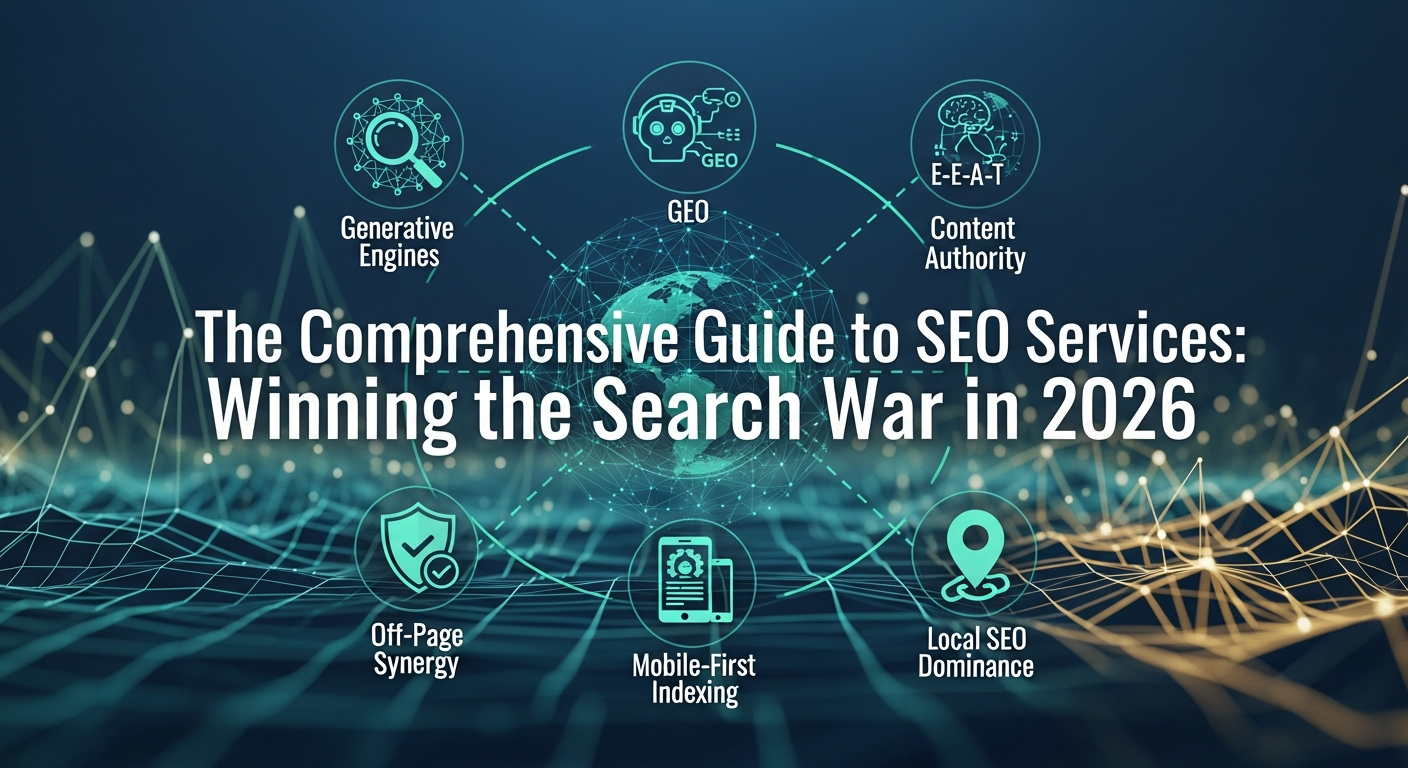
The Comprehensive Guide to SEO Services: Winning the Search War in 2026
The digital landscape has undergone a tectonic shift. As we navigate 2026, the traditional methods of Search Engine Optimization (SEO) have been reimagined. We are no longer just optimizing for a list of “blue links”; we are optimizing for Generative Engines, AI-driven summaries, and a user base that demands instant, authoritative answers.
This guide provides a deep dive into the modern world of SEO services, explaining how the industry has changed, why it remains your most valuable marketing asset, and the tactical “tricks” you need to dominate the market.
1. The New Reality: From SEO to GEO
In 2026, the term “Search Engine Optimization” is often used interchangeably with Generative Engine Optimization (GEO). Google’s Gemini and other AI models now synthesize information from across the web to provide users with a single, cohesive answer.
Professional SEO services today focus on “Retrieval-Augmented Generation” (RAG). This means ensuring your website’s data is so well-structured and authoritative that AI models choose to “retrieve” your information to build their answers. If you aren’t being cited by the AI, you are losing a massive share of the modern search market.
2. The Core Pillars of Professional SEO Services
To compete in this high-stakes environment, an SEO strategy must be built on a foundation of four key pillars:
A. Technical Precision (The Machine Foundation)
Before you can rank, search engine crawlers and AI bots must be able to “read” your site without friction. Technical SEO in 2026 focuses on:
Core Web Vitals 4.0: Speed is no longer a luxury; it is a requirement. Pages must load near-instantaneously on 5G and satellite connections.
Semantic HTML & Schema: Using JSON-LD to tell search engines exactly what your data means (e.g., distinguishing a “Product” from a “Review”).
Mobile-First Indexing: With 80% of searches now happening on mobile or wearable devices, your site must be responsive and lightweight.
B. Content Authority (The Human Element)
AI can write content, but it cannot provide Experience. Google’s E-E-A-T guidelines (Experience, Expertise, Authoritativeness, and Trustworthiness) are the primary filter for quality.
First-Person Perspectives: Content that includes “I did this” or “Our team tested this” ranks higher than generic “How-to” guides.
Topic Clusters: Instead of targeting one keyword, modern services build “Pillar Pages” that cover every aspect of a topic to prove total niche authority.
C. Off-Page Synergy (The Reputation Factor)
Backlinks are still the “currency” of the internet, but quality has completely overtaken quantity. One link from a high-authority Australian news site is worth more than 1,000 links from obscure directories.
Digital PR: Earning mentions in major publications.
Social Signals: High engagement on platforms like LinkedIn and Reddit tells search engines that humans actually value your content.
D. Local SEO Dominance
For businesses serving specific regions, Local SEO is the lifeblood of lead generation. This involves optimizing your Google Business Profile (GBP), managing localized reviews, and ensuring your NAP (Name, Address, Phone) data is consistent across the entire web.
3. High-Impact SEO Tricks for 2026
If you want to move the needle quickly, these specific tactics are used by top-tier agencies to bypass the competition:
The “Answer-First” Formatting Hack
AI models are programmed to find the most efficient answer.
The Trick: At the top of your page, include a 40–50 word summary that directly answers the primary keyword.
Why it works: It acts as a “magnet” for Featured Snippets and AI Overview citations.
The “SameAs” Schema Connection
AI needs to verify that you are a real expert.
The Trick: In your Schema markup, use the
sameAsproperty to link your website to your verified LinkedIn, Wikipedia, or government business registration.Why it works: It builds “Entity Authority,” making it harder for competitors to outrank you based on content alone.
Data-Rich Comparison Tables
AI “scrapers” love structured data.
The Trick: Instead of listing service features in a paragraph, use an HTML table to compare options or prices.
Why it works: Search engines often pull these tables directly into the search results, giving you massive visibility.
4. Why You Should Invest in Professional SEO Services
Many business owners attempt “DIY SEO,” but the complexity of the 2026 algorithm makes professional help essential.
Sustainable ROI: Unlike Paid Ads (PPC), which stop working the moment you stop paying, SEO builds “compounding interest.” A well-ranked page can generate leads for years.
Brand Credibility: Users trust organic results more than sponsored ads. Ranking #1 is a badge of authority.
Cost Efficiency: Over time, the cost-per-acquisition (CPA) for organic traffic is significantly lower than any other marketing channel.
5. The Role of AI in SEO Services
In 2026, we don’t fight AI; we use it. Professional services use AI for:
Predictive Analytics: Forecasting which keywords will trend in the next quarter.
Content Gap Analysis: Identifying exactly what your competitors are talking about that you are missing.
Automated Audits: Finding broken links and technical errors in real-time.
6. How to Choose an SEO Partner
Don’t be fooled by agencies promising “instant rankings.” SEO is a marathon. Look for:
Transparency: They should provide monthly reports showing traffic, conversions, and ranking shifts.
Strategic Depth: They should ask about your business goals, not just your keywords.
Ethical Practices: Avoid “Black Hat” techniques that can lead to Google penalties.
7. Frequently Asked Questions (FAQs)
Q1: How long does it take to see results from SEO services?
In 2026, you can see technical improvements within weeks, but significant ranking shifts and traffic growth usually take 3 to 6 months. SEO is a long-term investment in your digital infrastructure.
Q2: What is the difference between SEO and GEO?
SEO focuses on ranking in traditional search results (links). GEO (Generative Engine Optimization) focuses on being included in AI-synthesized answers (like Google’s AI Overviews). Modern SEO services do both.
Q3: Is SEO better than Google Ads (PPC)?
Both have their place. PPC is great for immediate sales or seasonal promos. However, SEO offers a higher long-term ROI and builds a “moat” around your business that competitors can’t simply outspend.
Q4: How much do SEO services cost in Australia?
Prices vary based on the scope. A local business might spend $1,500 – $3,000 per month, while national e-commerce brands may invest $5,000 – $15,000+ to maintain dominance.
Q5: Does my business need a blog for SEO?
Yes. A blog is the primary way to target “Informational” keywords. By answering your customers’ questions, you build the authority needed to rank your “Transactional” service pages.
Q6: Can AI-generated content rank on Google?
Yes, but only if it is edited and enhanced by humans to provide unique value. Google penalizes “low-effort” AI content that doesn’t add anything new to the conversation.
Q7: What are “Core Web Vitals”?
They are a set of metrics that measure a user’s experience on your page, including loading speed, interactivity, and visual stability. They are a major ranking factor in 2026.
8. Summary: The Path Forward
SEO is no longer an optional add-on; it is the heartbeat of your digital strategy. By focusing on Technical Excellence, Human Experience, and AI Adaptability, you can ensure your business doesn’t just survive in 2026 it thrives.
The secret to winning is consistency. The search landscape will continue to change, but the demand for high-quality, authoritative information is permanent.