
Businesses researching Joomla development in Australia often compare content management systems against their long-term website requirements, governance needs, maintenance capacity, and integration goals.
Introduction
Rather than starting with a preferred CMS, it is usually more effective to define business requirements first and then evaluate available platforms. Joomla provides configurable permissions, multilingual content management, publishing workflows, and extension support through its core platform and ecosystem. These capabilities should be assessed alongside hosting requirements, security responsibilities, future maintenance obligations, content ownership processes, and integration needs.
This guide explains where Joomla fits within modern website projects, when it may be suitable, what procurement considerations businesses should review, and how to compare proposals before selecting a platform.
Direct Answer
Joomla development in Australia involves planning, building, maintaining, upgrading, or migrating websites using the Joomla content management system. Joomla may be suitable for organisations that require structured content management, configurable permissions, multilingual capabilities, and flexible publishing workflows. Suitability ultimately depends on business requirements, governance responsibilities, maintenance capacity, and long-term website goals.
In This Guide
- What Joomla is and how it works
- When Joomla may be a suitable option
- Joomla migration and maintenance considerations
- Cost and timeline planning
- A proposal-comparison worksheet for evaluating suppliers
What Is Joomla?
Joomla is an open-source content management system that allows organisations to create, manage, and publish website content through a web-based administration interface.
The platform supports:
- Content publishing
- Content categorisation
- User permissions
- Multilingual websites
- Publishing workflows
- Templates
- Extensions
- Search-friendly URLs
Joomla also includes configurable Access Control Lists (ACL), allowing organisations to create permission structures for different content contributors and administrative roles. According to official Joomla documentation, the platform supports configurable user groups, access levels, workflows, and multilingual functionality.
Why Organisations May Consider Joomla
Platform selection should be based on requirements rather than familiarity.
Advanced Permissions and Governance
Some organisations need multiple publishing roles, approval processes, and administrative controls.
Examples might include:
- Membership organisations
- Educational institutions
- Government agencies
- Associations
- Corporate intranets
Documenting user roles and approval workflows before requesting proposals helps suppliers recommend appropriate solutions.
Multilingual Content Management
Joomla includes multilingual functionality that can support organisations publishing content across multiple languages. Official Joomla documentation lists multilingual content support among the platform’s key capabilities.
Before selecting a CMS, document:
- Required languages
- Translation ownership
- Approval workflows
- Update processes
- Content governance requirements
Structured Publishing Workflows
Some organisations manage:
- Knowledge bases
- Resource libraries
- Documentation portals
- Learning resources
- Member content
In these situations, publishing workflows and governance requirements may have a greater influence on CMS selection than website size alone.
When Joomla May Not Be the Right Choice
Not every organisation requires a feature-rich content management system.
Consider simpler solutions where requirements are limited to straightforward publishing and there is no need for:
- Advanced permissions
- Multilingual content
- Custom workflows
- Business system integrations
- Extensive governance processes
Questions worth addressing include:
- How frequently will content be updated?
- Who owns content approvals?
- Will multiple teams contribute content?
- Are integrations required?
- Who will maintain the website?
Page count alone should not determine platform suitability.
Questions to Answer Before Selecting a CMS
Questions to Answer Before Selecting a CMS
| Question | Why It Matters |
|---|---|
| Who manages content? | Influences governance and permissions |
| Who approves updates? | Defines publishing workflows |
| Are integrations required? | Influences technical scope |
| Will multiple departments contribute? | Affects user-role planning |
| Who owns maintenance? | Influences total ownership costs |
Many procurement challenges begin because requirements are not documented before quotes are requested.
Illustrative Joomla Proposal Comparison Worksheet
The following worksheet is an illustrative procurement template. Replace example owners with roles from your organisation and ask suppliers to explain implementation methods, dependencies, compatibility requirements, recurring costs, and acceptance criteria.
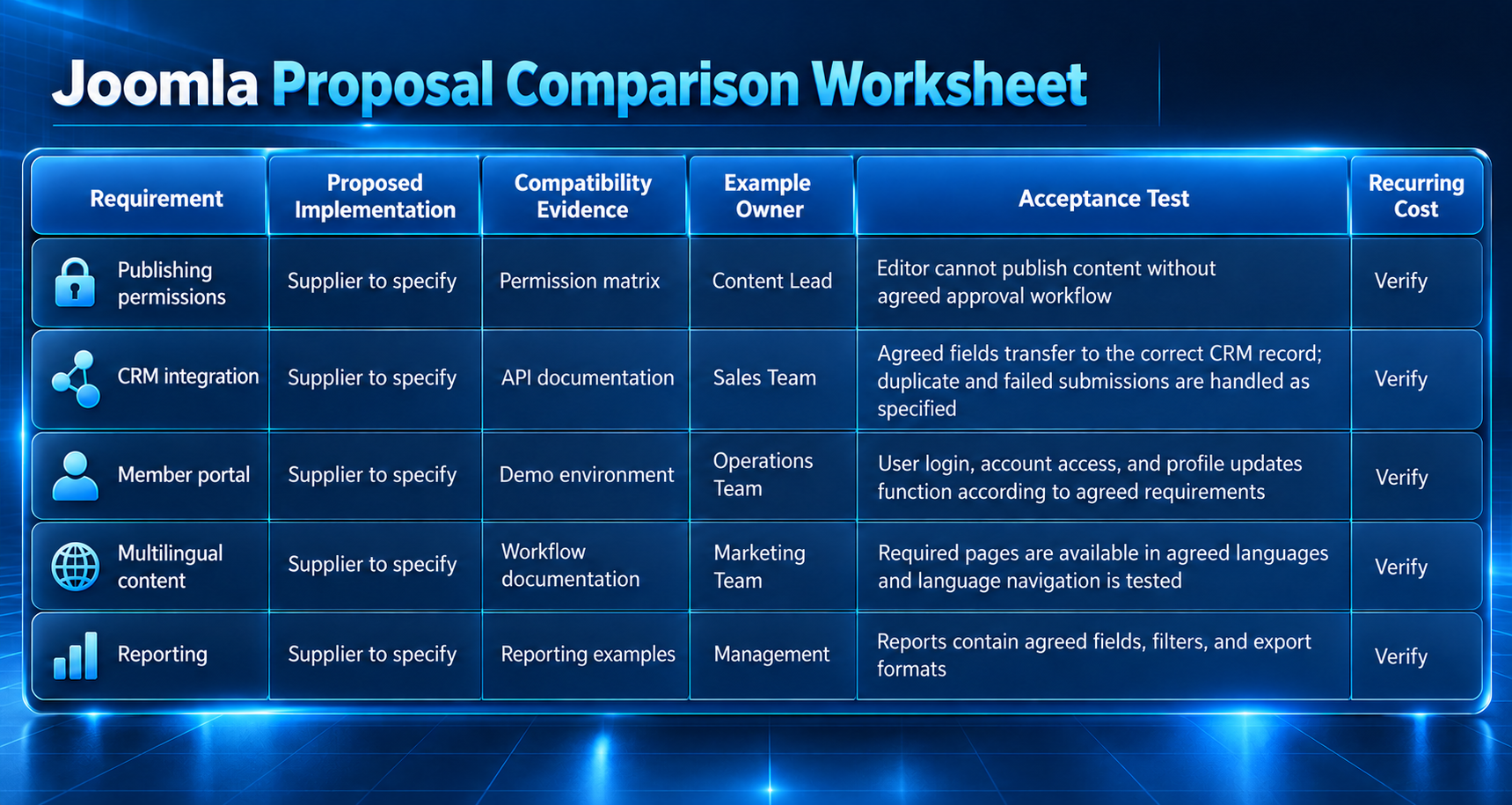
Use the worksheet to make proposal assumptions, responsibilities, and acceptance criteria explicit before implementation begins.
Joomla Migration Considerations
If your project involves moving from another CMS or upgrading an existing Joomla website, migration planning should be treated as a separate workstream.
Content Inventory
Include all relevant content and assets in the inventory so migration scope can be properly assessed.
Examples include:
- Pages
- Images
- Downloads
- Forms
- User accounts
- Documents
- Media libraries
URL Mapping
Migration planning should review:
- Existing URLs
- Redirects
- Navigation structures
- Internal links
- Canonicalisation requirements
Migration planning should focus on reducing risk rather than guaranteeing identical outcomes.
Extension Compatibility
Extension compatibility should be assessed before migration.
Organisations should review:
- Vendor support
- Available updates
- Licensing requirements
- Supported versions
- Upgrade pathways
Official Joomla update guidance recommends verifying compatibility and ensuring appropriate backups before updating systems.
Backup and Rollback Planning
Every migration plan should document:
- Backup procedures
- Recovery responsibilities
- Escalation contacts
- Rollback decision criteria
A rollback plan is a risk-management measure and should be defined before launch.
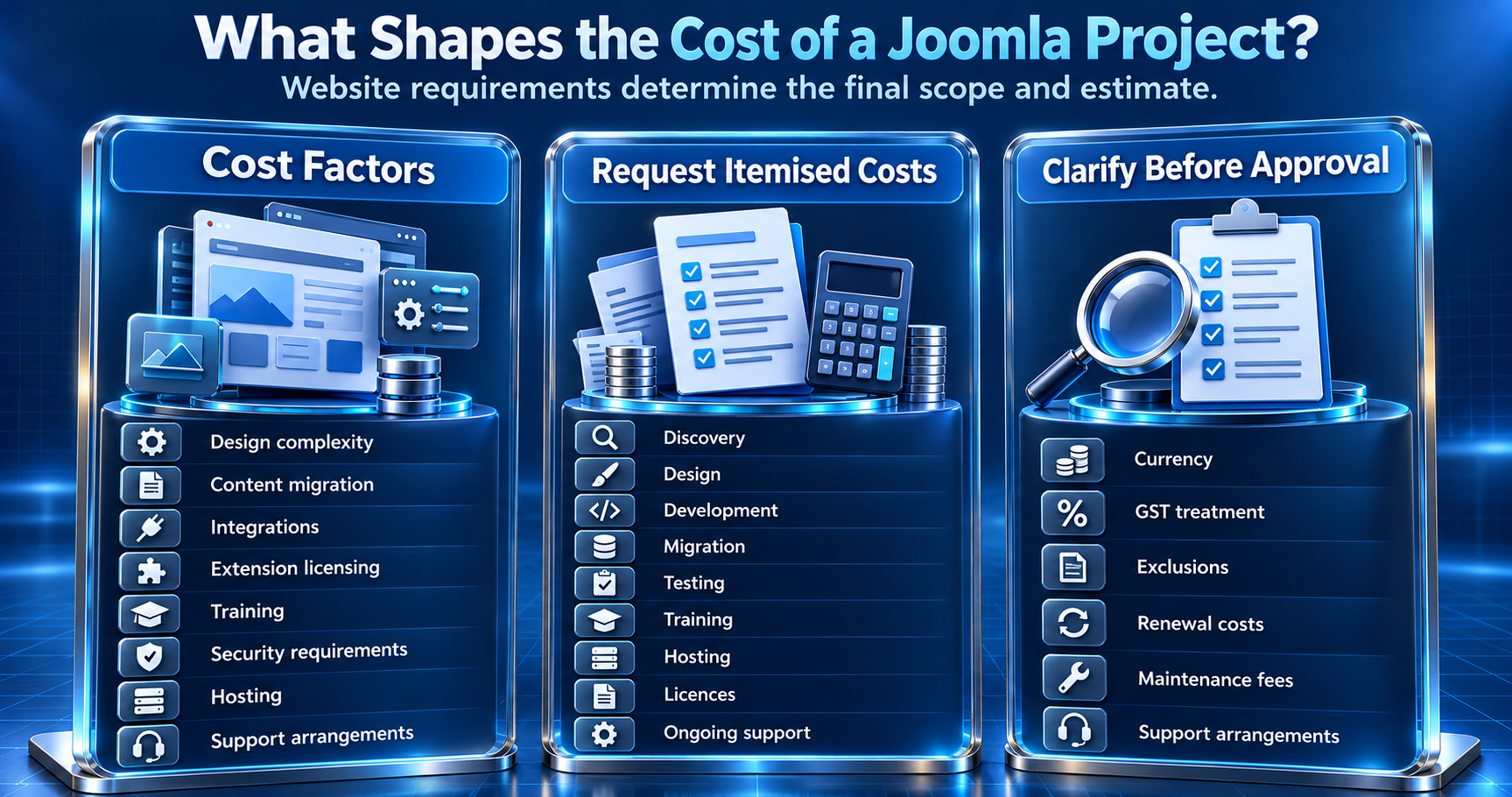
Understanding Joomla Project Costs
This guide does not provide a fixed Joomla project estimate because website requirements vary significantly.
Understanding Joomla Project Timelines
Project timelines depend on:
- Scope
- Content readiness
- Approvals
- Integrations
- Testing
- Migration requirements
Milestone plans should not be interpreted as delivery guarantees.
Website Project Milestones
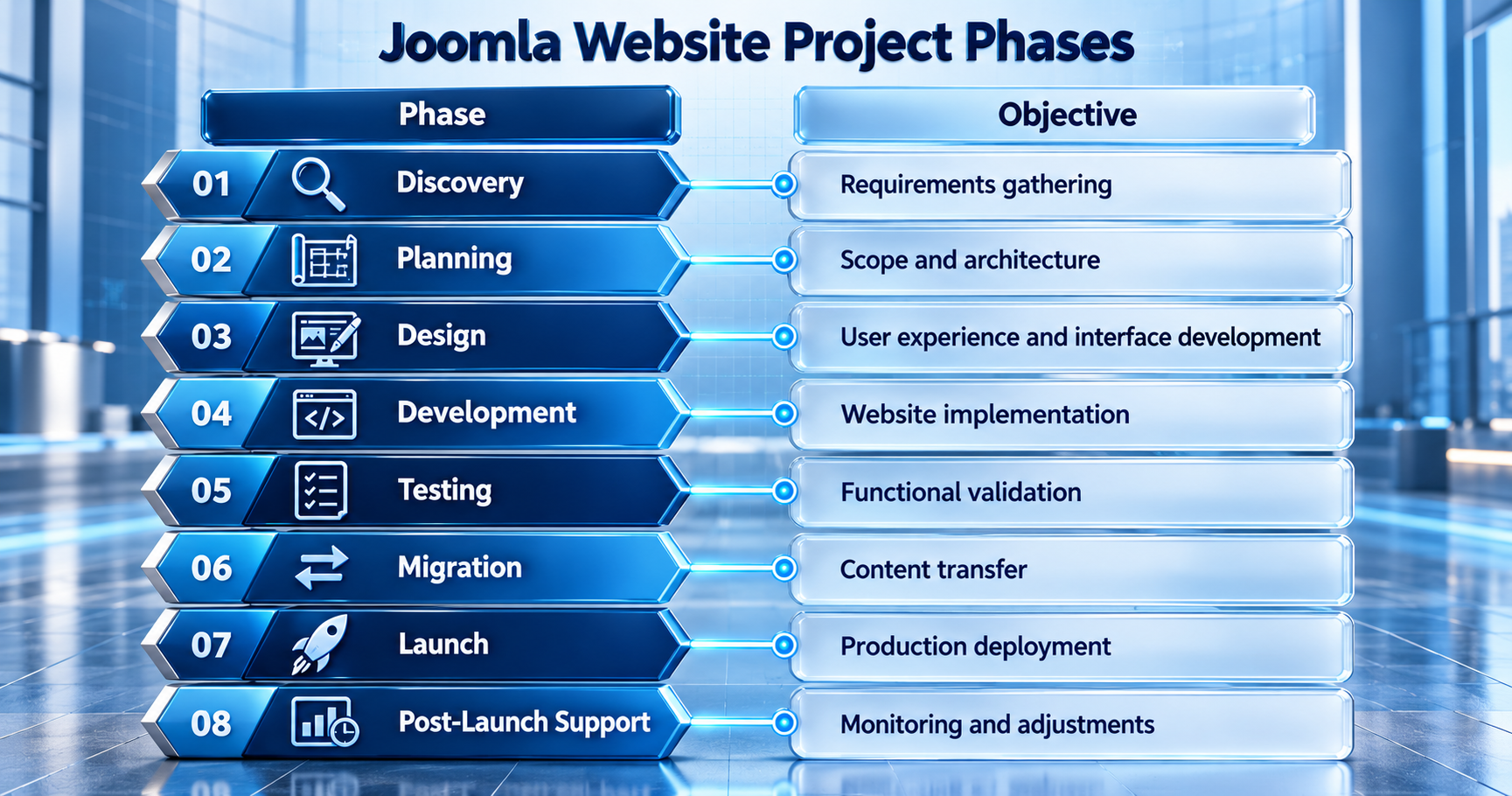
Ask suppliers to identify milestone dependencies, approval responsibilities, and acceptance criteria for each project phase.
Common Joomla Project Risks
Selecting the Cheapest Proposal
Compare deliverables, governance, maintenance responsibilities, training, and support arrangements rather than focusing solely on cost.
Weak Requirement Definition
Document requirements before requesting quotes.
Undefined Maintenance Ownership
Assign responsibility for updates, backups, monitoring, and security reviews.
Excessive Extension Usage
Review every extension’s function, support status, and business justification.
Inadequate User Testing
Schedule stakeholder acceptance testing before launch.
Weak Migration Planning
Document migration requirements, testing procedures, and rollback plans.
Undefined Governance Processes
Document content ownership, approval workflows, and publishing responsibilities.
Planning Joomla Projects Across Australia
Whether a project involves teams in Sydney, Melbourne, Brisbane, Perth, or multiple locations, the core evaluation criteria remain largely consistent.
For multi-location organisations, assess:
- Content ownership
- Governance processes
- Support arrangements
- Approval responsibilities
- Integration ownership
Governance requirements should be evaluated alongside platform capabilities during the procurement process.
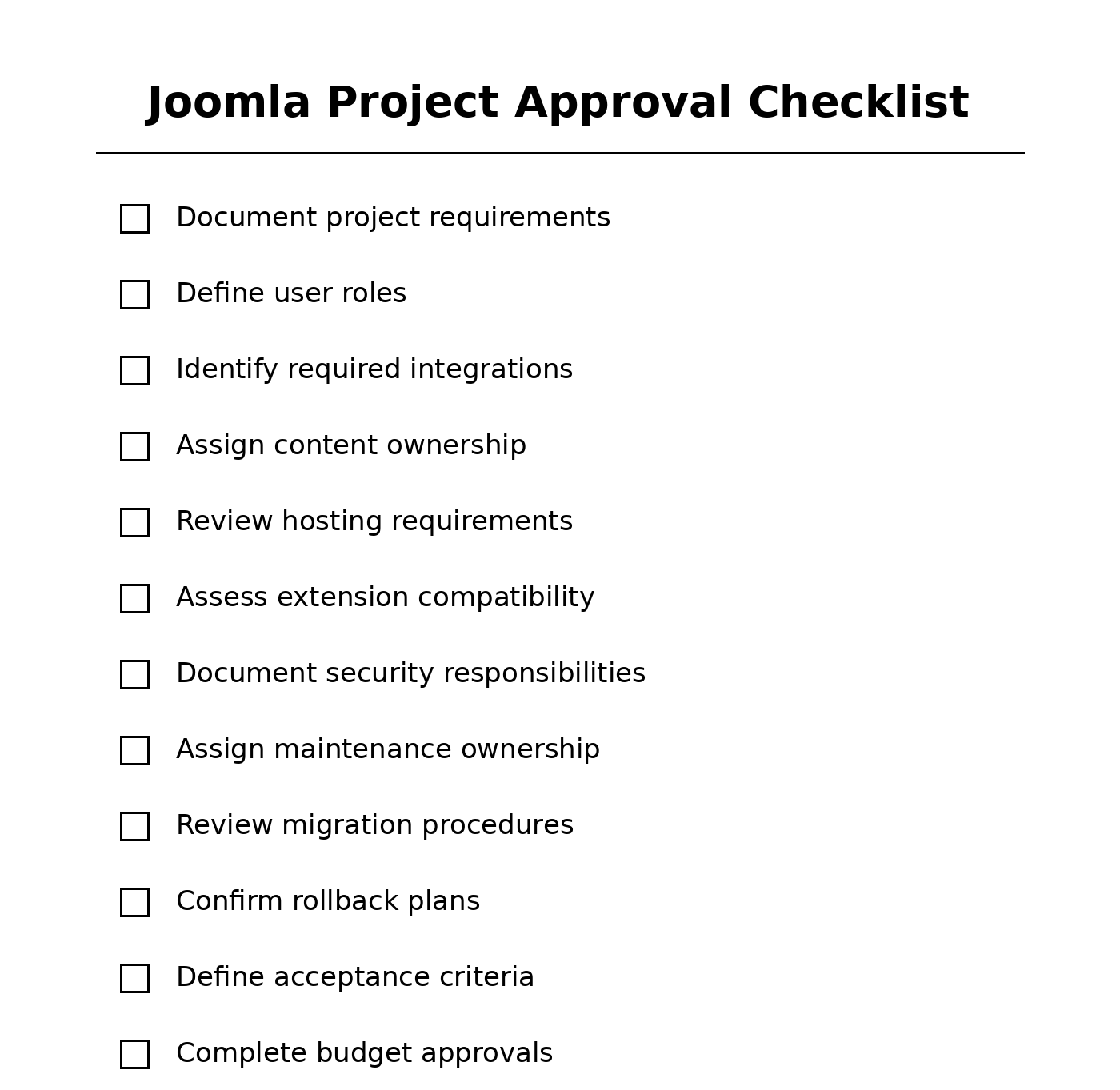
Joomla Procurement Checklist
Before approving a proposal:
Frequently Asked Questions
What is Joomla development?
Joomla development involves building, maintaining, extending, upgrading, or migrating websites using the Joomla CMS.
Is Joomla still used in Australia?
Australian providers currently advertise Joomla-related development, migration, maintenance, and support services. This does not establish how widely Joomla is used or which sectors use it most.
Can Joomla support multilingual websites?
Yes. Joomla includes multilingual functionality as part of its supported capabilities. Official Joomla documentation provides details on multilingual features.
Is Joomla secure?
Security depends on implementation quality, governance processes, hosting configuration, update management, and ongoing maintenance.
How long does a Joomla project take?
Project duration depends on scope, integrations, content readiness, approvals, migration complexity, and testing requirements.
Is Joomla better than WordPress?
Neither platform is universally better. Suitability depends on organisational requirements, governance needs, support resources, and operational goals.
Final Thoughts
Evaluating Joomla for an Australian business website means selecting a platform that fits your organisation’s requirements rather than choosing technology based on familiarity or trends.
Joomla offers structured content management, configurable permissions, multilingual functionality, workflows, and extensibility. However, successful outcomes depend on planning, governance, maintenance ownership, migration readiness, acceptance criteria, and clearly documented requirements.
Before choosing a platform, complete the proposal-comparison worksheet, assign responsibility owners, define measurable acceptance criteria, and compare supplier recommendations against documented business needs. This approach helps ensure proposal assumptions, responsibilities, and delivery requirements are understood before implementation begins.
