

Australian property customers often begin their journey online. A buyer may compare listings, research a suburb and review an agent before making contact. Vendors and landlords may also assess an agency’s recent results, local knowledge and property services before requesting an appraisal. This makes a real estate website more than an online brochure. It must present current listings, support detailed searches and direct enquiries to the right person. It also needs to perform reliably across mobile devices, where many property searches take place.
Introduction
A basic template may provide a quick online presence, but limitations often appear when an agency needs CRM integration, automated listings, suburb pages or separate workflows for sales and property management.
Effective real estate web development connects these requirements within one practical platform. Agencies planning a new website can review the company’s professional website design services to understand how discovery, responsive design, development, integration, testing and ongoing support fit together. IT Company Australia’s website design service describes a process covering discovery, wireframing, responsive development, integration, testing and post-launch maintenance.
What is real estate web development?
Real estate web development is the process of building and maintaining websites for agents, property managers, buyers’ agents and developers. It can include property feeds, searchable listings, agent profiles, CRM connections, appraisal forms, suburb pages, analytics, security and mobile-friendly design.
In this guide
You will learn:
- Which five features a real estate website needs in 2026
- How listing feeds, search and CRM routing work
- Why local content, privacy and accessibility matter
- What influences project costs and timeframes
- Which development mistakes agencies should avoid
Why a standard website may not meet real estate needs
A real estate website handles frequently changing information. Properties move between listed, under offer, sold and leased statuses, while prices, inspection times and agent information can change during a campaign.
Manual website updates can become slow and inconsistent when an agency manages many properties. A reliable feed between the property platform and website can reduce repeated data entry, although the exact options depend on the agency’s existing software.
The site must also support several audiences. Buyers need property search, vendors want appraisals, tenants need rental information and landlords require property management details. Each audience should have a clear path rather than being directed to one general contact form.
Custom functionality may be appropriate when standard website tools cannot support these workflows. The article about custom web and mobile app development explains how tailored applications can connect business systems and support specialised processes.
Top 5 real estate web development features for 2026
A modern property website must do more than display professional photographs. Its technical foundation should keep listings accurate, make search easy and turn relevant visits into useful enquiries.
1. Automated property listing integration
Property listings should remain current without requiring staff to enter the same information into several systems. An automated feed can transfer listing data from the agency’s CRM or property platform into the website.
The connection may use an API, XML feed or another format supported by the provider. Before development starts, the agency should identify the master system and obtain its integration documentation.
The scope should define how often information updates, how changed property statuses are handled and what happens when a record is incomplete. Developers should also test the connection after software or access settings change.
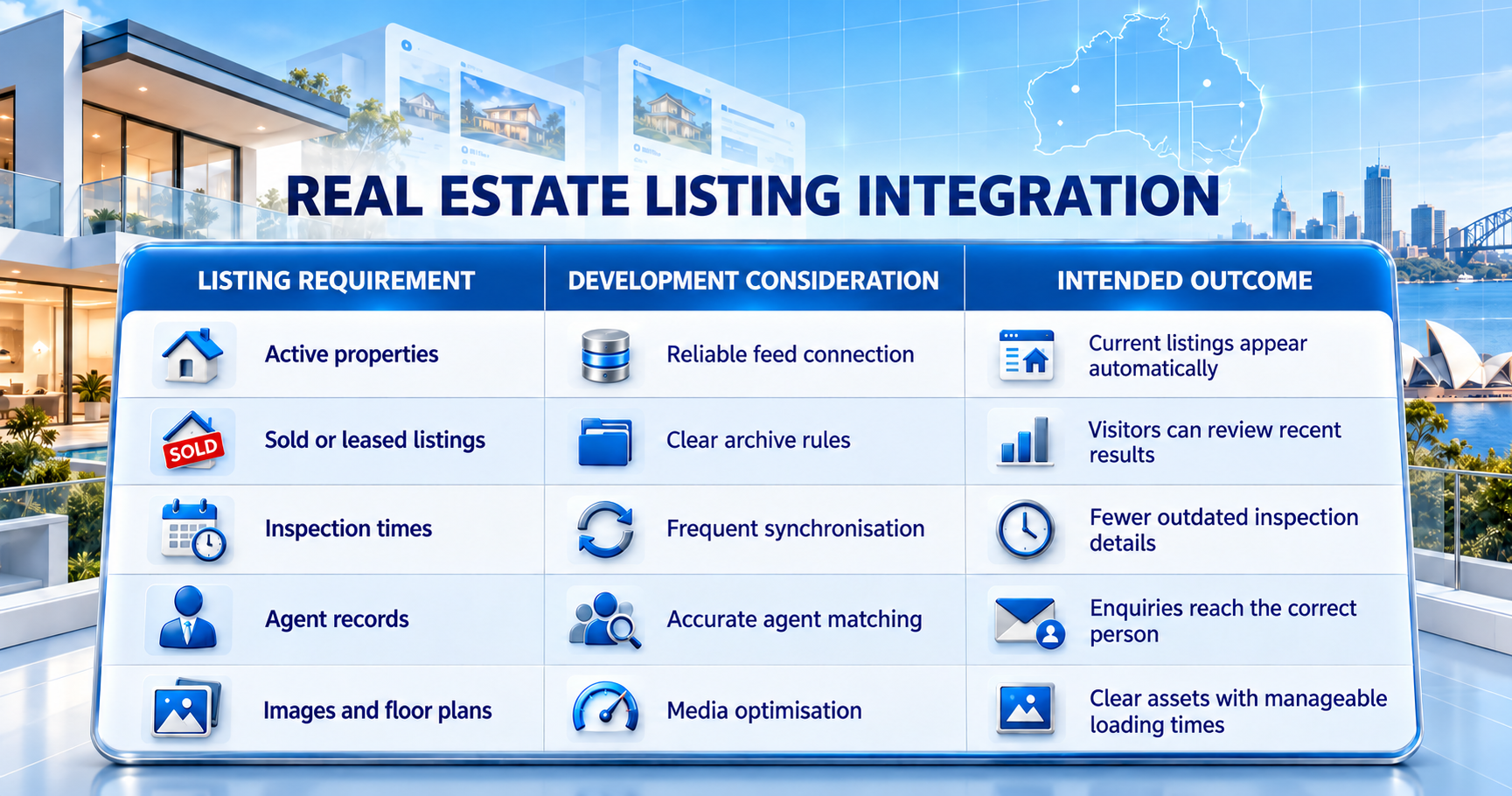
Only useful fields should become search filters. Suburb, price, property type, bedrooms and listing status are common examples, but each filter depends on consistent source data.
2. Fast, mobile-first property search
Property searches often involve many images, filters and map elements. These features can create a slow or confusing mobile experience when they are added without a clear performance plan.
A mobile-first interface should make it easy to choose whether the visitor wants to buy, rent or view sold properties. It should then present relevant filters without overwhelming the screen.
Individual listing pages need the same attention. The address, price, property features, inspection details and enquiry action should remain easy to find on a smaller device.
Images should be resized and compressed rather than uploaded directly from a camera. Pagination, caching and controlled image loading can also help the website manage large listing collections.
Accessibility should be considered during design, not added after launch. W3C guidance on applying WCAG 2.2 to mobile experiences covers the application of accessibility principles and success criteria to mobile websites and applications.
A structured website design and development process can map mobile property journeys before development begins. Early wireframes allow an agency to test search, filters and calls to action before changes become expensive.
3. Lead capture and CRM routing
Website traffic alone does not show whether a property website supports the business. Visitors need clear actions that correspond with their reason for visiting.
A listing enquiry should record the relevant property automatically. An appraisal form may collect the address, property type, contact details and preferred response method. Rental and property management enquiries may require separate forms and internal workflows.
Submissions should reach the agent, office or property management team responsible for the enquiry. A CRM connection can also record the listing, page and campaign associated with the lead.
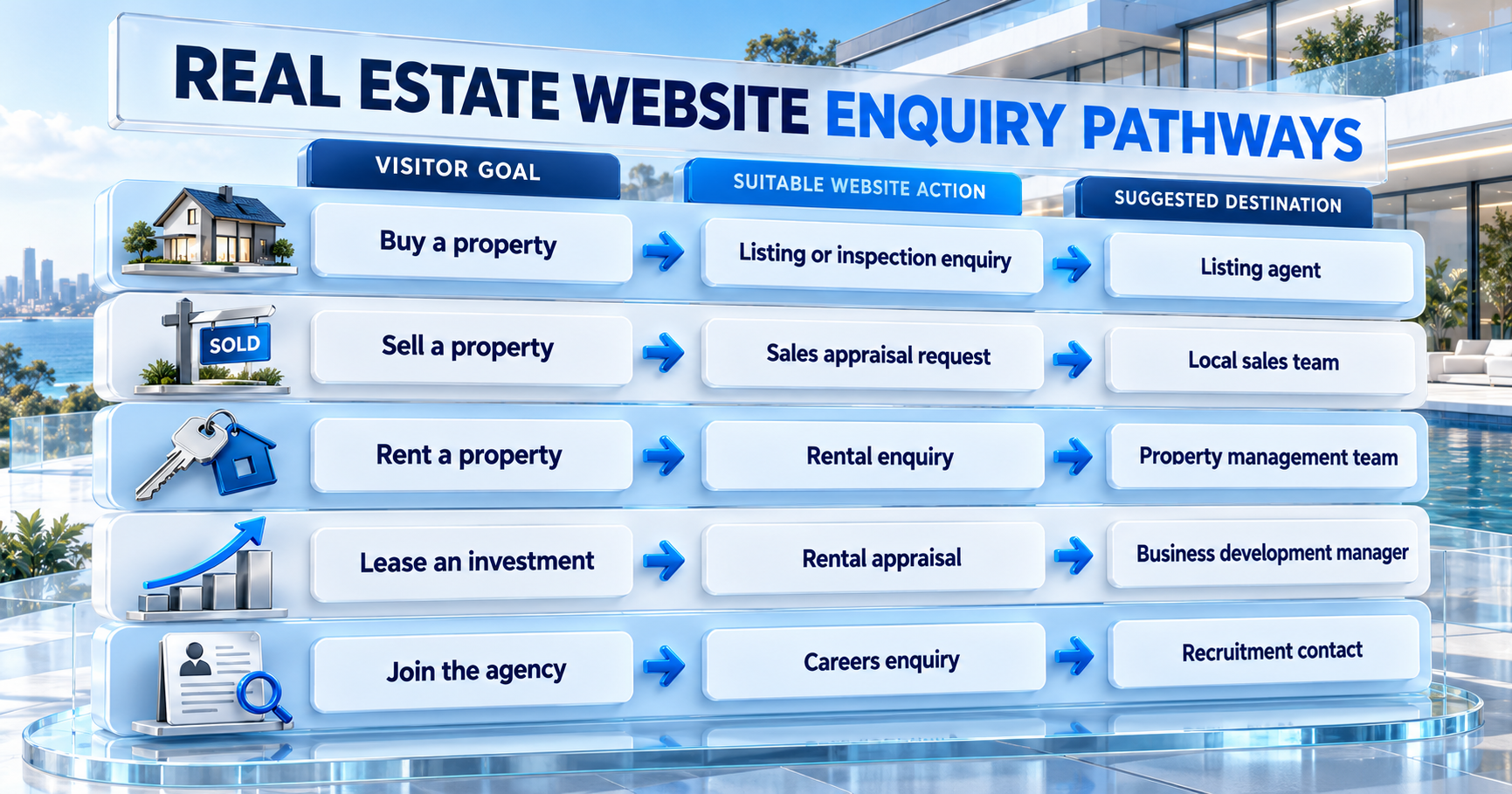
Forms should collect only the information needed for the stated purpose. They should also link to a current privacy policy and explain how the agency will use the submitted information.
The Office of the Australian Information Commissioner states that the Australian Privacy Principles govern the collection, use, disclosure, security and correction of personal information for organisations covered by the Privacy Act 1988.
4. Suburb pages and local search structure
Real estate decisions are closely connected with location. A useful suburb page can demonstrate local knowledge while helping visitors find relevant agents, services, listings and recent results.
Each page should contain original information relevant to the area. It might explain common property types, local amenities, transport choices and the services the agency provides in that market.
Agencies should avoid creating hundreds of pages that differ only by suburb name. Thin, repetitive pages offer little help to customers and become difficult to maintain.
The site structure should connect each suburb with appropriate listings, agents and services. Breadcrumbs and descriptive internal links can help customers understand those relationships.
The page should not make unsupported claims about market leadership or property performance. Any median prices, clearance rates or market statistics must include their source and date because property data changes regularly.
Businesses planning a wider organic-search strategy should keep this article focused on the property sector rather than generic design terms. The existing guide to website design services in Australia already covers broad topics such as UX, performance, security and search optimisation.
5. Secure and scalable website management
A real estate website depends on its CMS, property feed, forms, analytics and third-party integrations. A failure in one component can leave incorrect listings online or prevent an enquiry from reaching the agency.
Maintenance should cover software updates, backups, security monitoring and routine functional testing. Listing imports, contact forms and appraisal requests deserve particular attention because a failure may not be immediately visible.
User permissions should also reflect staff responsibilities. An agent may only need to update a profile, while an administrator manages pages and a technical user controls system settings.
Reusable page components can make expansion easier when an agency adds an office, suburb or service. This is generally more manageable than duplicating fixed page layouts for every new location.
IT Company Australia’s website maintenance service lists CMS updates, performance checks, SSL validation, backups, uptime monitoring and security scanning among its maintenance functions.
For a deeper explanation of ongoing care, read the guide to web maintenance for business websites. It covers backups, security, broken links, forms, mobile testing and technical SEO after launch.
Template versus custom real estate websites
A template may suit an independent agent or small agency with standard requirements. It can reduce the initial setup effort, but its integrations, page layouts and provider conditions require careful review.
Custom development offers greater control over property search, CRM routing and local content. It may suit multi-office agencies or businesses with specialised workflows, although it requires more detailed planning.
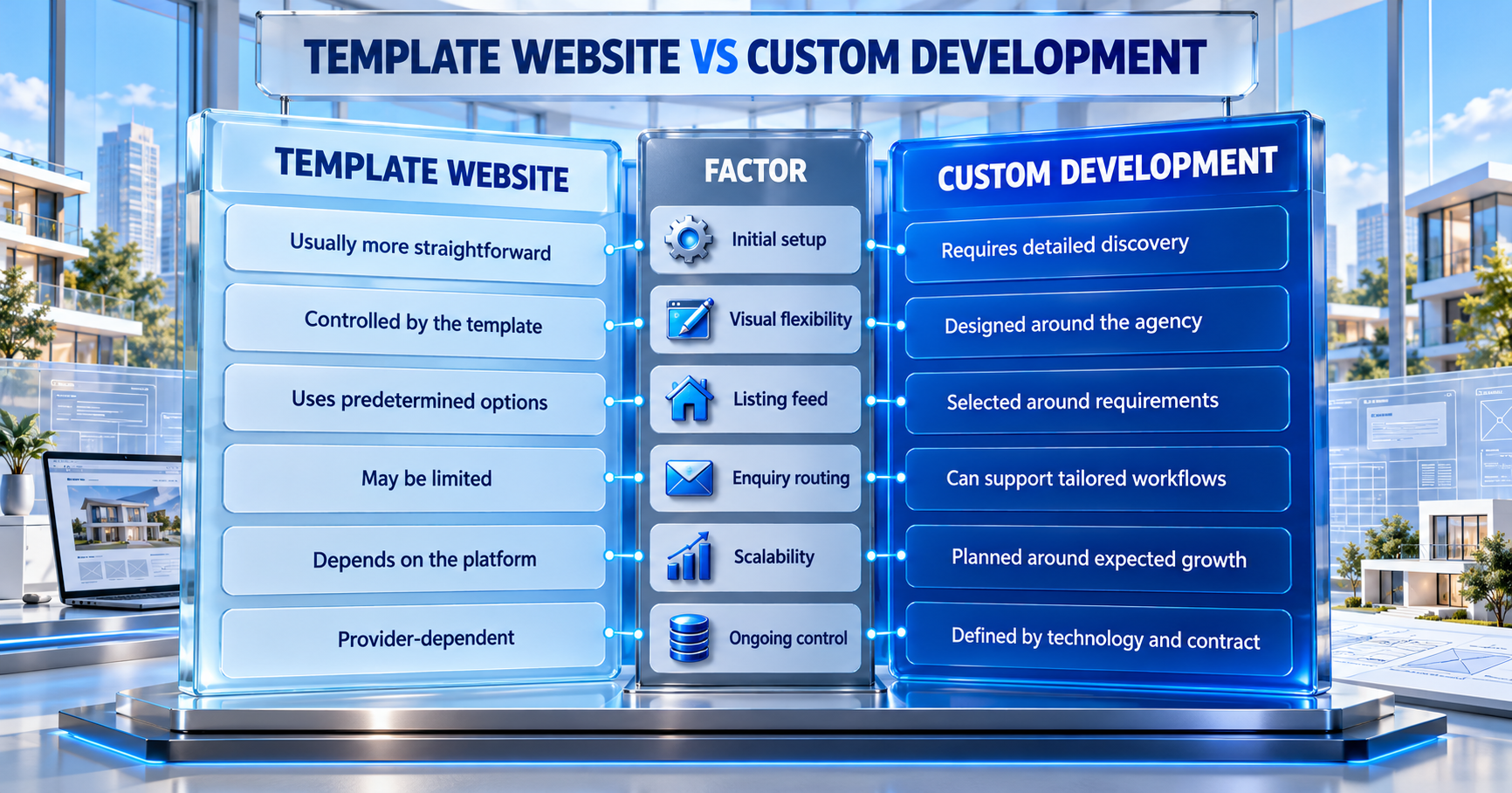
Neither option is automatically better. The right choice depends on the number of offices, listing volume, internal skills, required integrations and available budget.
Agencies can review completed website design projects when assessing responsive layouts and integration capability. The portfolio includes custom WordPress work, CRM connections and mobile-first projects, although every real estate platform requires its own technical scope.
Real estate web development process
Discovery and technical planning
Discovery should document the agency’s services, offices, audiences, property platform and existing CRM. The output may include a sitemap, content list, integration plan and measurable project goals.
If the project replaces a live website, the team should also document important existing URLs. That information supports redirect planning and reduces the risk of creating broken links during launch.
Wireframes and property journeys
Wireframes map how visitors move between search, listings, agent profiles and enquiry forms. They allow the agency to evaluate page hierarchy before visual details influence decisions.
Mobile layouts should receive equal attention. Search controls, image galleries, inspection details and form fields need adequate space on smaller screens.
Design, development and integration
The visual design applies the agency’s brand to approved layouts. Developers then build the page components and connect the property feed, CRM, analytics, forms and approved third-party tools.
Development should occur in a protected staging environment. Staff can test listings and workflows there without affecting the live website.
Testing, launch and staff training
Testing should cover common devices, browsers, forms, filters and listing updates. The team should also check keyboard access, labels, alternative text, error messages and page performance.
The launch plan needs redirects, analytics, backups and rollback arrangements. Staff should receive suitable training before becoming responsible for routine content updates.
Costs and timeframes
Project timelines vary according to the website’s scope, content readiness, integrations and approval process. The following estimates provide a general planning guide rather than guaranteed completion dates.
- Agent profile website: A focused website for an individual agent may take approximately 4–8 weeks. The timeframe usually depends on content preparation, design decisions and the number of revision rounds.
- Small agency website: A website for a small real estate agency may require around 8–14 weeks. Property listings, enquiry forms and the total number of pages can affect the development schedule.
- Custom property platform: A more advanced platform may take approximately 12–24 weeks, particularly when it involves third-party integrations, specialised functionality and detailed testing.
- Multi-office solution: A website supporting several offices may require 16–30 weeks or longer. User permissions, data requirements, stakeholder approvals and location-specific workflows can add complexity.
Clear requirements, prepared content and timely feedback can help keep each project moving efficiently.
These ranges are general editorial estimates, not delivery commitments from IT Company Australia. A proposal should define milestones, responsibilities, inclusions and review periods.
Agencies can discuss their website requirements with ITCompany Australia after documenting the listing platform, CRM, office structure and required features.
Common real estate website mistakes
| Mistake | Likely impact | Recommended fix |
|---|---|---|
| Uploading oversized property images | Slow mobile pages | Resize, compress and use suitable formats |
| Using an unreliable listing feed | Incorrect prices or statuses | Monitor imports and define update rules |
| Sending all enquiries to one inbox | Delayed responses | Route forms by property, office or service |
| Publishing thin suburb pages | Weak customer value | Create useful, original local content |
| Forgetting redirects | Broken links after launch | Map old URLs before migration |
| Skipping maintenance | Unnoticed feed or form failures | Schedule updates, backups and testing |
Real estate website launch checklist
Before launch, confirm that:
- Listings, statuses and inspection times update correctly
- Property search and forms work on mobile devices
- Enquiries reach the correct agent or team
- Analytics, redirects, backups and security controls are active
- Staff know how to update content and report faults
Quick facts
| Question | Direct answer |
|---|---|
| Who needs it? | Agents, agencies, property managers and developers |
| What does it include? | Listings, search, forms, CRM connections and security |
| Where is it used? | Sales, rentals, appraisals and local property marketing |
| When should planning start? | Before a redesign, rebrand or system replacement |
| What does it cost? | Cost depends on scope, integrations and support |
| What is the main risk? | Building an attractive site without reliable data handling |
Frequently asked questions
What is real estate web development?
Real estate web development creates websites and online systems for property businesses. It can include automated listings, search filters, agent profiles, suburb pages, CRM integration, appraisal forms, analytics and security.
Can property listings update automatically?
Yes, when the property platform provides a supported API, XML feed or other connection. The implementation depends on available fields, permissions and update rules.
Does a real estate website need CRM integration?
Not every site requires a complex integration. However, a CRM connection can reduce duplicate entry, preserve enquiry context and route leads to the appropriate agent or team.
Should an agency use a template or custom website?
A template may suit standard requirements and a smaller initial scope. Custom development offers more control over search, branding, integrations and future expansion.
How long does a real estate website take to build?
A simple agent site may take several weeks, while a custom multi-office platform can require several months. Integrations, content readiness and approval speed affect the final schedule.
How does a property website generate leads?
It uses focused actions such as listing enquiries, inspection requests and appraisal forms. Each action should retain its property or service context and reach the correct team.
What pages should a real estate website include?
Common pages cover listings, buying, selling, renting, property management, agents, offices, suburbs, appraisals, contact details and privacy information. The final structure should reflect the agency’s actual services.
Does a real estate website need ongoing maintenance?
Yes. Listing feeds, forms, integrations, software, security and backups require regular monitoring. Ongoing checks help identify failures before they affect property customers.
Conclusion
Real estate web development must balance attractive presentation with accurate listings, responsive search and reliable enquiry handling. A polished homepage provides limited value when property information is outdated, or leads reach the wrong team.
The strongest projects begin with the agency’s services, customer journeys and existing technology. Automated listings, mobile search, CRM routing, suburb content and ongoing maintenance should operate as one connected platform.
Agencies should also clarify ownership after launch. Staff need to know who updates content, checks listing feeds, reviews form submissions and responds to technical problems.
For a practical discussion covering listing feeds, responsive design, CRM requirements and ongoing support, contact IT Company Australia. Bring your current platform details and required workflows so the scope can reflect the agency’s actual needs.
