
Your business may be receiving fewer organic clicks while customers increasingly use AI-assisted search to compare services, research products and shortlist providers. That change can create pressure to hire an AI SEO agency quickly, particularly when competitors claim visibility in AI answers.
Introduction
The proposals can be difficult to compare. One agency may offer technical SEO, content and reporting. Another may sell GEO, AEO, LLM optimisation, AI citations or a proprietary visibility score without explaining how the work will be completed or verified.
That uncertainty creates a real commercial risk. A business may approve months of content production, schema changes or prompt tracking without establishing a technical baseline, protecting account ownership or defining what a successful result looks like.
This guide focuses on what an Australian AI SEO agency should actually deliver, how its work should be measured and what evidence a business should request before approving an ongoing campaign. Location-specific AI SEO tactics are covered separately in the Sydney and Melbourne guides.
What Is an AI SEO Agency Engagement?
An AI SEO agency engagement is a structured service arrangement designed to improve a business’s visibility across traditional search and AI-assisted discovery. The scope may include technical SEO, content quality, entity clarity, structured data, digital authority and measurement.
The important word is “structured.” A professional engagement should identify the current problem, the pages and entities involved, the work to be completed and the evidence the business will receive.
Terms such as AEO, GEO and LLM optimisation may describe parts of the service. They should not replace a clear statement of deliverables, responsibilities, limitations and measurement methods.
No agency controls generated answers from ChatGPT, Gemini, Copilot, Perplexity or Google’s AI features. The agency can improve the quality, accessibility and consistency of the information those systems may encounter.
Direct Answer
An Australian business should hire an AI SEO agency only after defining its baseline, priority pages, verified business information, deliverables and measurement method. The agreement should identify implementation owners, account access, claims approval, reporting evidence, costs, exclusions and exit procedures without promising guaranteed AI citations.
In This Guide
This guide explains how to:
- Audit the business before requesting an AI SEO proposal
- Turn broad AI visibility promises into clear deliverables
- Define evidence, measurement and implementation responsibilities
- Protect accounts, business data and advertising claims
- Score Australian AI SEO agencies through a consistent framework
AI SEO Agency Engagement Quick Facts
| Question | Practical answer |
|---|---|
| Who should consider an agency? | Organisations with technical, content, entity or measurement gaps that internal teams cannot address reliably |
| What should happen first? | A baseline review of technical access, priority pages, business information and current visibility |
| Where should the scope be recorded? | In a written proposal, responsibility matrix and measurement plan |
| When should performance be reviewed? | At agreed stages after implementation, with platform and search changes considered |
| How should success be measured? | Through implementation evidence, search visibility, AI observations, accuracy, qualified visits and conversions |
| What is the greatest risk? | Paying for unclear activity, unsupported claims or accounts the business does not control |
Why AI SEO Proposals Are Hard to Compare
AI search optimisation does not yet have one universal service definition. Agencies may package similar work under AI SEO, GEO, AEO, answer optimisation or LLM visibility.
Different wording is not automatically a problem. The risk appears when the provider cannot translate the label into observable work, responsible owners and evidence.
A proposal promising “AI dominance” does not explain which pages will change, which systems will be reviewed or how visibility will be tested. A credible scope explains the work without relying on dramatic language.
Australian businesses should compare deliverables rather than acronyms. The proposal should remain understandable to marketing, technical, legal and commercial decision-makers.
Establish the Business Problem Before Selecting a Provider
Do not begin with the assumption that the business needs more AI-generated content. The actual problem may be weak technical access, inconsistent services, unsupported claims or unreliable measurement.
Start with the customer journey. Identify how customers research the product or service, which questions influence decisions and which pages should help them complete the next step.
Review whether the website already answers those questions clearly. Some businesses need better service pages, while others need stronger author information, structured business details or external evidence.
The problem statement should be specific. “Improve AI visibility” is too broad, while “make three priority services easier to discover and verify across search and AI-assisted research” creates a workable starting point.
Complete a Baseline Assessment
The baseline records the business’s position before agency work begins. Without it, later reports may show activity without demonstrating what changed.
Technical evidence should cover crawl access, indexation, canonical instructions, internal links and important page status codes. Confirm that priority pages are eligible for ordinary search before discussing AI visibility.
Content evidence should cover service clarity, customer questions, authorship, examples and supported claims. Business information should be checked across the website, key profiles and authoritative external sources.
Measurement should include Search Console, analytics, conversions and a controlled AI-query sample. The prompt set should record platform, date, wording, location context, observed answer and cited sources.
Baseline Assessment Framework
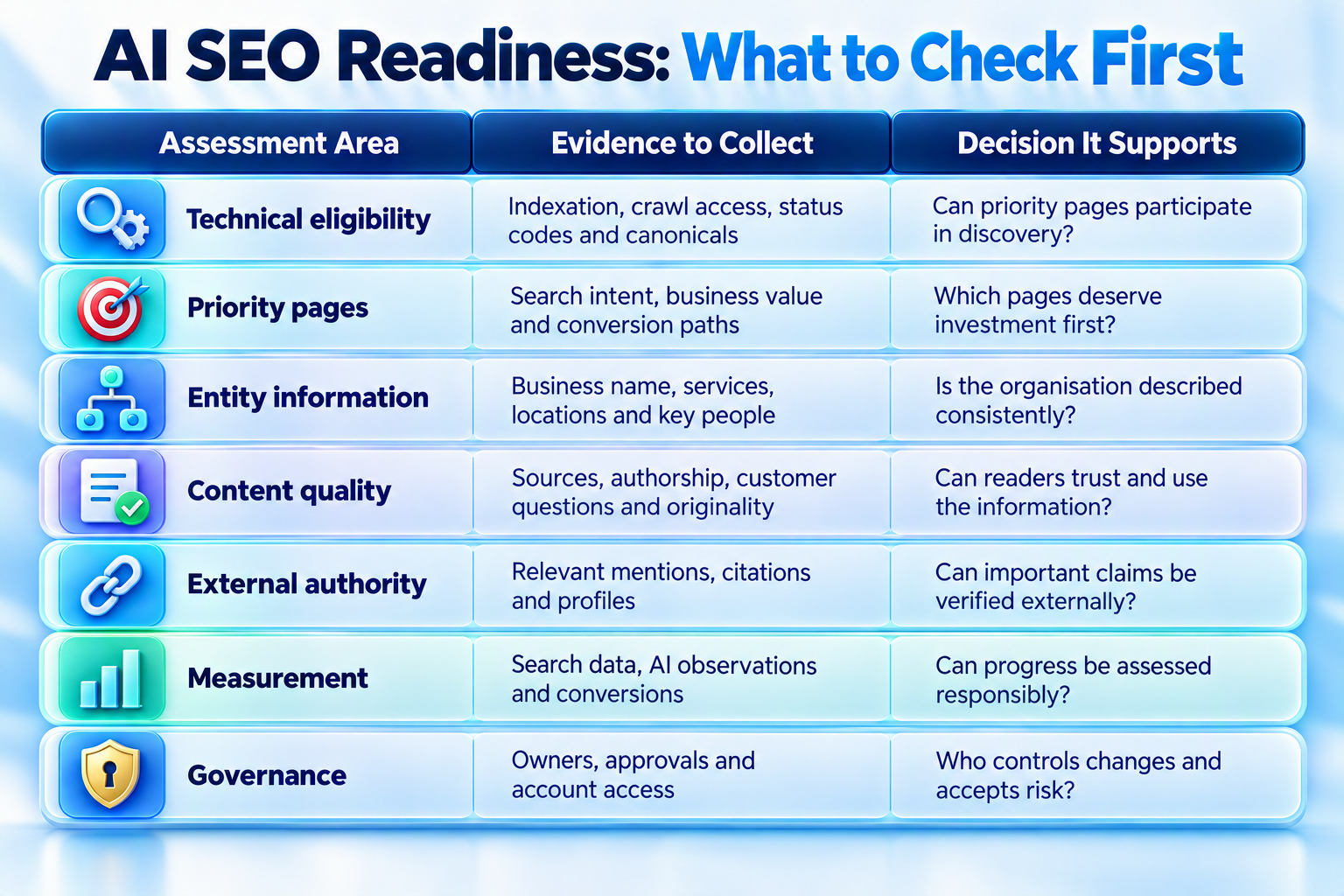
A baseline does not promise future visibility. It establishes enough evidence to decide whether technical, editorial, authority or measurement work should come first.
Define Priority Pages and Entities
An agency should not optimise every URL equally. Select a smaller set of commercially important services, products, locations or resources.
Each priority page should have a verified owner. The owner confirms service scope, customer fit, commercial claims and intended conversion action.
The entity list should identify the organisation, services, verified locations, authors and other subjects that customers need to understand. It should not include invented experts or unsupported service categories.
This stage prevents the campaign from publishing large amounts of content around topics the business cannot support. It also gives reporting a clear page-level focus.
Turn AI SEO Promises into Deliverables
Every proposal should translate broad outcomes into specific work. “Improve AI visibility” might involve auditing priority pages, correcting technical barriers, clarifying services and establishing a prompt-monitoring process.
The deliverables should state whether the agency will make changes or only provide recommendations. A technical audit has limited value when no developer owns implementation.
Content deliverables should identify page type, purpose, source requirements, reviewer and approval route. A promise to publish “20 AI-optimised articles” does not establish quality or business relevance.
Reporting deliverables should describe the platforms, prompts, pages, search data and conversions that will be reviewed. The agency should also explain the limitations of each measure.
AI SEO Deliverables and Evidence
| Service area | Minimum deliverable | Evidence to request |
|---|---|---|
| Technical SEO | Prioritised access and indexation review | Issue, affected page, impact, owner and status |
| Entity clarity | Verified business-information map | Approved names, services, locations and sources |
| Priority-page work | Updated commercial or informational pages | Before-and-after copy, sources and approval |
| Structured data | Supported markup matching visible content | Validation result and implementation URL |
| Internal linking | Priority-page relationship map | Source, destination, anchor and status |
| Authority work | Relevant mention and promotion plan | Publisher, method, destination and live reference |
| AI observation | Controlled query-monitoring set | Platform, prompt, date, result and cited sources |
| Reporting | Monthly or milestone performance report | Completed work, impact, risks and next decision |
The agency should not report an activity as complete when implementation remains pending. Recommendations, implementation and verification are separate stages.
Assign Implementation Responsibilities
AI SEO work often involves marketing, development, content, analytics and legal teams. A written responsibility matrix keeps important tasks moving and prevents confusion between teams.
An agency may identify an incorrect canonical, but a developer may need to update the template. A content team may rewrite a service page, while the service owner checks its claims, accuracy and customer suitability.
Assign one accountable owner to every deliverable. The owner does not need to complete every task but must track progress, arrange the required review and confirm completion.
The proposal should also define the information, access and approvals required from the client. Hidden client dependencies can delay implementation while ongoing agency fees continue.
Responsibility Matrix for an AI SEO Engagement
| Work item | Agency responsibility | Client responsibility | Approval evidence |
|---|---|---|---|
| Technical audit | Diagnose and prioritise issues | Provide access and developer contact | Approved findings register |
| Website implementation | Complete agreed changes or assist developer | Approve deployment and testing | Live URL and test record |
| Service content | Research and draft approved pages | Verify scope, claims and customer fit | Named content approval |
| Entity information | Map inconsistencies and recommended sources | Confirm legal and trading details | Verified entity sheet |
| Structured data | Create supported markup | Confirm visible information | Validation and page review |
| AI monitoring | Run controlled prompt sample | Approve questions and target markets | Dated observation log |
| Reporting | Explain activity, evidence and next decisions | Review results and approve priorities | Meeting notes or action register |
Responsibility should remain visible throughout the engagement. It should not appear only in the original proposal and disappear from monthly reporting.
Require Evidence for Important Claims
AI SEO agencies often use phrases such as “future-proof,” “AI-ready,” “top cited” or “guaranteed visibility.” These phrases need careful review.
Ask what each claim means, how it was measured and which variables could affect the result. A screenshot from one prompt does not prove broad or stable AI visibility.
Case studies should identify the starting position, work completed, period and result where client permission allows. Results from one industry or website should not be presented as a guaranteed outcome for another.
Claims about proprietary technology should also be explained. The client needs to know what data enters the tool, how outputs are reviewed and whether the business receives access to exported records.
Apply Australian Consumer Law to AI SEO Claims
Australian businesses must not make false or misleading claims about services, benefits, prices or likely outcomes. Claims need to be accurate and supported by reasonable grounds.
This obligation applies to agency advertising and to content an agency prepares for a client. Using an AI tool does not remove responsibility for the final statement.
Future-facing claims require particular care. Statements that a campaign “will secure citations” or “will double leads” should not be accepted unless the provider can support the claim appropriately.
The agreement should include a claims-approval process. Commercial, technical and legal reviewers may need to verify different parts of a page before publication.
Create a Claims Governance Process
A claims register records important statements before publication. It can cover performance, experience, locations, partnerships, awards, pricing and expected outcomes.
For each claim, identify the exact wording, evidence source, owner and last review date. Do not rely on outdated presentations or internal assumptions.
The agency should mark uncertain information for verification rather than filling gaps with plausible language. This is especially important when AI tools are used to draft service comparisons or product descriptions.
Remove or correct a claim when the evidence expires. An old award, discontinued partnership or changed service area should not remain live indefinitely.
Protect Account and Data Ownership
The business should own its domain, website, Search Console, Analytics, Business Profile and primary advertising or merchant accounts. Agencies should receive role-based access.
Do not allow a provider to create critical assets under a private account that cannot be transferred. Losing access at the end of the relationship can interrupt reporting and website management.
The agency should explain what information enters third-party AI tools. Confidential client records, customer data and unpublished strategies should not be uploaded without an approved process.
Access should be reviewed regularly and removed when no longer required. The exit procedure should include content, code, reports, prompt sets and account permissions.
Set a Defensible Measurement Method
AI-generated answers can vary by platform, prompt, location, user context and time. Measurement must acknowledge that variability.
Create a controlled prompt set around genuine customer questions. Record the exact wording and test conditions so later observations can be compared responsibly.
Separate observations from business outcomes. A mention or citation may support discovery, but qualified traffic, enquiries and sales show whether the visibility has commercial value.
Traditional search data remains important. Google reports traffic from AI Overviews and AI Mode within overall Web search data in Search Console rather than as a fully separate reporting channel.
AI SEO Measurement Method
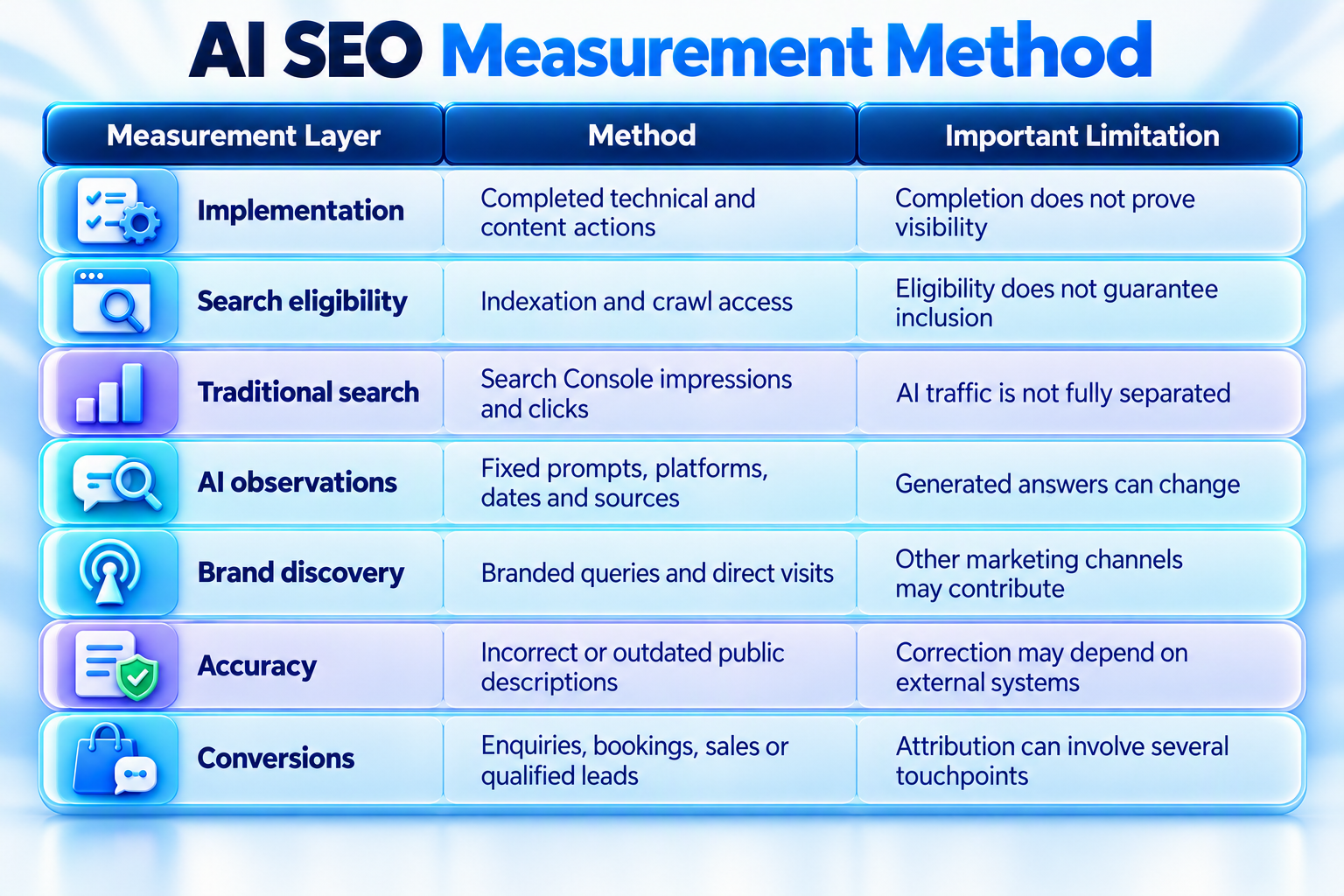
The agency should explain how missing or contradictory data will be handled. Silence in a report should not be interpreted as positive performance.
Review AI SEO Reports Critically
A useful report separates completed work, observed changes and interpretation. It should not use one combined score to hide weak or missing evidence.
Technical reporting should identify what changed on the live website. Content reporting should name the affected page, source evidence and approval status.
AI observations should show the tested prompt, platform, date and cited sources. Screenshots may support the record but should not replace structured data.
The report should end with decisions. Identify what needs approval, what remains blocked and why the next priority has been selected.
Keep Tactical Work Within the Approved Scope
Technical SEO, answer-ready content, entities, internal links and structured data remain important. However, detailed local tactics already belong in the dedicated Sydney and Melbourne guides.
Businesses targeting Sydney can review AI SEO Services Sydney: 9 Growth Strategies for 2026. That guide covers practical visibility improvements for Sydney businesses.
Businesses evaluating Melbourne-specific AI discovery can review Claude SEO Agency Melbourne: 9 Ways to Improve AI Search Visibility.
This national guide remains focused on engagement governance. Use the local articles for campaign tactics, then apply the evidence, access and reporting controls described here.
Distinguish Agency Comparison from Engagement Governance
A comparison article identifies potential providers and their public offerings. An engagement guide defines how any selected provider should be controlled and measured.
Businesses wanting a Melbourne provider overview can review 6 Best LLM SEO Agencies in Melbourne for Australian Businesses in 2026.
Do not treat an agency directory or editorial list as a substitute for due diligence. Profiles may contain self-reported claims, broad budget ranges and incomplete service descriptions.
Use provider lists to build a shortlist. Then apply a consistent request for scope, evidence, access, governance and reporting.
Score AI SEO Agencies Consistently
A scorecard reduces the effect of persuasive presentations and different agency terminology. Apply the same evidence request to every shortlisted provider.
Weights should reflect business risk. A regulated organisation may give more weight to claims governance and data handling, while an ecommerce store may prioritise technical implementation and product-data quality.
The score should not replace professional judgement. A provider may achieve a strong total while failing one critical requirement such as account ownership.
Record the evidence behind every score. Do not award points based on a verbal promise that has not entered the proposal.
AI SEO Agency Evaluation Scorecard
| Evaluation area | Suggested weight | Evidence to request |
|---|---|---|
| Baseline and diagnosis | 15% | Sample audit, prioritisation method and measurement baseline |
| Technical implementation | 15% | Implementation examples, testing and developer responsibility |
| Content and evidence | 15% | Briefs, sources, authorship and review workflow |
| AI measurement | 15% | Prompt set, platforms, dates, source tracking and limitations |
| Claims governance | 10% | Claims register, approvals and Australian-law awareness |
| Account and data control | 10% | Ownership, permissions, exports and exit procedure |
| Commercial alignment | 10% | Priority pages, conversions and business outcomes |
| Reporting and communication | 10% | Sample report, decisions, risks and next actions |
This scorecard is an editorial planning tool, not an industry standard. Change the weights to suit the organisation’s priorities and document any non-negotiable requirement separately.
Questions to Ask Before Approving a Proposal
What Baseline Will the Agency Establish?
Ask which technical, content, entity and measurement evidence will be collected. The proposal should identify the pages and platforms included.
What Will the Agency Implement?
Confirm whether the agency changes the website, supplies recommendations or depends on the client’s developer. Implementation delays should appear clearly in reports.
How Will AI Visibility Be Tested?
Request the platforms, prompts, markets, frequency and observation format. The agency should explain that generated responses can vary.
How Will Claims Be Approved?
Ask who verifies service, performance, location and future-outcome statements. The process should prevent unsupported AI-generated wording from reaching the website.
Who Owns Accounts and Campaign Data?
The business should own its core accounts. Confirm whether reports, prompt sets, content and technical documentation remain available after termination.
Proposal and Contract Checklist
Use this checklist before signing:
- The proposal defines priority pages, entities and target markets
- Deliverables separate recommendations, implementation and verification
- Reports include dates, sources, owners and limitations
- Claims, content and business facts require named approval
- The contract explains account ownership, data handling and exit support
A checklist cannot replace legal advice. Obtain qualified review where the contract, data handling or advertising claims create material risk.
AI SEO Costs in Australia
AI SEO pricing varies by technical scope, website size, content, target markets and reporting depth. Agency directories display broad project categories, but those listings do not establish standard market prices.
Ask for an itemised, GST-clear proposal. Separate audit work, technical implementation, content, structured data, digital authority, tools and reporting.
Confirm whether the agency expects additional developer, writer or legal-review costs. A low monthly fee can become expensive when implementation is repeatedly excluded.
Avoid paying for a fixed number of AI citations. External platforms control generated output, and a responsible provider cannot guarantee that quantity.
Set Milestones Without Guaranteeing Outcomes
A contract can guarantee deliverables and review dates. It cannot responsibly guarantee rankings, citations or enquiries.
The first milestone may complete the baseline and priority-page plan. Later milestones may cover implementation, content approval, observation and reporting.
Expected completion dates should account for client approvals and development access. The agency should identify dependencies before work begins.
Use a change-control process when scope expands. New markets, languages or website sections can affect cost, measurement and review requirements.
Common AI SEO Engagement Mistakes
Hiring Before Establishing a Baseline
Without a baseline, later performance claims become difficult to test. Complete technical, content, entity and conversion checks before approving ongoing work.
Approving Activity Instead of Deliverables
“Monthly AI optimisation” does not define useful work. Require named pages, actions, owners and evidence.
Allowing Unsupported Claims
AI-generated copy can sound confident while containing weak or invented statements. Use a claims register and named reviewers.
Letting the Agency Own Core Accounts
Private ownership creates dependency and exit risk. Keep core accounts under the business and provide controlled access.
Measuring One Prompt as a Trend
One answer reflects one moment and context. Use a repeatable prompt set with dates, platforms and source records.
Ignoring Implementation Responsibility
An audit cannot improve a live website until someone acts. Assign owners and track each recommendation through implementation and verification.
Accepting Guaranteed Citations
No provider controls external AI systems. Treat guaranteed mentions, rankings or lead outcomes as warning signs.
The IT Company Australia Service Context
IT Company Australia publicly offers AI search optimisation services involving AI discovery, voice search, structured content, localised content and reporting.
These public descriptions should be treated as intended service outcomes, not guaranteed citations. The final proposal should identify platforms, priority pages, deliverables and measurement limitations.
The broader SEO services for Australian businesses cover technical SEO, content, local search, ecommerce and link building. An AI SEO engagement should remain connected with those search foundations.
Businesses can request an AI SEO assessment and ask for an itemised scope covering baseline evidence, implementation, claims governance, account ownership and reporting.
Frequently Asked Questions
What Does an AI SEO Agency Do?
An AI SEO agency improves technical access, content clarity, business information, authority and measurement. The work should support traditional search and AI-assisted discovery without guaranteeing citations.
How Should a Business Audit an AI SEO Agency?
Request sample deliverables, reporting, measurement methodology, claims governance and account-ownership terms. Score each provider against the same documented criteria.
What Should an AI SEO Proposal Include?
The proposal should identify priority pages, baseline work, deliverables, implementation owners, measurement, reporting, costs, assumptions, exclusions and exit procedures.
Can an Agency Guarantee AI Citations?
No. External platforms control generated responses. An agency may improve content and source quality but cannot guarantee mentions or recommendations.
What Evidence Should Monthly Reports Show?
Reports should show implemented work, affected pages, dated AI observations, cited sources, search performance, conversions, risks and next decisions.
Does an AI SEO Agency Need Website Access?
Some work requires CMS, Search Console, Analytics or structured-data access. Provide role-based permissions and retain business ownership of every core account.
How Much Does an AI SEO Agency Cost in Australia?
There is no standard price. Cost depends on technical condition, website size, content, markets, implementation and reporting. Request an itemised, GST-clear proposal.
How Long Should an AI SEO Engagement Run?
Duration depends on scope and implementation speed. Use milestone-based delivery and agreed review periods instead of accepting guaranteed outcome dates.
How Does Australian Consumer Law Affect AI SEO?
Service and advertising claims must be accurate, truthful and based on reasonable grounds. AI-generated content still requires business review and approval.
What Is the Safest First Step?
Start with a fixed-scope baseline assessment. Use the findings to decide whether ongoing technical, content, authority or measurement work is justified.