
Choosing a marketing partner should make business growth easier. However, many businesses encounter proposals filled with vague deliverables, unexplained costs and activities that are difficult to connect with enquiries, sales or revenue.
The challenge is not a lack of options. Businesses can invest in search engine optimisation, Google Ads, social media, email marketing, content, website improvements and conversion optimisation. The difficult part is deciding which services are needed now, which can wait and how much support the business can manage internally.
Well-designed marketing agency packages help solve this problem by connecting services, responsibilities, reporting and commercial terms with defined business objectives. They also give decision-makers a clearer way to compare providers without selecting an agency on headline price alone.
This guide explains what marketing packages include, how pricing models differ and which questions to ask before signing an agreement. It also introduces a practical framework Australian businesses can use to compare proposals consistently.
Direct answer
Marketing agency packages are structured service arrangements that combine agreed marketing activities, deliverables, reporting and support. A suitable package should reflect the business’s objectives, customer journey, internal capabilities and available budget rather than forcing every organisation into the same combination of services.
Before choosing a package:
- Identify the most important business or customer constraint.
- Determine which capabilities already exist internally.
- Compare agency proposals using the same scope, cost and ownership criteria.
- Confirm how performance will be measured.
- Document review dates, notice periods and handover requirements.
What are marketing agency packages?
A marketing agency package is a defined arrangement covering one or more marketing disciplines. It may focus on a single channel, such as SEO, or combine several services in an integrated digital marketing package.
Monthly packages commonly include some combination of:
- Planning and prioritisation
- Campaign implementation
- Content or creative production
- Technical optimisation
- Performance monitoring
- Reporting and review meetings
- Ongoing recommendations
Some agencies use fixed tiers such as Standard, Business and Premium. Others allocate a set number of hours each month or produce a customised proposal following an audit or discovery process.
The name of a package is less important than its scope. Two agencies may both offer a “growth package” while including different channels, quantities, meeting schedules and responsibilities.
Package versus campaign
A package establishes an ongoing service framework. A campaign is normally a time-limited initiative with a defined audience, offer and objective.
For example, a paid advertising package may provide continuous account management. Within that package, the agency could run a six-week campaign for a new product or service.
Package versus project
A project has a defined completion point. Website development, brand guidelines, tracking implementation and technical SEO audits are commonly treated as projects.
A monthly marketing retainer is better suited to work that requires ongoing testing, monitoring and improvement. Examples include organic search, paid advertising, email campaigns, social media management and conversion optimisation.
Common types of digital marketing packages
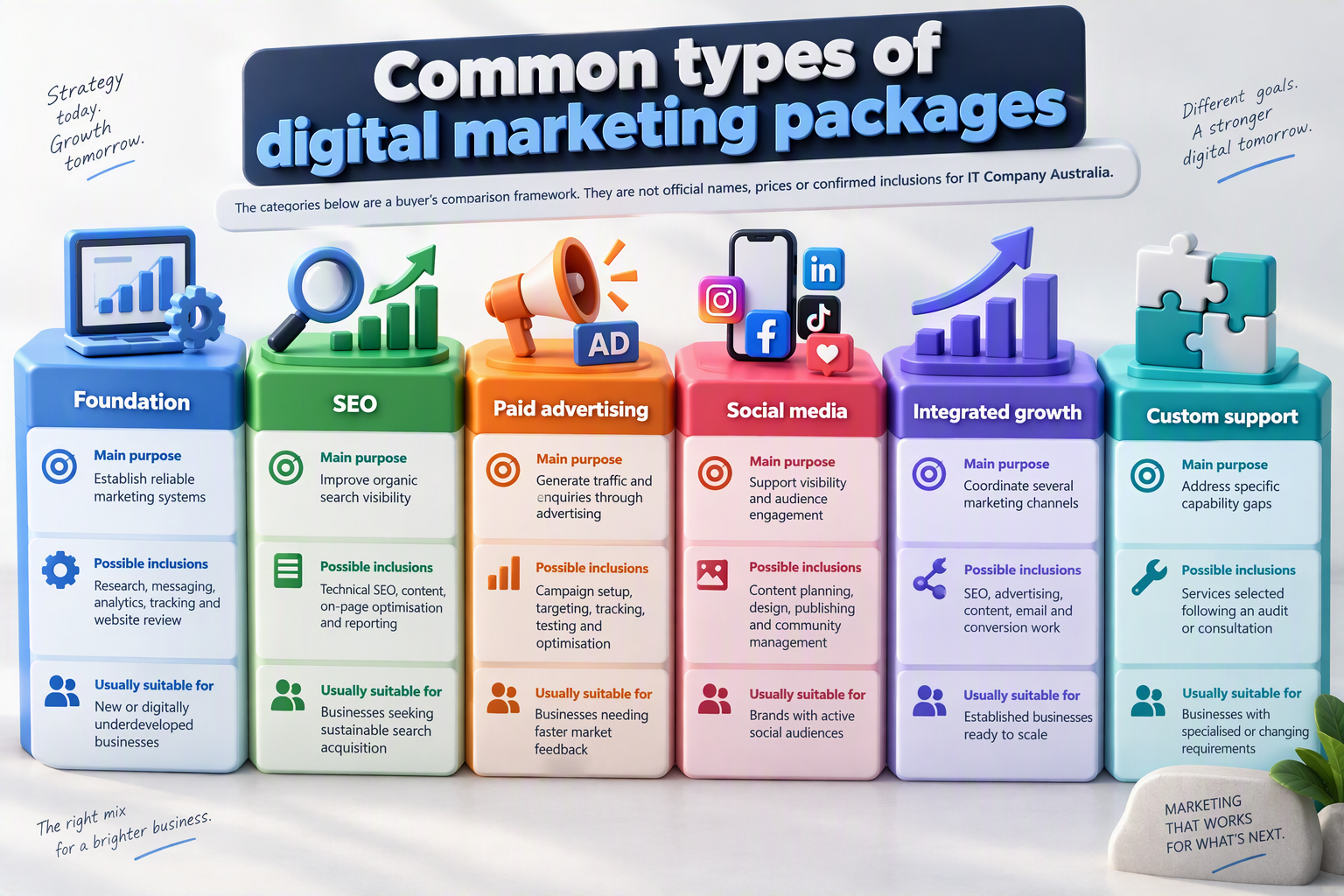
The categories below are a buyer’s comparison framework. They are not official names, prices or confirmed inclusions for IT Company Australia.
Foundation packages
Foundation packages address problems that could undermine later marketing activity. These problems may include incomplete analytics, weak conversion tracking, unclear messages, inconsistent branding or a confusing website journey.
This work may appear less exciting than launching advertising. However, increasing traffic to an unclear offer or poorly tracked website can create additional cost without showing which activities are producing results.
A foundation package should finish with clearly defined priorities, ownership and next steps.
SEO packages
SEO packages may combine technical improvements, keyword and audience research, content development, internal linking and performance monitoring.
Businesses should confirm whether the package includes:
- Technical audits and fixes
- Keyword and competitor research
- Existing-page optimisation
- New service or blog content
- Local SEO
- Digital PR or link acquisition
- Reporting and recommendations
- Conversion-focused website improvements
Google advises site owners to create helpful, reliable, people-first content and make pages understandable to users and search engines. Meeting technical and content requirements does not guarantee crawling, indexing or a particular ranking. Agencies should therefore explain assumptions and risks rather than promise guaranteed positions.
IT Company Australia publishes Standard, Business and Premium SEO scopes through its Local SEO Services Australia | Boost Ranking | IT Company page. The published inclusions vary across content, keyword research, backlinks, competitor analysis, reporting and other activities, while prices are available by quotation. Businesses should request confirmation of current inclusions before purchasing.
Paid advertising packages
Paid advertising packages can include account setup, keyword research, audience targeting, creative testing, bid management, conversion tracking and landing-page recommendations.
The proposal should separate:
- Agency management fees
- Advertising or media spend
- Creative production
- Landing-page work
- Software or tracking costs
- Additional or out-of-scope services
- GST and other applicable charges
IT Company Australia currently publishes three Google Ads service levels with different campaign types, targeting methods, reporting options, support levels and advertising-spend limits. Buyers should verify the current price, term and inclusions directly before making a decision.
Businesses considering this channel can review the company’s Google Ads agency services.
Social media packages
Social media packages may cover strategy, content calendars, graphic design, video, publishing, community management, paid campaigns and reporting.
Useful questions include:
- Which platforms are included?
- How many posts, videos or stories will be produced?
- Who supplies photographs and video footage?
- Is community management included?
- Are paid campaigns included or separately charged?
- Who approves and publishes content?
- How quickly will comments and messages be handled?
- Are editable source files provided?
IT Company Australia publishes Standard, Business and Premium social media scopes. The displayed inclusions differ across content volume, consultation frequency, account management, audience engagement, reporting, competitor analysis, video creation and monitoring.
Current details are available on the company’s social media management agency page.
Integrated marketing packages
Integrated packages coordinate several channels around a common customer journey.
Search marketing may capture existing demand. Social content may build awareness and trust. Email may nurture prospects who are not ready to buy. Conversion optimisation may help more website visitors complete an enquiry or purchase.
Integration does not mean buying every available service. A strong integrated package concentrates resources on the channels most likely to influence the target customer.
What should a marketing package include?
A useful proposal should explain more than the number of posts, advertisements or articles supplied each month. It should show how each activity supports a defined need.
| Package component | What to verify | Why it matters |
|---|---|---|
| Objectives | Specific customer or commercial outcome | Prevents activity without direction |
| Scope | Included channels, tasks, quantities and exclusions | Reduces misunderstandings |
| Responsibilities | Agency and client obligations | Prevents access and approval delays |
| Measurement | Metrics, attribution and reporting approach | Creates a shared performance view |
| Ownership | Accounts, data, content and creative assets | Protects business continuity |
| Governance | Meetings, approvals and escalation process | Keeps decisions moving |
| Commercial terms | Fees, media spend and additional work | Makes the total cost visible |
| Exit provisions | Notice period, access removal and handover | Reduces transition risk |
A defined objective
“Grow the brand” is too broad to guide a package.
A more useful objective could be to increase qualified enquiries for a particular service, improve conversion from an existing traffic source or reduce the cost of acquiring suitable leads.
The objective should be translated into relevant indicators. Depending on the business, these may include:
- Qualified enquiries
- Conversion rate
- Sales opportunities
- Customer acquisition cost
- Lead quality
- Marketing-influenced revenue
Not every metric represents a final commercial outcome. Traffic, impressions and engagement can still help diagnose performance, but they should be interpreted alongside meaningful customer actions.
A clear scope
The scope should say exactly what is included.
“SEO management” could mean a monthly report, or it could include technical work, content, local optimisation and conversion improvements. The proposal should state what will be delivered, how frequently work will occur and what requires a separate quotation.
Responsibilities and dependencies
Marketing often depends on information, approvals and technical access from the client.
The proposal should identify:
- Who supplies product or service information
- Who approves content and creative work
- Who provides access to the website and accounts
- Who implements technical recommendations
- Who responds to leads
- What happens when an approval is delayed
These details make it easier to diagnose delays without assigning every problem to the agency or the client.
Account and data ownership
The agreement should identify the legal owner and administrators of important business assets, including:
- Domain name
- Website and hosting
- Analytics property
- Advertising accounts
- Social media profiles
- Customer and campaign data
- Creative source files
- Tracking configurations
The business should also understand what happens to permissions, data and files when the agreement ends.
How to compare marketing agency pricing
Marketing agency pricing cannot be assessed fairly without comparing scope, service intensity, experience, media costs and production requirements.
A lower monthly fee may exclude strategy, creative work, landing pages or conversion tracking. A higher-priced package may include these services but still offer poor value if they do not address the business’s main constraint.
Compare the complete cost
Use this calculation when reviewing a proposal:
Agency fee + advertising spend + production + software + website work + additional charges + GST = complete package cost
Illustrative comparison
The following example is hypothetical.
Agency A quotes $2,000 per month but excludes advertising spend, landing pages and creative production. Agency B quotes $3,200 and includes creative production, conversion tracking and landing-page support.
Agency A has the lower headline fee, but it is not automatically the lower-cost option. Both proposals must be normalised using the same period, services and assumptions before they can be compared fairly.
Fixed monthly package
A fixed monthly package provides predictable billing and a defined service schedule. It can work well when deliverables are repeatable and both parties understand the expected workload.
The agreement should explain how urgent requests, unused capacity and additional work will be handled.
Hour-based retainer
An hour-based retainer gives the agency a defined amount of time each month. This can suit businesses whose priorities change regularly.
Verify:
- Which roles use the allocated hours
- Whether roles have different hourly rates
- How time is tracked
- Whether unused hours expire or carry forward
- How additional hours are approved
Performance-related pricing
Performance-related pricing links part of the agency fee to agreed results.
This model can create alignment, but it requires reliable attribution and a result that both parties can influence fairly. Sales may also depend on price, availability, sales follow-up, customer service and wider market demand.
The agreement should define the outcome, data source, attribution method and treatment of cancellations or invalid leads.
Project followed by ongoing support
This model begins with foundational work before moving into monthly management.
An agency might first complete an analytics implementation, website audit or marketing strategy. Ongoing SEO, advertising or content work begins after the most important technical and measurement problems have been addressed.
How to choose the right marketing package
Start with the business constraint rather than a preferred channel.
A company with limited visibility has different needs from a business receiving substantial website traffic but few enquiries. A business generating many leads but converting few of them may need sales-process or website improvements rather than more advertising.
| Business situation | Likely priority | Potential package emphasis |
|---|---|---|
| Limited online visibility | Improve discovery | SEO, local search and targeted awareness |
| Traffic but few enquiries | Improve conversion | Messaging, landing pages and tracking |
| Inconsistent brand presence | Improve coherence | Strategy, design and content systems |
| High acquisition costs | Improve efficiency | Measurement, campaign optimisation and conversion |
| Limited internal capacity | Extend execution capability | Integrated or fractional marketing support |
| Unclear performance | Establish reliable data | Analytics, attribution and reporting |
Review internal capabilities
Document what the internal team can already do well.
Paying an agency to duplicate an established capability can consume budget without adding much value. A better package may fill only two important gaps, such as technical SEO and paid advertising, while brand content and approvals remain internal.
Map the customer journey
Review how customers:
- Discover the business
- Understand its services
- Compare alternatives
- Make contact
- Decide whether to buy
- Return or recommend the business
This process helps identify where marketing is breaking down. It also prevents unrelated tactics from being bundled together without a clear role.
Use the CLEAR package test
The CLEAR test gives Australian businesses a consistent way to assess marketing package inclusions.
C: Commercial objective
Is the package connected with a defined customer or commercial outcome?
L: Listed scope
Are tasks, quantities, exclusions and dependencies documented?
E: Evidence and measurement
Does the proposal specify tracking, reporting and decision-making methods?
A: Asset ownership
Will the business retain suitable ownership and administrative access to its accounts, content and data?
R: Review and exit
Are review dates, change controls, notice periods and handover procedures clear?
A proposal that cannot answer these five areas may require further clarification before it can be compared confidently.
What should happen in the first 90 days?
The exact process will vary by provider and package. The following is a suggested evaluation framework rather than a confirmed IT Company Australia process.
Days 1 to 30: establish the baseline
The agency and client may confirm objectives, responsibilities, account access, tracking, audience assumptions and existing performance.
Days 31 to 60: implement priorities
Work may move into technical corrections, campaign setup, content production, landing-page improvements or other agreed priorities.
Days 61 to 90: assess early evidence
The agency should explain what has been completed, what the initial data indicates and what will change next.
SEO and brand-building programmes may not demonstrate final commercial outcomes within this period. The review should therefore consider completed foundations and relevant leading indicators as well as revenue or lead results.
Seven marketing package mistakes to avoid
| Mistake | Likely impact | Better approach |
|---|---|---|
| Choosing on price alone | Important work may be excluded | Compare total cost, scope and expected value |
| Buying every channel | Budget and attention become fragmented | Prioritise the strongest customer opportunities |
| Accepting vague deliverables | Expectations become difficult to enforce | Define outputs, standards and responsibilities |
| Focusing only on vanity metrics | Reports may not reflect business progress | Connect marketing metrics with qualified outcomes |
| Ignoring asset ownership | Changing providers becomes difficult | Document ownership and access before work begins |
| Expecting immediate SEO results | Pressure can encourage poor decisions | Agree on milestones and appropriate indicators |
| Skipping privacy and legal review | Campaigns may create compliance risks | Obtain qualified advice where required |
Avoid unsupported performance promises
Agencies should explain assumptions, dependencies and risks rather than guarantee outcomes outside their control.
The Australian Competition and Consumer Commission states that advertising claims should be truthful, accurate and based on reasonable grounds. Businesses must be able to substantiate the claims they make.
Consider privacy requirements
Marketing systems may process names, contact information, behavioural data and customer records.
The Office of the Australian Information Commissioner explains that Australian Privacy Principle 7 may apply when organisations use or disclose personal information for direct marketing. Email, SMS and other messages can also be subject to separate legal requirements.
The applicable obligations depend on the organisation and activity. Obtain qualified legal or privacy advice rather than treating a marketing proposal as compliance advice.
Questions to ask before signing an agency agreement
Use the proposal meeting to test clarity rather than chemistry alone.
Ask:
- What would you prioritise during the first three months?
- Which services are included and excluded?
- Which results would cause you to change direction?
- What information and access do you need from us?
- Who will complete the work?
- How frequently will campaigns be reviewed?
- How will results be reported?
- Are advertising and third-party costs separate?
- Who owns the accounts, content and data?
- What happens when work exceeds the agreed scope?
- What is the notice period?
- What is included in the final handover?
How IT Company Australia supports digital marketing
IT Company Australia publishes services covering SEO, Google Ads, social media management, email marketing, website design and AI search optimisation. Its website also presents hosting, security, managed IT and automation services. [Technology…IT Company]
This range may be useful where marketing work depends on connected website, hosting or technology requirements. The proposal should nevertheless specify which services are included, how responsibilities are divided and how performance will be reviewed.
Businesses can also review this guide to the benefits and risks of outsourcing a digital marketing agency. The related article discusses specialist skills, internal capacity, reporting, account ownership and outsourcing risks.
IT Company Australia provides consultation and contact options and lists contact details for Sydney, Brisbane, Melbourne and Perth. [Contact IT…IT Experts]
Frequently asked questions
What are marketing agency packages?
They are structured combinations of marketing strategy, implementation, optimisation, reporting and support. A package can focus on one channel or coordinate several channels within an ongoing engagement.
Which marketing package is best for a small business?
The best option addresses the business’s most important constraint without spreading the available budget too thinly. Many small businesses are better served by strong tracking.
How much do marketing agency packages cost?
Digital marketing package costs depend on scope, expertise, service frequency, creative requirements, advertising complexity and support level. Ask providers to separate management fees, media spend, production costs, software charges, additional work and GST.
How long should a marketing package run?
There is no universal period suitable for every service. The agreement should use defined review milestones and explain when the scope, priorities, commercial terms can be changed as well.
Is advertising spend included in the package fee?
This depends on the proposal. Advertising spend should be disclosed separately even when it appears on the same invoice as the management fee. Separating the figures makes cost and performance comparisons clearer.
Can a marketing package be customised?
Many agencies offer custom arrangements. Any flexibility should be documented, including which services may change, how frequently changes are allowed and whether a change affects the fee or contract period.
Who should own the marketing accounts?
The agreement should clearly identify ownership and administrative access. The business should retain suitable control of its domain, website, analytics, advertising accounts, customer data and other essential assets.
Is SEO included in every digital marketing package?
No. Some packages exclude SEO or offer it separately. Confirm whether technical work, content, local SEO, authority development as well as reporting are included.
How should an agency report results?
Reports should connect completed work with agreed objectives. They should state what happened, why it matters, what was learned and what will change next.
What should I take to a marketing consultation?
Bring your main objectives, current marketing activities, available performance information, approximate budget parameters and a list of internal capabilities. This helps the provider identify genuine gaps rather than recommending unnecessary services.
Choose clarity before choosing a package
The strongest marketing agency packages make priorities, responsibilities, costs and ownership easier to understand. They are designed around the customer journey and the business’s real capability gaps, not around the number of services an agency wants to sell.
Before appointing a provider, define the desired outcome and compare complete scopes. Confirm how performance will be measured, who will own the accounts and data, when the strategy will be reviewed and how the arrangement can end.
IT Company Australia offers services across SEO, paid advertising, social media, email, website development and related digital systems. Businesses should obtain a current proposal confirming the recommended services, inclusions, fees and contract terms.
Contact IT Company Australia to discuss your objectives, current marketing systems and the services that may be relevant to your next stage of growth.
