
A business can publish articles, improve page titles and acquire backlinks yet still see little commercial progress. Each activity may appear useful on its own, but disconnected SEO work often sends effort towards the wrong pages.
Introduction
The problem is usually not a lack of activity. It is the absence of a shared campaign workflow. Technical fixes, content, internal links, external promotion and reporting must support the same commercially important pages.
Link building and SEO services work best when they operate as one system. An external link cannot repair an inaccessible page. A well-optimised service page may also struggle when the website gives it little internal or external support.
For Australian businesses in 2026, the practical goal is not to collect the highest backlink count. It is to improve the right pages, create useful supporting assets, earn appropriate external coverage and measure whether those actions produce qualified visibility.
This guide focuses on how technical SEO, target-page improvement, content, internal linking, promotion and external references should operate as one campaign. It does not provide a provider-selection framework or a standalone list of backlink tactics.
What Should Link Building and SEO Services Achieve?
Link building and SEO services should improve how search engines and customers discover, understand and use commercially important pages. The work may combine technical SEO, content optimisation, internal linking, authority building and campaign reporting.
Link building supports the external part of that system. It can help a useful page gain references from relevant websites, publications, suppliers, associations or partners. Those references should make sense to readers, not exist only to influence rankings.
SEO prepares the destination. The target page must be accessible, relevant and clear enough to deserve promotion. Internal links should help visitors reach it, while conversion paths should support the business outcome behind the campaign.
Australian businesses seeking a broader managed service can review SEO and link-building services. The published offering includes technical work, content, backlink building and reporting, but the final project scope should define exact responsibilities.
Direct Answer
Integrated link building and SEO services begin with diagnosis, select commercially important pages, improve those pages, add internal support, create useful assets, promote them to relevant audiences and measure page-level outcomes. The campaign then uses evidence to choose the next technical, content or promotion priority.
In This Guide
This guide explains how to:
- Establish a reliable technical and measurement baseline
- Select target pages using commercial and search evidence
- Improve content and internal support before external promotion
- Connect link-earning assets with important service or category pages
- Measure outcomes and improve the campaign through iteration
Link Building and SEO Campaign Quick Facts
| Question | Practical answer |
|---|---|
| Who needs an integrated campaign? | Businesses investing in SEO, content and backlinks without a shared page-level plan |
| What should happen first? | Technical diagnosis, baseline measurement and target-page selection |
| Where should external coverage point? | To useful and indexable pages that serve a clear audience need |
| When should promotion begin? | After the destination and supporting content are ready |
| How should progress be measured? | By page-level visibility, qualified traffic, conversions and relevant external coverage |
| What creates the greatest risk? | Scaling backlinks before technical, content and measurement problems are resolved |
Why Backlinks Alone Are Not a Strategy
A backlink package can create activity quickly. It does not establish whether the website is promoting the right page, matching customer intent or measuring the correct business action.
A service page may receive backlinks while carrying an incorrect canonical, weak copy or a broken enquiry form. The campaign can report completed placements even though the destination cannot perform its intended role.
Another campaign may publish useful articles but fail to connect them with the main service pages. The supporting content gains traffic while the commercial pages remain isolated.
An integrated SEO strategy solves these gaps by assigning a purpose to each activity. Technical work prepares the website, content improves relevance, internal links create pathways and external promotion expands discovery.
Google explains that links help users and search engines discover pages. It also recommends descriptive anchor text that gives useful context about a destination. These principles support links that help real readers rather than links created only to manipulate rankings.
The Integrated SEO and Link-Earning Loop
The integrated campaign operates as a repeatable loop rather than a one-time checklist. Each stage produces evidence for the next stage.
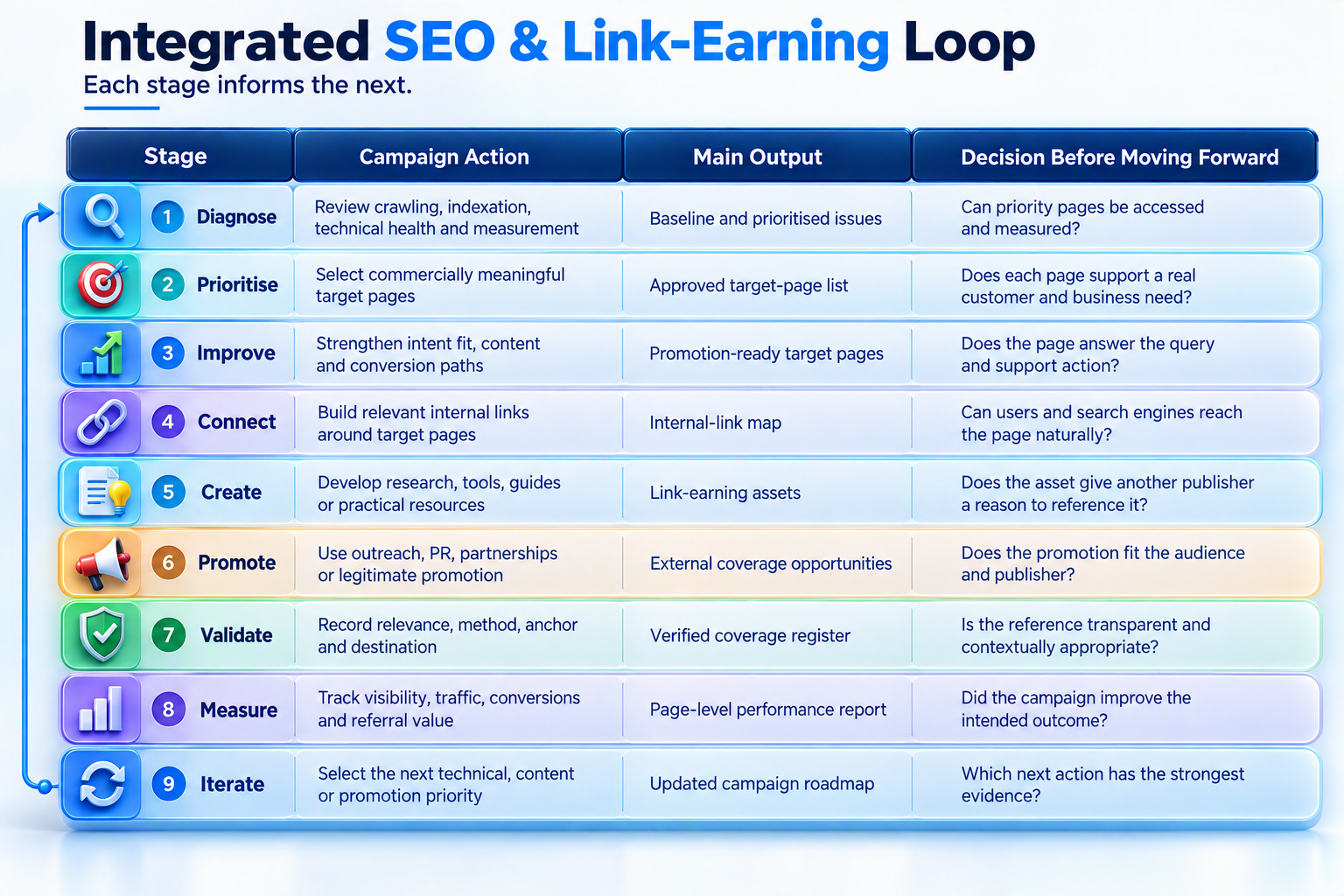
The loop prevents the campaign from scaling one activity before the previous stage is ready. It also makes responsibility clearer because every output has a decision point.
Diagnose the Website Before Expanding the Campaign
The first campaign stage should establish whether search engines can access and process the intended pages. Review crawling, indexation, response codes, canonical tags, redirects, XML sitemaps and mobile presentation.
Technical findings should be prioritised by business impact. A blocked service page matters more than a duplicate tag page that receives no traffic or links.
Measurement must also be checked. Google Search Console, analytics and conversion systems should record the pages, queries and business actions relevant to the campaign.
The Free SEO Audit Australia guide explains why diagnosis should come before expanding content or backlinks. An initial review helps separate urgent access problems from longer-term opportunities.
Establish a Useful Baseline
A baseline should include more than rankings. Record impressions, clicks, organic landing-page visits, conversions and existing referring pages for every priority URL.
Check whether the chosen conversion is working. A form confirmation does not prove that the enquiry reached the business inbox, customer relationship management platform or ticketing system.
The baseline should also note current content quality and internal support. This evidence allows the team to compare the page before and after technical, content and promotion work.
Prioritise Commercially Important Target Pages
An SEO campaign cannot promote every page with equal attention. Select a smaller group of pages that represent valuable customer needs and realistic search opportunities.
A useful target page may be a core service, product category, location or high-intent resource. The page should connect visibility with a meaningful business action such as an enquiry, booking or sale.
Search volume is not enough. A lower-volume query may produce stronger leads than a broad phrase attracting people outside the intended audience.
The target-page list should record the page, search intent, business value, current visibility, content gap and conversion action. This creates a practical bridge between SEO reporting and commercial priorities.
Use Page-Level Campaign Ownership
Assign one person to approve each target page. The owner may be responsible for service accuracy, product information, compliance or conversion decisions.
SEO professionals can improve structure and search alignment, but the business must verify claims, availability and customer expectations. This prevents technically polished pages from publishing inaccurate information.
The campaign should also record which pages are excluded. Login pages, expired offers and weak duplicate pages should not receive promotion simply because they already exist.
Improve Target Pages Before Promotion
Target-page SEO prepares the destination for visitors and external references. The page should explain the service or subject clearly, match the intended query and guide the visitor towards a suitable next action.
Review the title, main heading, body content and supporting evidence. Remove vague claims and add useful explanations of process, scope, limitations and customer fit.
Conversion elements deserve the same attention. Important forms, telephone links, bookings and checkout functions should receive end-to-end testing before the campaign directs more visitors towards them.
The guide to improving SEO on a website covers page titles, content, technical health, internal links and authority building. Use those foundations before beginning large-scale promotion.
Match Page Type to Search Intent
A research query may need a detailed guide. A commercial comparison may need clear options, inclusions, trade-offs and decision criteria.
A service page should not imitate an educational article when the customer wants to understand scope and request help. Likewise, a short sales page may not satisfy a complex research query.
Search intent can change over time. Review current results and Search Console query data rather than relying permanently on the intent assigned during the original keyword research.
Build Internal Support Around Target Pages
Internal linking connects relevant website content with the priority page. It helps customers continue their journey and shows how topics relate across the website.
Begin with pages already receiving traffic or links. Add a contextual link where the target page genuinely expands the reader’s next step.
Use descriptive anchor text without forcing a repeated exact-match phrase. The wording should help the reader understand the destination before following the link.
A target page should also link back to useful supporting resources. This two-way relationship creates a topic cluster rather than a set of isolated pages.
Create an Internal-Link Map
The map should identify the source page, target page, anchor wording and reason for the relationship. It should also record whether the link has been implemented.
Review navigation, breadcrumbs and related-content components where appropriate. A body link may support context, while permanent navigation can signal stronger site-wide importance.
Do not add links merely to meet a target number. Every internal link should help a customer understand, compare or act.
Create Assets That Give Publishers a Reason to Link
A link-earning asset provides value beyond a standard service description. It may help an audience make a decision, complete a task or understand an issue.
Useful formats include original research, downloadable templates, calculators, transparent comparisons and detailed practical guides. The best format depends on the intended audience and available expertise.
The asset should support a priority topic while remaining useful on its own. It can then link internally to the relevant service or category page without turning into a disguised advertisement.
Do not manufacture statistics or claim original research without a verifiable method. Label illustrative calculations and hypothetical examples clearly.
Connect Assets with Commercial Pages
A supporting guide may attract references more naturally than a sales page. The campaign should use internal links to pass interested readers from the resource to the appropriate service.
This connection must remain useful. A guide about website migration can link to a migration service, but a general industry article should not force an unrelated commercial destination.
Track the performance of both pages. External coverage of the asset may increase discovery, while the connected service page may gain impressions, visits or enquiries.
Select Promotion Methods by Audience
Promotion should begin with the people and publications likely to value the asset. A broad automated list may create more outreach volume but lower relevance.
Identify the audience, publisher type and reason the resource matters. A trade association may value a technical checklist, while a business publication may prefer original data or expert commentary.
Editorial outreach, partnerships, digital PR and legitimate sponsorship can all form part of promotion. The acquisition method should remain transparent in campaign records.
Detailed link-building tactics belong in the existing guide to seven smart SEO link-building strategies. This playbook focuses on where promotion belongs within the wider campaign.
Assess External Coverage Before Recording Success
A live link should not automatically be counted as a successful outcome. Review whether the source page, audience and destination are relevant.
Record the publication, source URL, target page, anchor text and acquisition method. If payment or sponsorship is involved, document the link qualification.
Google’s spam policies identify paid ranking links, excessive link exchanges and automated link creation as link spam. Sponsored advertising is allowed when links are qualified appropriately.
Publisher metrics can support investigation, but they should not replace editorial review. The campaign needs evidence that the external opportunity fits the subject and audience.
Use a Consistent Validation Record
The validation record should state why the placement matters. Generic comments such as “high authority” provide little accountability.
A stronger note might explain that an Australian industry publication referenced an original compliance checklist within an editorial article read by the target professional audience.
If a link disappears or the source changes topic, update the record. Monthly reporting should distinguish live, changed and removed coverage.
Worked Integrated Campaign Example
The following example is illustrative. It does not describe a verified client result or promise a particular outcome.
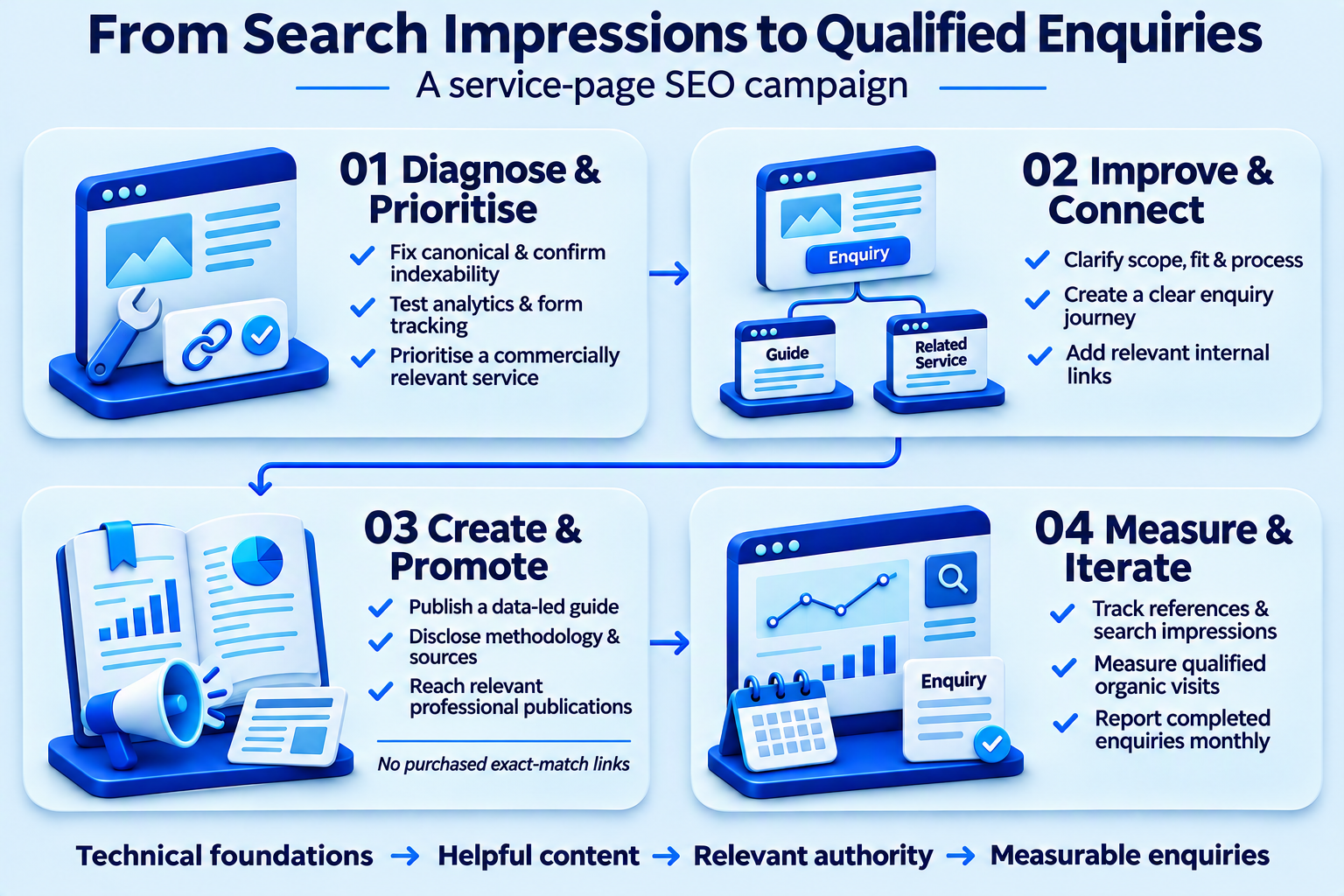
An Australian professional-services website has one commercially important service page receiving impressions but few clicks. The page also has weak internal support and an incorrect canonical pointing to an older URL.
Diagnose and Prioritise
The campaign first corrects the canonical and confirms that the live service page can be indexed. Analytics and form tracking are tested before performance changes are measured.
The service page is selected as a priority because the business can deliver the service and the page supports qualified enquiries.
Improve and Connect
The team rewrites the page to explain scope, customer fit and the service process. A clear enquiry journey replaces a generic contact button.
Relevant internal links are then added from existing guides and related service pages. The service page links back to a new supporting resource where visitors can explore the subject in greater depth.
Create and Promote
The team publishes a data-led guide addressing a recurring industry problem. The methodology and sources are disclosed so editors can assess its credibility.
Outreach promotes the guide to relevant professional publications. The campaign does not purchase exact-match links directly to the service page.
Measure and Iterate
Monthly reporting tracks external references to the guide, impressions for the service page, qualified organic visits and completed enquiries.
If visibility improves but enquiries do not, the next iteration examines the offer and conversion path. If discovery remains weak, the team reassesses intent, internal support and promotion quality.
Use Page-Level Measurement
Campaign reporting should connect each activity with a target page. An overall domain score cannot show whether priority services gained useful visibility.
Track impressions and clicks for relevant queries. Review organic landing-page visits, conversions and assisted customer journeys.
Referral traffic can also reveal whether external coverage reaches a real audience. A link generating no visits may still help discovery, but referral behaviour provides useful context.
Do not claim that one backlink caused a ranking change. Search performance can shift because of technical fixes, content changes, competitors, search systems and customer demand.
Monthly SEO Campaign Reporting
| Reporting area | Evidence to include | Decision supported |
|---|---|---|
| Technical health | Resolved issues, new risks and implementation status | Is the target page accessible and stable? |
| Target-page SEO | Content changes, intent alignment and conversion tests | Is the destination ready for more visibility? |
| Internal support | New contextual links and supported pages | Is the target connected naturally within the website? |
| Content assets | Published resources, use and engagement | Is there something useful to promote? |
| External coverage | Source, destination, anchor, method and status | Is the campaign earning relevant references? |
| Search performance | Impressions, clicks and query movement | Is the intended audience discovering the page? |
| Business outcomes | Enquiries, bookings, sales or qualified leads | Is visibility supporting commercial action? |
| Next iteration | Priority, owner, evidence and due date | What should the campaign improve next? |
The report should explain what happened, why it matters and what action follows. A long activity list without decisions does not help the business improve the campaign.
Run the Campaign as a Monthly Workflow
An integrated monthly workflow should begin with the previous report. The team reviews target-page performance, technical changes and external coverage before assigning new work.
Technical issues affecting priority pages receive early attention. Content and internal links are then updated where evidence shows a gap.
Promotion continues for assets that remain useful and timely. New assets should be commissioned only when the campaign identifies an audience need that existing content cannot meet.
At month end, the team records completed work, live coverage and page-level outcomes. The next cycle follows the evidence rather than repeating the same backlink quota automatically.
Australian Campaign Considerations
Australian campaigns should reflect real service areas, customer language and market relationships. Relevant opportunities may include professional associations, suppliers, industry publications, events and local business organisations.
A local publisher is not useful only because it uses an Australian domain. The audience and editorial context must still match the topic.
Businesses relying on local customers should also maintain consistent business information, service areas and location pages. These elements work with content and external references to support regional discovery.
IT Company Australia publicly describes its SEO offering as combining technical work, content, backlink building and reporting through its SEO services for Australian businesses. Confirm every deliverable and acquisition method in the written scope.
Ecommerce Campaign Integration
Ecommerce SEO requires careful target-page selection. Product URLs may change or disappear, while category pages and buying guides can provide more stable campaign destinations.
Technical work should address category accessibility, canonicals, faceted navigation and internal linking before promotion. External coverage cannot repair large groups of duplicate or inaccessible URLs.
A useful buying guide, comparison or research asset can attract references and support related categories through internal links. The campaign should track product discovery, category visits and revenue actions separately.
Promotional timing should also reflect stock and seasonality. Avoid directing publisher attention to products that are unavailable or scheduled for removal.
AI Search and Brand Discovery
Search now includes traditional results, AI-generated summaries, answer engines and voice interfaces. No provider controls whether an AI system cites a particular page.
Clear entities, accessible content and relevant external references may support broader brand discovery. These foundations also help conventional organic search.
Do not sell backlinks as guaranteed AI citations. Measure brand mentions, referral visibility and the quality of sources where the business appears.
Businesses exploring this area can review AI search optimisation services. Any visibility or timing claim should remain qualified because platforms and generated answers can change.
Costs, Timing and Campaign Risks
The cost of an integrated campaign depends on website condition, target pages, content requirements, outreach effort and reporting depth. A backlink quota does not describe the complete workload.
Request a written scope separating technical SEO, target-page work, content assets, promotion, publisher costs, tools and reporting. The proposal should state who implements each recommendation.
Google explains that some changes can appear quickly while others may take months. It recommends allowing several weeks before assessing whether many SEO changes produced a benefit.
No provider can guarantee rankings, traffic or conversions. The campaign should use staged decisions, documented methods and measurable review periods to manage uncertainty.
Common Campaign Execution Problems
Promotion Starts Before the Target Page Is Ready
Sending external attention to a weak or broken page wastes campaign effort. Complete technical, content and conversion checks before outreach begins.
Teams Work from Different Priority Lists
Developers, writers and outreach teams may support different URLs. Use one approved target-page list with owners and commercial reasons.
Content Assets Do Not Support Commercial Pages
A guide may attract links but remain disconnected from the business offer. Add relevant internal relationships before promotion.
Backlink Reports Ignore Acquisition Methods
A live URL does not explain how the link was obtained. Record editorial, partnership, advertising or sponsored methods clearly.
Monthly Activity Replaces Iteration
Repeating the same backlink and content quota can hide weak results. Use monthly evidence to choose the next technical, content or promotion priority.
Campaigns Measure Rankings Without Conversions
Ranking movement does not prove business value. Test forms and track meaningful customer actions alongside visibility.
Choosing an Integrated SEO Service
This article explains how the campaign should operate. Businesses comparing agencies, contracts or backlink proposals should use the dedicated guide to evaluating link building and SEO services.
That guide covers technical review, publisher standards, acquisition methods, anchor controls, reporting, ownership and contract terms. Keeping provider evaluation separate protects the operational purpose of this playbook.
Ask potential providers to map their proposal to the nine-stage campaign loop. The response should show which team completes each stage and which evidence the business receives.
A provider should also explain what happens when the evidence contradicts the original plan. A credible campaign can change priorities rather than deliver unsuitable work simply because it appeared in an initial quota.
Frequently Asked Questions
What Are Link Building and SEO Services?
They combine website optimisation with external promotion. The work may include technical reviews, target-page improvement, content, internal linking, outreach, external coverage and reporting.
Why Should Link Building Be Integrated with SEO?
Integration ensures external coverage supports pages that are accessible, useful and commercially relevant. It also connects backlinks with internal links, content and measurable customer actions.
What Is an SEO Campaign Workflow?
An SEO campaign workflow defines the order of diagnosis, page selection, improvement, content creation, promotion, validation and reporting. Each stage produces evidence for the next decision.
Which Pages Should an SEO Campaign Target?
Prioritise indexable pages connected with genuine customer demand and business value. Typical targets include services, product categories, locations and useful resources.
Do More Backlinks Produce Better Results?
Not automatically. Relevance, editorial context, destination quality and acquisition method matter more than a raw backlink total.
How Long Does an Integrated SEO Campaign Take?
There is no universal duration. Timing depends on website condition, competition, content, implementation speed, external coverage and search-engine processing.
What Should Monthly SEO Reporting Include?
Reporting should cover technical health, target-page changes, internal links, content assets, external coverage, search visibility, conversions and next actions.
Can SEO Services Guarantee Rankings?
No. Google states that no method automatically guarantees first position. Providers also cannot control competitors, search-system changes or customer demand.
How Should Paid Links Be Handled?
Paid advertising and sponsorship should be disclosed and use suitable link qualifications. Paying for links intended to pass ranking credit conflicts with Google’s spam policies.
How Can an Australian Business Start?
Begin with an SEO audit and identify a small number of commercially important target pages. Confirm measurement, improve the pages and internal links, then create and promote relevant supporting assets.
Final Thoughts
Link building and SEO services should operate as one accountable campaign. Technical reviews establish the foundation, target-page improvements strengthen the destination and internal links connect the website around commercial priorities.
Useful assets create a reason for external coverage. Promotion then reaches relevant audiences, while validation records how every reference was obtained and where it leads.
Measurement completes the loop. Page-level evidence shows whether the next priority should be technical, editorial, promotional or conversion-related.
IT Company Australia offers SEO and link-building services for Australian businesses. Request an SEO assessment and ask for a written scope covering technical SEO, target pages, content assets, internal linking, promotion methods and campaign reporting.