
A Sydney business website can remain visible while an important function fails. An enquiry form may stop delivering leads, a booking connection may expire or a software update may affect checkout. The business may not notice until customers report the problem.
Introduction
Reliable website support Sydney businesses choose should provide more than routine software updates. The agreement should explain who receives support requests, how quickly the provider responds and who manages investigation, repair and recovery.
The Australian Cyber Security Centre recommends current software, secure hosting, backups, multi-factor authentication and controlled administrator access. Its guidance also advises website owners to watch for suspicious activity and prepare for cyber incidents.
Sydney businesses can choose one-off repairs, retained support or wider managed services. This guide explains seven essentials for selecting a provider, comparing quotes and arranging a safe handover in 2026.
Direct Answer: What Should Website Support Sydney Include?
Website support Sydney businesses rely on should include a documented request process, response targets, repairs, tested backups, security assistance and useful reporting. The agreement should define support hours, emergency contacts, severity levels, included time, account ownership, exclusions and provider handover requirements.
In This Guide
You will learn how to:
- Compare Sydney website support providers
- Set response targets for different incidents
- Evaluate local and offshore support models
- Compare one-off repairs with retained support
- Plan a safe handover between providers
What Is Website Support Sydney?
Website support covers the people, processes and tools used to resolve website problems and protect important customer functions. The service may include maintenance, troubleshooting, updates, minor repairs, content assistance and incident recovery.
The required support depends on the website. A professional-services website may prioritise enquiry forms and contact information. An ecommerce website may also need support for checkout, payments, customer accounts, stock updates and order notifications.
The website maintenance service from IT Company Australia includes WordPress updates, uptime monitoring, SSL checks, backup schedules, performance reviews and reporting. The available security, content and backup inclusions vary between packages.
Website support is not the same as hosting. Hosting provides the technical environment that keeps a website available. Support manages website software, customer journeys, information and connected systems.
Why Sydney Businesses Need Defined Support Operations
Sydney businesses often depend on websites for leads, appointments and online sales. A broken form or checkout can interrupt revenue while the homepage continues to load normally.
A reliable support process defines how the provider receives and classifies requests. The process should also explain which failures qualify as urgent and how those incidents reach the right technician.
A website support agreement should name every supported platform and major integration. “Website support” remains too broad when the provider does not support the organisation’s ecommerce platform, booking system, custom plugin or customer relationship management connection.
Local availability can help with Sydney business-hour alignment. However, location alone does not prove technical capability. Businesses should compare service scope, response evidence, escalation procedures and account ownership.
Website Support, Maintenance and Hosting Compared
Website support services perform different roles. A provider may offer several services under one agreement, but each responsibility should remain clear.
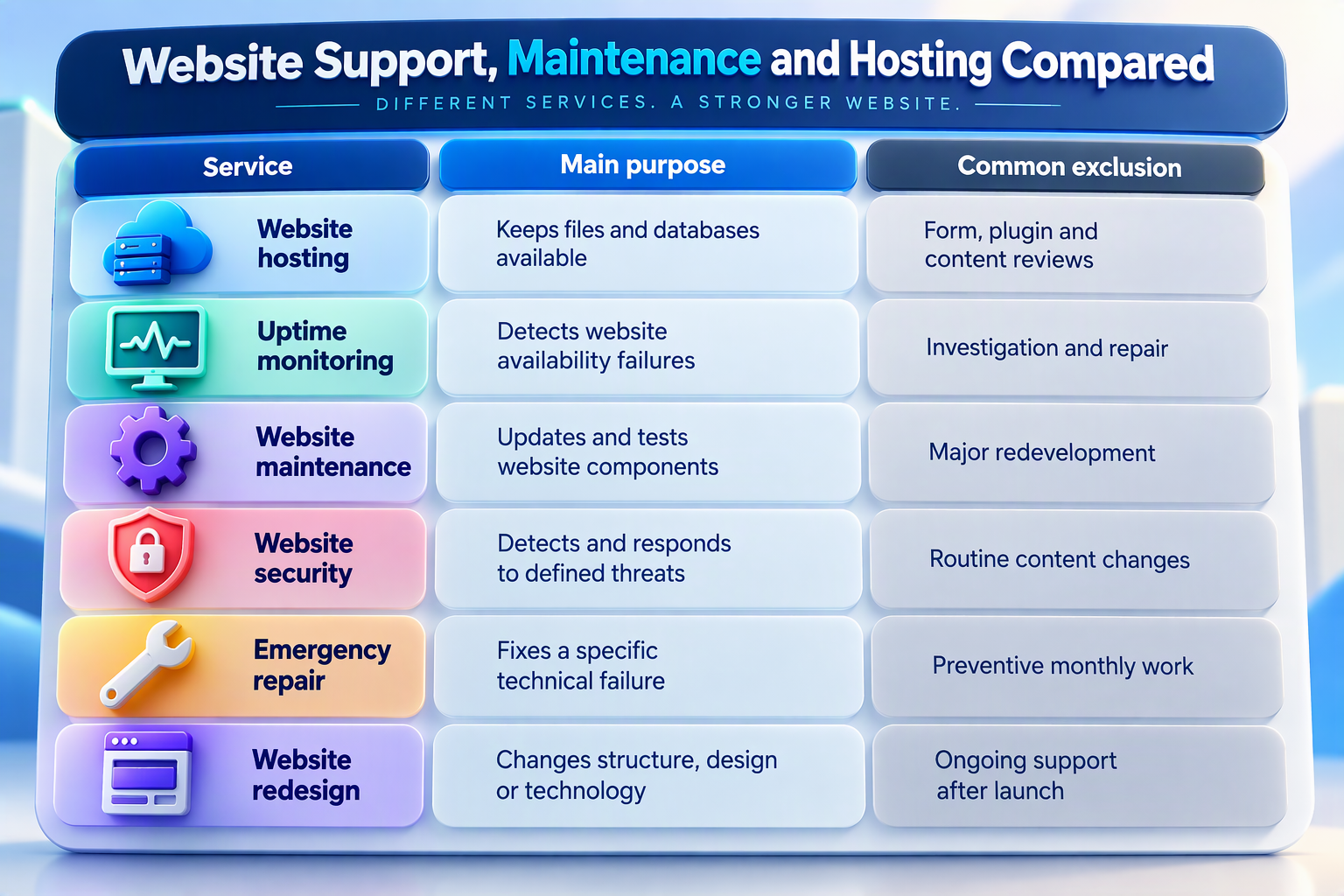
A hosting company may keep the server online without repairing a broken booking form. A maintenance provider may update software without controlling the server resources that affect availability.
The guide to website maintenance and hosting in Australia explains how the two services work together and where responsibilities may overlap.
The 7 Essentials of Website Support Sydney
1. Supported Platforms and WordPress Support
A Sydney website support provider should document every supported platform and important integration. These may include WordPress, WooCommerce, Shopify, payment gateways, booking systems and customer relationship management platforms.
The agreement should separate support from development. Plugin updates, content changes and small repairs differ from custom coding, migration work or a complete website rebuild.
Businesses using WordPress can consider a dedicated WordPress hosting environment when staging, automated backups and platform-specific support are important requirements. Hosting should support WordPress maintenance and troubleshooting rather than replace an ongoing support agreement.
Ask whether the provider supports custom themes, plugins and integrations. General WordPress experience may not be enough for custom code. The provider should also explain how changes are tested before deployment.
2. Sydney Support Hours and Escalation Coverage
A provider should document standard support hours and the timezone used. Sydney businesses should confirm whether those hours follow Australian Eastern Standard Time and Australian Eastern Daylight Time.
Normal requests may use email or a ticket portal. Emergency website support Sydney businesses need should have a separate contact procedure that reaches someone who can investigate the failure.
Urgent incidents may include complete downtime, checkout failure, confirmed malware or loss of administrator access. The provider should define these categories instead of leaving urgency to personal judgement.
After-hours coverage may require a higher plan or separate fee. Confirm the emergency contact method, response target and approval process before an incident occurs.
3. Website Support SLA and Response Targets
A website support SLA should distinguish response time from resolution time. Response time measures how quickly the provider acknowledges and assesses the problem. Resolution time depends on complexity, access and third-party systems.
The example below offers a practical evaluation framework. It does not establish a universal Sydney support standard.
| Severity | Example | Suggested response target | Expected action |
|---|---|---|---|
| Severity 1 | Website unavailable, failed checkout or active compromise | 30 to 60 minutes | Immediate assessment and containment |
| Severity 2 | Form, booking or important integration failure | 2 to 4 business hours | Diagnose and provide an action plan |
| Severity 3 | Localised functional or display problem | One business day | Schedule repair in the support queue |
| Severity 4 | Content change or minor improvement | Two business days | Confirm scope and completion date |
The agreement should state when the response clock starts and pauses. Waiting for approval, credentials or third-party information may pause work. The provider should record each pause in the ticket.
Response targets should match business impact. A failed ecommerce checkout requires faster attention than a small text correction. Buying the fastest response level for every request may create unnecessary cost.
4. Security Response and Account Protection
Website support should include a clear security process. The provider should know who investigates suspicious activity, who approves containment and who communicates with affected stakeholders.
The Australian Cyber Security Centre recommends HTTPS, strong passwords, multi-factor authentication, secure hosting, backups and current software. A serious event may also need reporting through the government’s incident channels. Review the cyber incident-reporting options.
A specialist website security service may provide malware scanning, blacklist monitoring and application-security checks. The business should confirm whether the service includes detection, removal, restoration and post-incident reporting.
The business should own its administrator accounts and recovery information. Support providers should receive named, role-based access. Former employees and suppliers should lose access promptly.
5. Backups and Tested Recovery
A support provider should define which website files, databases and settings each backup includes. The agreement should also state the backup schedule, retention period and storage location.
A successful backup notification does not prove that restoration will work. The provider should test recovery in a protected environment. The test record should identify the backup used, restoration time and missing information.
Businesses with wider continuity requirements can assess cloud backup services. Confirm encryption, covered systems, storage location, retention periods and assisted recovery before selecting a service.
Recovery targets should reflect business impact. A busy online store may need a shorter recovery window than a small information website. The agreement should identify who can authorise a restoration.
6. Hosting, Speed and Technical Coordination
Slow pages and recurring outages may involve hosting, website software or third-party tools. A support provider should investigate the complete environment rather than changing random settings without evidence.
Businesses that have outgrown their infrastructure can compare Australian web hosting services by processing resources, backups, security, scalability and technical assistance. Storage allowances alone do not show whether a plan suits a business-critical website.
Support responsibilities require extra clarity when different companies provide hosting and maintenance. The website support provider may need server logs or configuration changes from the hosting provider.
Performance support should focus on customer journeys. Test enquiry pages, booking flows and checkout screens on mobile and desktop devices. A fast homepage offers little value when customers cannot complete the main action.
7. Reporting, Account Ownership and Exit Arrangements
A useful support report should identify requests received, investigations completed, repairs made and risks still open. A generic statement such as “website checked” provides limited evidence.
The business should own its domain, hosting, analytics, payment services and primary administrator accounts. A provider should receive only the access needed to deliver support.
The website support agreement should explain what happens when the relationship ends. A proper handover protects the business from losing passwords, documentation, backups and technical knowledge.
A structured website design and development process may become necessary when repeated tickets reveal wider problems with old code, poor navigation or unstable integrations. Routine support cannot correct every structural issue.
Local Versus Offshore Website Support
A Sydney-based provider may offer aligned working hours and direct communication. An offshore or distributed team may provide wider coverage or a different cost structure. Neither model automatically delivers better support.
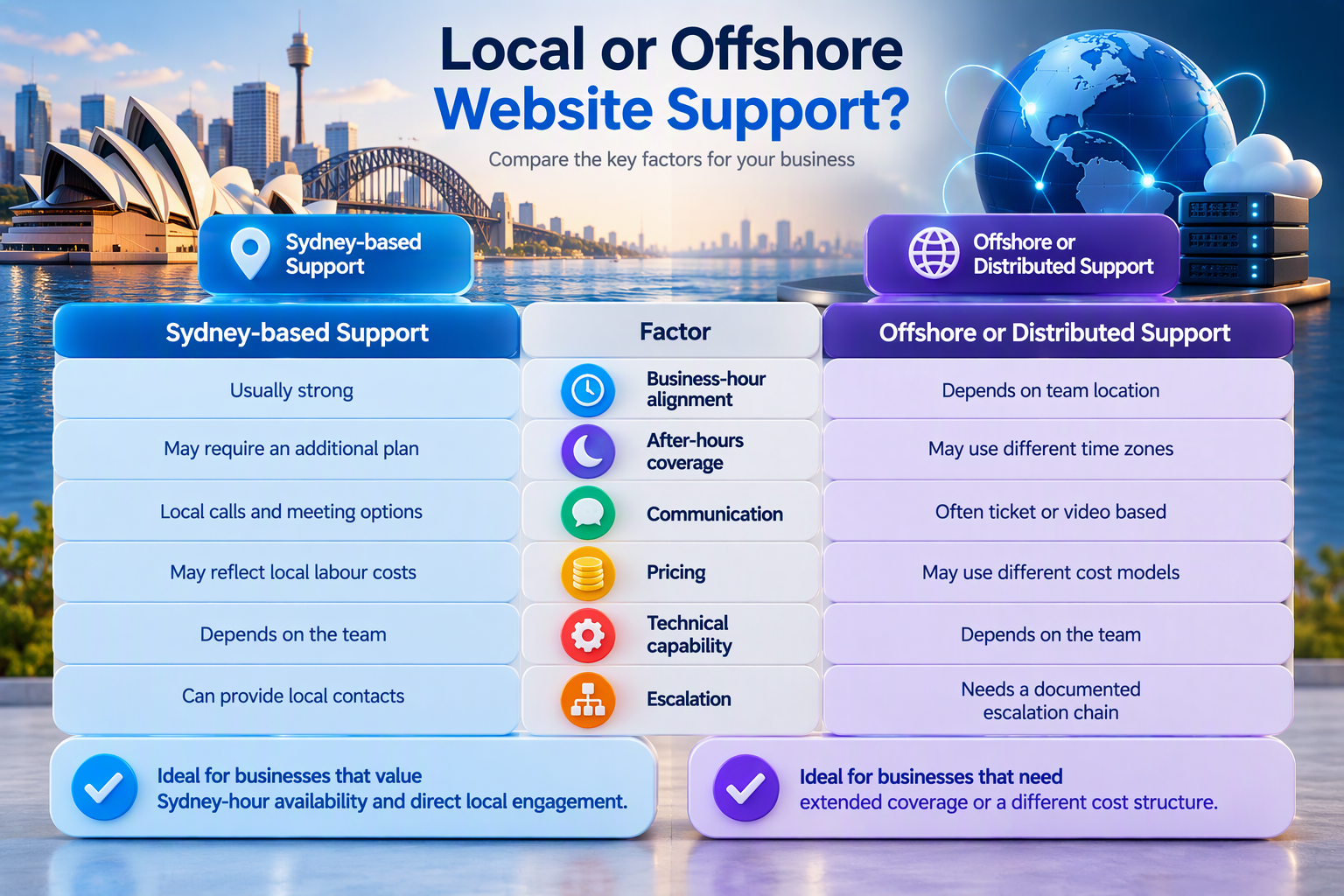
A hybrid model may combine local account management with a distributed engineering team. Ask who completes the work and who owns escalation. The contract should identify the accountable provider.
Location matters when the business needs Sydney-hour availability. Technical skills, evidence and reliable communication remain more important than the office address alone.
One-Off Repair Versus Retained Website Support
One-off repair suits a known and contained problem. Retained support suits businesses that need ongoing maintenance, predictable technical access and faster escalation.
| Support model | Best suited to | Main limitation |
|---|---|---|
| One-off repair | One defined technical problem | No continuing prevention |
| Hourly support | Irregular technical requests | Monthly costs can vary |
| Monthly support | Routine maintenance and minor repairs | Included time may be limited |
| Managed support | Business-critical websites | Higher ongoing commitment |
| Custom agreement | Ecommerce and complex platforms | Requires detailed scoping |
Retained support does not mean unlimited development. The agreement should separate maintenance, minor repairs, project work and emergency charges. It should also explain whether unused time carries forward.
One-off repair may suit a simple and stable website. However, repeated requests can make reactive support expensive. Review the pattern of incidents before selecting a model.
Example Website Support Ticket Lifecycle
The following hypothetical example shows how a Sydney support ticket may progress.
A professional-services business discovers that website enquiries are not reaching the sales inbox. The website still displays a success message, so customers believe that the business received their enquiries.
| Stage | Provider action | Business responsibility | Evidence |
|---|---|---|---|
| Ticket logged | Record form, URL and failure time | Provide examples and business impact | Ticket number |
| Severity assigned | Classify the lead-delivery failure | Confirm affected services | Severity record |
| Investigation | Test form, email and CRM delivery | Provide relevant access | Diagnostic notes |
| Repair | Correct routing or integration | Approve work outside scope | Change record |
| Validation | Complete an end-to-end test | Confirm receipt of the lead | Email and CRM record |
| Closure | Document cause and prevention | Accept result or request follow-up | Closure report |
This lifecycle shows whether the provider merely acknowledged the issue or completed a validated repair. The business can also identify where delays occurred. Each stage needs a clear owner.
A useful ticket record supports future troubleshooting. Similar failures can follow the documented solution, reducing repeated investigation time.
Handover Checklist When Changing Sydney Providers
Changing a provider requires more than sending one password. The outgoing team should transfer access, backups, documentation and current technical information.
Use this handover checklist:
- Transfer domain, hosting and CMS access.
- Provide current backups and recovery instructions.
- Document plugins, themes and key integrations.
- List open incidents, licences and renewal dates.
- Remove old provider access after acceptance.
Set a handover period and assign an internal owner. Do not end the outgoing agreement before the incoming provider confirms access, creates a backup and tests an important website function.
Sydney Website Support Quote Scorecard
Use the same scorecard for every provider. This makes it easier to compare scope, response and total cost instead of marketing language.
| Quote field | Provider A | Provider B | Provider C |
|---|---|---|---|
| Supported platform | |||
| Standard support hours | |||
| Emergency contact method | |||
| Severity 1 response target | |||
| Included repair hours | |||
| Unused-hours policy | |||
| Malware cleanup included | |||
| Backup retention | |||
| Last restoration-test date | |||
| Staging available | |||
| Business owns accounts | |||
| Handover period | |||
| GST-inclusive monthly total |
Record evidence from each written quote or agreement. A verbal promise should not replace a formal support commitment. Ask the provider to clarify every blank field before signing.
Questions to Ask a Sydney Support Provider
Ask these questions before accepting an agreement:
- Which platforms and integrations does the plan support?
- What are the standard Sydney support hours?
- How do staff report a Severity 1 incident?
- What response target applies to website downtime?
- How many repair or development hours are included?
- Does unused support time carry forward?
- Who owns the domain, hosting and analytics accounts?
- How does the provider test backup restoration?
- What information appears in the monthly report?
- What handover assistance applies when support ends?
Clear answers help distinguish an operational support service from a basic update package. Compare responses using the quote scorecard and keep the completed scorecard with the contract.
Website Support Sydney Pricing
Published Sydney website-support prices vary according to scope. Some providers publish monthly starting prices, while others use one-off repair fees or website-specific quotes.
Check whether GST, support hours, development time and emergency work appear in the quoted total. Confirm whether the price is introductory and whether the provider requires a minimum contract period.
A lower-cost plan may rely mainly on automated updates and monitoring. A broader plan may include staging, manual testing, repair time, reporting and emergency escalation.
Request a quote for the actual website. Provide the platform, important integrations, likely request volume and required support hours. Explain the effect that downtime or checkout failure would have on the business.
Common Website Support Mistakes
Assuming Monitoring Includes Repair
Monitoring identifies a failure but may not include investigation or repair. Confirm who acts on each alert and how the provider charges for corrective work.
Treating Hosting as Complete Support
Hosting keeps website infrastructure available. Hosting may not include software updates, form testing, content changes or malware removal.
Accepting Untested Backups
A successful backup notification does not prove recovery will work. Require restoration testing and a dated recovery result.
Selecting a Provider Only by Price
A low monthly fee may exclude manual testing, repairs and emergency support. Compare scope, response targets, escalation and the GST-inclusive total.
Giving the Provider Permanent Ownership
The business should own domains, hosting and analytics accounts. Provider access should remain documented, role-based and removable.
Ignoring Support-Hour Differences
A provider may operate in another timezone or use delayed ticket handling. Confirm technician availability and the process for after-hours incidents.
Quick Facts
| Question | Direct answer |
|---|---|
| Who needs Sydney website support? | Businesses relying on websites for leads, bookings or sales |
| What should support include? | Requests, repairs, maintenance, backups, security and reporting |
| When should emergency support apply? | During downtime, checkout failure or confirmed compromise |
| Who should own website accounts? | The business |
| Does hosting include support? | Not automatically |
| Can support prevent every incident? | No, but support can reduce risk and improve recovery |
| What affects support pricing? | Scope, platform, hours, complexity and response targets |
| What should every quote include? | Support hours, response targets, inclusions and exclusions |
Frequently Asked Questions
What Does Website Support Sydney Include?
Website support may include technical requests, software updates, backups, security checks, troubleshooting, repairs and reporting. The agreement should identify every supported platform, business hours and repair limit.
Is Website Support the Same as Maintenance?
Maintenance forms part of website support. Broader support may include emergency troubleshooting, content assistance, hosting coordination, minor development and technical advice.
How Quickly Should a Support Provider Respond?
Response time should match severity. Complete downtime may justify a 30 to 60-minute response target, while a standard content request may receive a response within one or two business days.
Does Sydney Website Support Include Emergency Repairs?
Only when the agreement states that it does. Confirm the emergency contact method, support hours, response target, additional rate and approval process.
Should a Business Choose a Local or Offshore Provider?
Choose based on capability, coverage, evidence and communication. A Sydney provider may align with local business hours, while a distributed team may provide wider coverage.
Does Hosting Include Website Support?
Not automatically. Hosting keeps the infrastructure online. Website support covers software, customer functions, integrations and technical requests according to the agreement.
What Should a Website Support SLA Include?
A website support SLA should define severity levels, response targets, support hours, escalation contacts, exclusions and reporting. It should distinguish acknowledgement from resolution.
Who Should Own Website Accounts?
The business should own the domain, hosting, analytics, payment services and primary administrator accounts. The provider should receive only role-based access.
How Much Does Website Support Cost in Sydney?
Pricing depends on the platform, response targets, included hours and website complexity. Request a written quote that clearly states GST, emergency rates and included work.
How Does a Business Change Support Providers?
Complete a documented handover covering accounts, backups, licences, integrations, open incidents and technical documentation. Remove the outgoing provider only after the incoming provider confirms access.
Final Thoughts
Reliable website support Sydney businesses choose should provide more than routine software updates. The service needs documented support hours, severity targets, repair boundaries, tested recovery and useful reporting.
Sydney businesses should compare local and offshore providers using the same quote scorecard. This approach reveals differences in emergency coverage, included hours, account ownership and handover support.
The business should retain control of every important system. Written evidence of testing, repairs and recovery reduces confusion when a serious problem occurs.
Review the available website maintenance plans or contact IT Company Australia to discuss Sydney support requirements.