

Two link building and SEO services proposals may promise similar backlink numbers while delivering completely different work. One provider may improve target pages, research relevant publishers and support the campaign with technical SEO. Another may place links on unrelated websites created mainly to sell placements.
Introduction
That difference matters because links are not interchangeable, and link building is only one part of SEO. A relevant editorial reference can help readers discover a useful resource, but it cannot repair inaccessible pages, weak content or serious technical issues.
Australian businesses should assess the complete SEO process rather than compare backlink quantities alone. The provider should explain how technical reviews, content improvements, internal links, outreach and reporting work together.
Google states that links help it find new pages and understand relevance. Google also recommends concise, descriptive anchor text that gives users and search systems useful context about the destination.
This guide presents six checks for evaluating providers in 2026. It also includes a hypothetical Australian campaign scenario showing why an integrated SEO approach may offer more accountability than a bulk backlink package.
Direct Answer: How Should Businesses Evaluate Link Building and SEO Services?
A reliable provider should explain its technical SEO review, target pages, content requirements, publisher standards, outreach methods, paid-placement policy, anchor-text approach and reporting. Avoid proposals that guarantee rankings, hide publishers, rely on automated placements or measure success only through backlink volume.
In This Guide
You will learn how to:
- Assess technical SEO and target-page readiness
- Review publisher relevance and acquisition methods
- Evaluate content and anchor-text controls
- Compare backlink and SEO reporting
- Confirm ownership, exit terms and campaign risks
What Should Link Building and SEO Services Include?
Link building and SEO services should begin with a review of the website’s technical condition, content and search objectives. The provider needs to determine whether search engines can access the target pages and whether those pages satisfy a genuine customer need.
Broader SEO work may include technical audits, keyword research, on-page optimisation, internal linking, content planning and performance reporting. Link building can then support selected pages through publisher research, outreach, digital PR and relevant external references.
A provider should not use backlinks as a substitute for essential website work. Broken internal links, incorrect canonical tags, poor mobile performance or weak content may need attention before external promotion begins.
A broader SEO strategy for Australian businesses can connect technical optimisation, content, local search, backlink activity and reporting. The published service page currently covers on-page SEO, keyword research, backlinks, competitor analysis and reporting.
Link Building Compared With Broader SEO Services
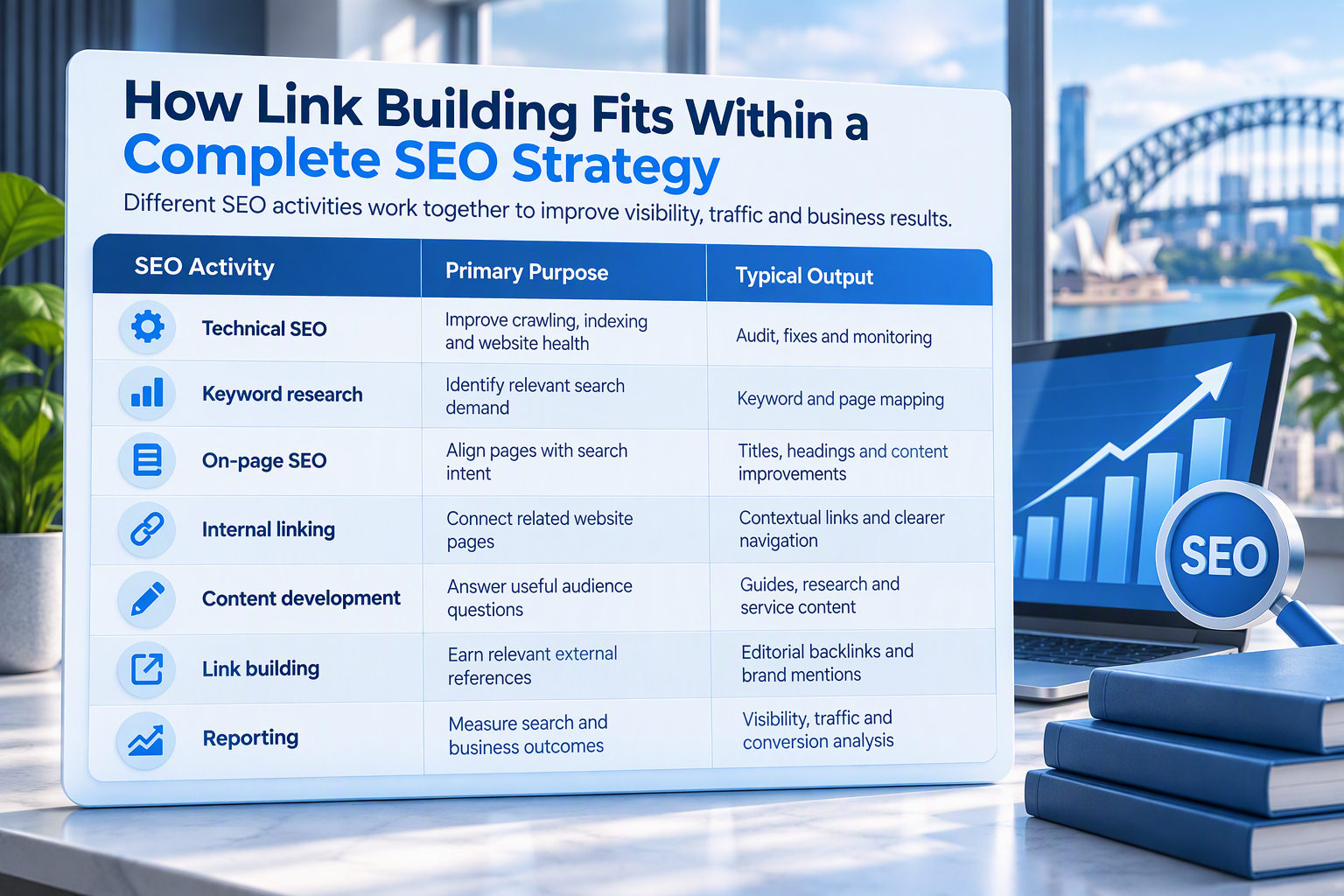
The proposal should state which activities are included. A provider selling backlinks alone should not describe the package as complete SEO unless technical, content and measurement work genuinely forms part of the scope.
Why Provider Evaluation Matters
Third-party SEO platforms assign authority, traffic and risk metrics to websites. However, these figures only support initial research. They do not confirm that a publisher is credible, relevant or capable of reaching the intended audience.
Six Checks for Evaluating Link Building and SEO Services
1. Check the Technical SEO Review and Target Pages
A provider should explain which pages will receive links and why the campaign will target them. First, the provider should identify any technical or content problems that could reduce the campaign’s value.
Questions to Ask
- Has the provider reviewed crawling and indexing?
- Why was each destination page selected?
- Does the page satisfy a clear customer or search need?
- Will technical or content improvements occur before outreach?
- How will visitors move from the page to a useful next step?
2. Review Publisher Relevance and Editorial Standards
A suitable publisher should serve an audience connected with the business, industry or subject covered by the target page. Relevance should be visible across the website’s normal content rather than created through one isolated guest article.
Review recent articles, author information, contact details, outgoing links and subject consistency. A website that publishes unrelated topics every day may exist mainly to sell backlinks rather than serve a stable audience.
Authority metrics should not replace this assessment. They are proprietary estimates that can differ between platforms and should be treated as supporting signals rather than proof of quality.
| Evaluation area | Strong proposal | Warning sign |
|---|---|---|
| Target pages | Explains why each page deserves promotion | Sends every link to the homepage |
| Publishers | Uses relevant, manually reviewed websites | Hides publishers until after payment |
| Editorial context | Places links where they help readers | Inserts links into unrelated paragraphs |
| Audience relevance | Reviews subject and geographic fit | Reports estimated traffic alone |
| Content quality | Uses reviewed, useful articles | Publishes thin or automated content |
| Transparency | Explains commercial arrangements | Refuses to disclose placement methods |
3. Ask How Each Link Will Be Acquired
The provider should describe how opportunities will be researched and how publishers will be contacted. Methods may include digital PR, expert commentary, resource promotion, content partnerships and legitimate business citations.
Generic mass outreach can damage the organisation’s reputation. An outreach message should explain why the resource suits the publication and how the publication’s audience may benefit from it.
Ask whether paid placements form part of the campaign. Sponsored content can be legitimate, but commercial relationships should be disclosed and links should use appropriate attributes.
Promotion can continue through owned channels. Social media management can distribute research to established audiences, while email marketing and CRM workflows can support permission-based communication with existing contacts.
These channels do not automatically generate backlinks. They make useful resources easier to discover, allowing publishers and industry professionals to reference them independently.
4. Examine Content and Anchor-Text Controls
Anchor text is the visible wording within a link. It helps readers and search systems understand the destination before following it.
A natural backlink profile may include business names, page titles, URLs and partial descriptions. Requiring the same commercial keyword across many external placements can make the campaign appear engineered.
Google recommends descriptive, concise anchor text. Excessive wording, empty anchor text and unclear destinations make links less useful for people and search systems.
Publishers should retain reasonable editorial control. A provider may suggest a relevant destination and context, but rigid exact-match anchor requirements across many websites create unnecessary risk.
Professional graphic design and branding support can turn verified research into clearer charts, diagrams and downloadable assets when visual presentation improves understanding.
5. Compare SEO Reporting and Backlink Measurement
A monthly report should show more than the number of backlinks created. It should identify live source URLs, destination pages, anchor wording, placement context and acquisition methods.
Reporting should also cover broader SEO outcomes. These may include resolved technical problems, organic impressions, clicks, referral visits, enquiries and assisted conversions.
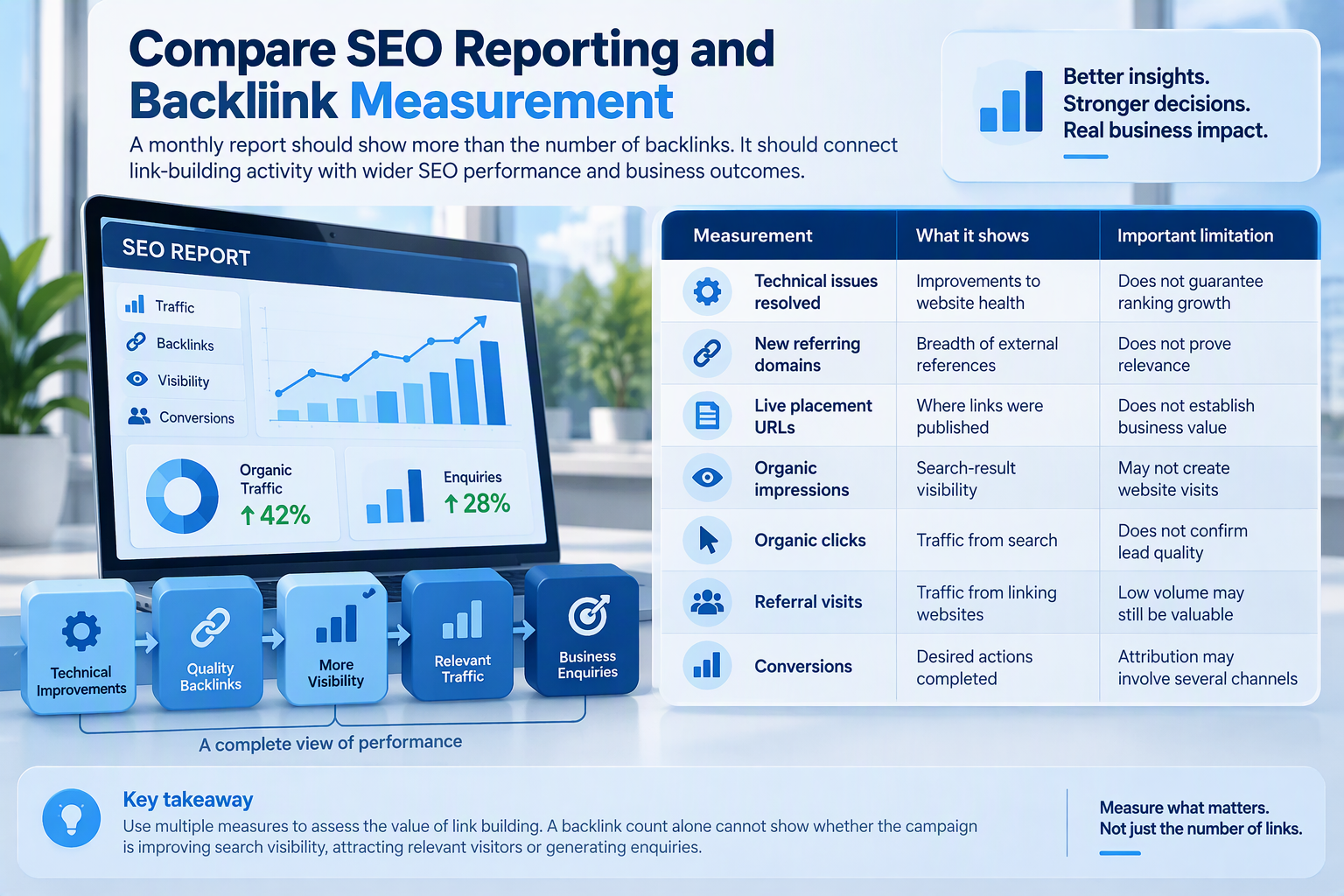
Reports should identify the source of each metric. Google Search Console and third-party platforms can show different figures because they gather and process data differently.
6. Confirm Ownership, Exit Terms and Risk Handling
The business should retain ownership of its website, analytics, Search Console property, content and campaign records. A provider may receive suitable access, but ownership should not depend on the contract continuing.
The agreement should explain what happens when a publisher rejects content or removes a link. Replacement policies need defined limits because an SEO provider cannot permanently control an independent website.
Ask who approves content and verifies factual claims. An incorrect statistic published under the business’s name can create a reputation problem even when the backlink remains active.
Final Contract Checks
- The business retains platform and data ownership
- Paid placements and sponsorships are disclosed
- Content approval responsibilities are documented
- Removed-link and replacement terms are explained
- Cancellation and account handover procedures are clear
Hypothetical Australian Link Building and SEO Services Scenario
This hypothetical scenario shows how two proposals can be compared without assuming that a larger backlink count provides greater value.
An Australian professional-services firm has published a detailed compliance guide. The information is accurate, but the page has weak internal links, limited visual support and no clear route to the related service.
Provider A promises 100 backlinks within one month. The proposal does not include a technical review, does not disclose publishers and reports success through backlink quantity.
Provider B begins with a technical and content review. The proposal recommends improving headings, internal links and the conversion pathway before promoting the guide to relevant Australian publications.
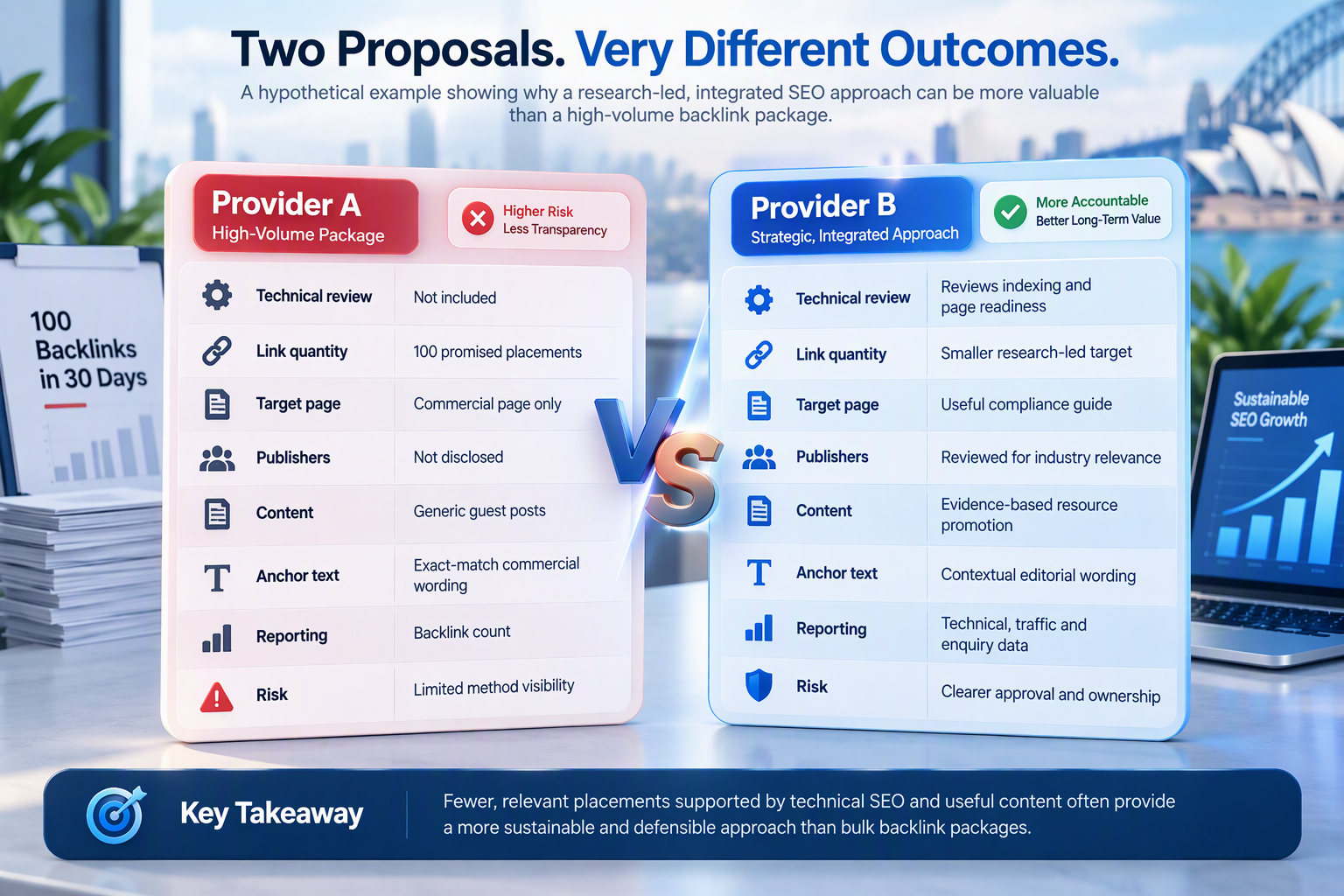
Provider B presents the more accountable proposal despite offering fewer backlinks. The process explains the technical foundation, target page, audience, editorial purpose and measurement approach.
The example does not guarantee ranking improvements. Search performance depends on several factors, and Google’s SEO documentation focuses on making pages easier to crawl, understand and present rather than promising fixed results.
Costs, Timing and Commercial Terms
The cost of link building and SEO services depends on the website’s condition, technical work, content production, publisher research, outreach and reporting.
A campaign requiring original data, new content and website improvements will usually involve more work than promoting an existing guide. Paid publication fees, software subscriptions and design work may also be quoted separately.
The existing SEO service page publishes packages with different backlink, keyword, content and reporting allowances. These are company-specific package details, not universal industry prices or guaranteed outcomes.
No universal result timeframe applies. Competition, website history, technical health, content quality and publisher response rates can all affect progress.
Common Provider-Selection Mistakes
Comparing Backlink Quantities Instead of Methods
Accepting Guaranteed Rankings
Approving Undisclosed Paid Links
Ignoring Target-Page Quality
Giving an Agency Permanent Account Ownership
Measuring Only Authority Scores
Quick Facts
| Question | Direct answer |
|---|---|
| Who should use this framework? | Australian businesses comparing SEO providers |
| What should be checked first? | Technical readiness, target pages and methods |
| What may a complete service include? | Technical SEO, content, links and reporting |
| Where should backlinks appear? | On credible and contextually relevant pages |
| Are paid links always prohibited? | No, but sponsorship needs disclosure |
| Can providers guarantee rankings? | No |
| Who should own Search Console? | The business |
| What is the main risk? | Links created mainly to manipulate rankings |
Frequently Asked Questions
What Do Link Building and SEO Services Include?
They may include technical audits, keyword research, on-page optimisation, content planning, internal linking, publisher outreach and reporting. The exact scope should be documented because some providers sell backlink placements without broader SEO work.
How Do I Compare SEO and Link-Building Providers?
Apply the same framework to each proposal. Compare technical reviews, target pages, publisher standards, acquisition methods, paid-placement policies, reporting, ownership and exit terms.
How Many Backlinks Should a Provider Deliver?
There is no universal target. A suitable number depends on the website, industry, topic, competition and publisher quality.
Are Paid Backlinks Safe?
Advertising and sponsorship are not automatically problematic. Commercial arrangements should be disclosed, and links intended for advertising should use suitable attributes.
What Makes a Backlink Relevant?
A relevant backlink connects related subjects and helps readers find useful information. The publisher’s audience, article context and target page should fit naturally.
How Long Do Link Building and SEO Services Take?
Technical and content work can begin early, while outreach and search effects may take longer. No reliable provider can guarantee the same timeframe for every website.
Who Should Control Search Console?
The business should retain ownership and give the provider suitable access. This makes future handover easier.
What Should an SEO Report Contain?
A report should include technical work, live backlinks, target pages, anchor text, visibility, traffic and relevant conversions. Backlink totals alone are not enough.
Should Low-Quality Links Be Disavowed?
Do not disavow a link only because a third-party tool labels it harmful. Review how the link was acquired, its live context and current Google guidance first.
Final Thoughts
Evaluating link building and SEO services starts with technical readiness, relevant content and transparent methods. In addition, businesses should review publisher standards, paid-placement policies and reporting processes. Consequently, the strongest proposal may offer fewer backlinks but provide greater relevance and accountability. Ultimately, Australian businesses should choose a provider that protects account ownership and avoids guaranteed ranking claims. To discuss an SEO proposal, backlink audit or provider comparison, contact IT Company Australia. The initial assessment can focus on technical readiness, methods, target pages and reporting without promising a specific ranking.
