
A website can appear online while an important function fails behind the scenes. An enquiry form may stop sending messages, a backup may fail silently or an outdated plugin may create a security weakness.
Introduction
Reliable site maintenance services help Australian businesses detect these problems before they interrupt sales, bookings or customer support. However, maintenance should cover more than software updates. It should define who monitors the website, who investigates alerts and who completes repairs.
The Australian Cyber Security Centre recommends multi-factor authentication, software updates and backups as practical security measures for small businesses. Its website guidance also covers HTTPS, administrator access, secure hosting and checks for suspicious activity.
This guide explains seven essential service areas for 2026. It focuses on provider scope, service boundaries and the process from monitoring through investigation, repair, recovery and reporting.
Direct Answer: What Should Site Maintenance Services Include?
Site maintenance services should include software updates, security monitoring, backups, recovery testing, uptime checks, functional testing, performance reviews, content support and reporting. The agreement should also define response hours, repair coverage, exclusions, account ownership and what happens after monitoring identifies a problem.
In This Guide
- Understand seven essential website maintenance service areas.
- Separate hosting, monitoring, maintenance and repair.
- Evaluate support boundaries and response arrangements.
- Compare maintenance-plan inclusions and exclusions.
- Confirm ownership, reporting and exit responsibilities.
What Are Site Maintenance Services?
In this article, site maintenance services mean ongoing technical and operational care for business websites. The term does not refer to physical property, equipment or industrial-site maintenance.
Website maintenance combines preventive work with scheduled testing. Preventive work aims to reduce avoidable failures. Testing confirms that important functions such as forms, bookings and checkout journeys continue to operate correctly.
The verified website maintenance service includes WordPress updates, uptime monitoring, SSL validation, performance checks, backups and reporting. Security, content and backup frequencies vary across its packages, so businesses should review the detailed scope.
A maintenance contract should not rely on broad phrases such as “complete care”. It should state which platforms the provider supports, which functions receive manual testing and which repairs require separate approval.
Why Australian Business Websites Need Ongoing Support
Many Australian businesses rely on websites for enquiries, appointments, payments and customer information. A technical problem can affect revenue even when the homepage remains visible.
Regular website support creates a defined process for detecting and resolving failures. It also provides records of updates, alerts, testing and corrective work, which can help technicians trace the cause of later problems.
Australian Government guidance advises website owners to update software, maintain backups, secure administrator access and review websites for suspicious activity. These controls can reduce risk, although no maintenance service can guarantee zero downtime or prevent every cyber incident.
Maintenance also protects information quality. Customers may lose confidence when a website displays outdated prices, expired offers, former employees or incorrect opening hours.
Site Maintenance Services Compared With Hosting and Repair
Hosting, monitoring, maintenance and repair perform different functions. A business may purchase them from one provider, but the agreement should still identify where each responsibility begins and ends.
Website support services and their usual boundaries
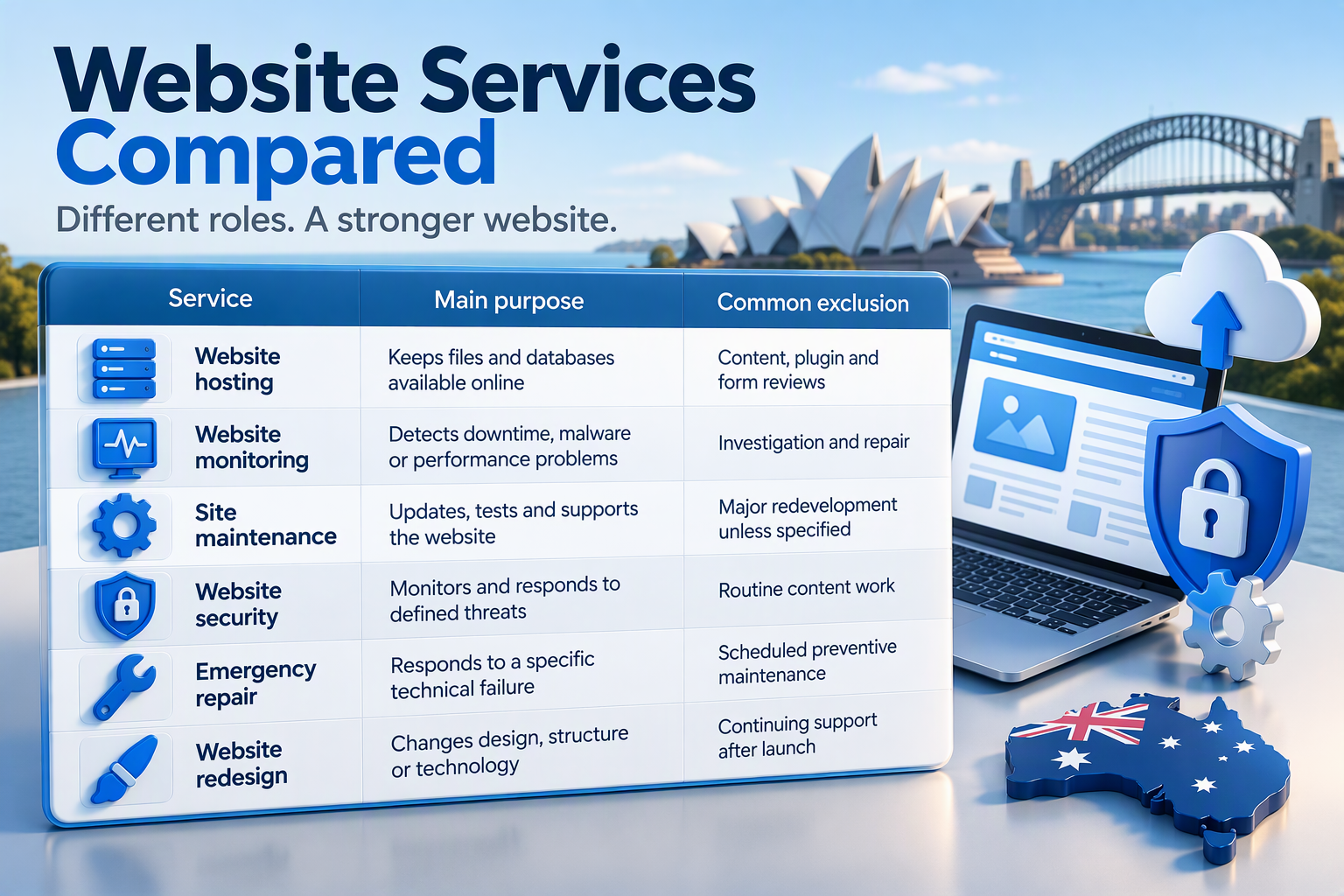
The most important question is not simply whether monitoring exists. The business must know who investigates the alert, who authorises the repair, how recovery works and what the provider reports afterwards.
The 7 Essential Site Maintenance Services
1. Website and WordPress Maintenance
Modern websites depend on content management systems, themes, plugins and third-party integrations. Each component can change over time and may create compatibility or security issues.
A provider should review updates before installation, create a current backup and test significant changes. After updating the software, the technician should inspect important pages, forms and integrations.
Businesses running WordPress can consider a dedicated WordPress hosting environment when staging, platform-specific support and automated backups are important requirements. Hosting should support WordPress maintenance rather than replace it.
The agreement should explain whether the provider tests updates on staging, how quickly the live website receives security releases and what happens when an update creates a conflict.
2. Security Monitoring and Account Protection
Website security requires account controls, software updates, monitoring and incident procedures. Installing one security plugin does not establish a complete protection process.
The maintenance provider should review privileged accounts, failed logins, suspicious files, unexpected redirects and unapproved content changes. The business should remove former staff and suppliers from every connected platform.
The Australian Cyber Security Centre recommends HTTPS, multi-factor authentication, strong access controls, backups and current software. Its guidance also identifies malware, website defacement and data breaches as relevant website threats.
A specialist website security service may add malware scanning, blacklist monitoring and application-level checks. Businesses should confirm whether the plan covers detection only or also includes cleanup, restoration and incident reporting.
3. Website Backups and Recovery Testing
A backup is useful only if the business can restore it successfully. The provider should protect the website files, database and relevant configuration data.
At least one suitable backup should remain separate from the live server. Otherwise, a compromised hosting account or server failure may affect both the website and its recovery copy.
A backup service should define frequency, retention, storage location and restoration support. The team should test recovery periodically and document the result, time required and any missing information.
Businesses with broader continuity needs can review cloud backup services. Before selection, confirm which systems the service covers, how long it retains copies and whether it includes assisted recovery.
4. Uptime, Hosting and Performance Support
Uptime monitoring should send alerts to people who can investigate the incident. An alert sent to an unattended inbox provides limited protection.
The maintenance provider should examine recurring timeouts, database failures and server errors. Several short outages may indicate limited hosting resources, unstable software or an unsuitable configuration.
Performance reviews should focus on useful customer journeys. Technicians should test service pages, forms, bookings and checkout functions on mobile and desktop devices.
Businesses that have outgrown their infrastructure can compare Australian web hosting services by capacity, security, backups and support. Storage allowances alone do not show whether a hosting package suits a business-critical website.
5. Forms, Checkout and Integration Testing
A website can remain online while its most important function fails. Regular testing should cover enquiry forms, bookings, account registration, payments and internal notifications.
Each test should confirm the customer-facing result and the internal data path. For example, the business should confirm that a submitted form reaches the intended inbox and appears in the connected CRM.
The provider should also test invalid entries and error messages. Visitors need clear instructions when a field is incomplete or a transaction fails.
Routine maintenance may not solve repeated failures caused by old code or poor architecture. A structured website design and development process can address broader issues involving navigation, integrations and responsive behaviour.
6. Content, Link and Search Maintenance
Website maintenance also covers information quality. Review service details, team profiles, opening hours, locations, prices and downloadable files on an agreed schedule.
Broken links interrupt customer journeys and can hide useful information. The provider should repair incorrect internal links and apply relevant redirects when important pages move.
Google Search Console helps website owners review search traffic, indexing, sitemaps and individual URLs. The platform also provides alerts and URL Inspection information for identified issues.
A broader SEO service for Australian businesses may support keyword research, technical SEO and content optimisation. Maintenance should still confirm that priority pages remain accurate, accessible and indexable.
7. Reporting, Repair and Website Support
A useful maintenance report should explain what the provider checked, what changed and which risks remain unresolved. A statement such as “all systems updated” provides limited operational evidence.
The report should cover updates, backups, uptime, security findings, functional tests and completed repairs. It should also identify recommendations that need business approval or additional budget.
A maintenance plan should define response hours and repair coverage. Businesses should ask whether the provider investigates every alert, how urgent incidents receive priority and when additional charges apply.
The business should retain ownership of its domain, hosting, analytics and administrator accounts. The provider should receive controlled access that the business can remove when the agreement ends.
The Monitoring-to-Recovery Responsibility Framework
Many maintenance agreements define monitoring but say little about the work that follows. Businesses should use the framework below to identify operational gaps before a website incident occurs.
Responsibilities after a website alert.
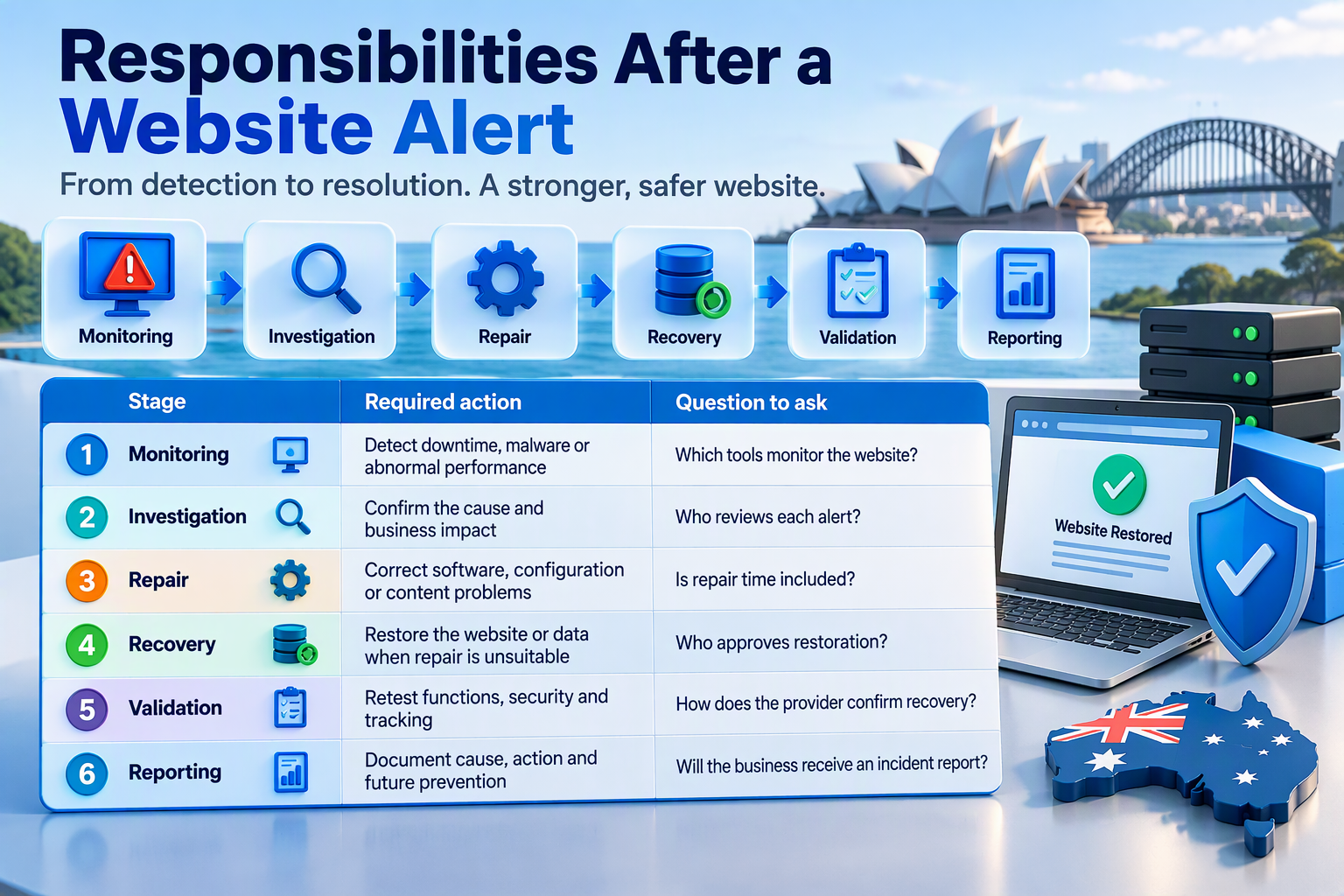
This framework protects the article’s distinct purpose. The dedicated website maintenance checklist explains how to perform recurring tasks, while this guide helps businesses evaluate service boundaries and support responsibilities.
Recommended Site Maintenance Schedule
The correct schedule depends on website traffic, functions and risk. An ecommerce platform usually needs closer monitoring than a small information website.
Suggested site maintenance frequency
| Frequency | Service activity | Typical owner |
|---|---|---|
| Continuous or daily | Uptime, malware, payment and backup monitoring | Automated tools with technical oversight |
| Weekly | Updates, forms and customer-journey checks | Website administrator |
| Monthly | Performance, links, content and search health | Marketing and technical teams |
| Quarterly | Recovery, permissions and integration review | Business owner and provider |
| Annually | Hosting, domain, licences and full scope review | Business owner and relevant advisers |
The provider should adapt this schedule to the website rather than apply one timetable to every client. The agreement should also explain whether checks occur automatically, manually or through both methods.
What Should a Maintenance Plan Define?
A maintenance plan should state what the provider monitors, updates, tests and repairs. Businesses should request written exclusions as well as inclusions.
Confirm the platforms covered, backup schedule, security response, support hours and content allowance. The plan should also explain whether major repairs, malware cleanup and development work attract additional charges.
Site maintenance agreement review
| Agreement area | What to confirm | Risk if unclear |
|---|---|---|
| Updates | Platforms and testing process | Failed or incompatible changes |
| Backups | Frequency, retention and recovery tests | Unusable recovery data |
| Security | Detection, cleanup and incident response | Alerts without action |
| Repairs | Included time and additional rates | Unexpected charges |
| Support | Hours, priority and escalation | Delayed incident response |
| Reporting | Evidence, risks and recommendations | Limited accountability |
| Exit process | Access, data and account handover | Loss of operational control |
Common Scope Mistakes to Avoid
Assuming Monitoring Includes Repairs
Monitoring identifies a problem but may not include investigation or repair. Confirm what happens after each alert and how the provider charges for corrective work.
Treating Hosting as Complete Website Support
Hosting keeps the website available online. It may not include updates, form testing, content changes, malware cleanup or recovery exercises.
Accepting Untested Backups
A completed backup notification does not prove recoverability. The maintenance plan should include scheduled restoration tests and documented results.
Giving the Provider Permanent Ownership
The business should own domains, hosting and analytics accounts. Provider access should remain permission-based, documented and removable.
Costs, Contracts and Commercial Risks
Australian site maintenance pricing varies because providers include different levels of automation, technician time, content support and urgent response. A lower fee may exclude manual testing, repair work or incident recovery.

The published IT Company Australia maintenance page lists different backup schedules, content allowances and security features across its plans. These package details apply to that provider and do not represent a regulated market rate.
Businesses researching cost ranges should read the separate Australian website maintenance pricing guide. That article owns pricing intent and explains factors affecting maintenance budgets.
A quote should identify monthly fees, urgent support rates, software costs and paid third-party services. It should also state whether unused support time expires or carries forward.
Quick Facts
Site maintenance services quick facts
| Question | Direct answer |
|---|---|
| What are site maintenance services? | Ongoing website updates, testing, monitoring and support |
| Who needs them? | Businesses that depend on a website for information, leads or sales |
| Does monitoring include repair? | Only when the agreement says it does |
| Does hosting include maintenance? | Not necessarily |
| Should providers test backups? | Yes, through documented restoration checks |
| Who should own the domain? | The business |
| What affects the price? | Website complexity, support hours, inclusions and repair coverage |
Frequently Asked Questions
What Do Site Maintenance Services Include?
They may include software updates, backups, security monitoring, uptime checks, functional tests, performance reviews, content support and reporting. The written agreement should define the exact scope.
Are Site Maintenance Services the Same as Hosting?
No. Hosting provides the infrastructure that keeps the website online. Maintenance supports the website’s software, functions, information and technical health.
Does Monitoring Include Investigation and Repair?
Not automatically. Some services send alerts only, while broader plans include investigation and limited repair time. Confirm this distinction before choosing a package.
How Often Should Website Maintenance Occur?
Monitor critical systems continuously. Complete software and functional checks weekly or monthly, then review recovery, access and integrations quarterly.
What Does WordPress Maintenance Include?
WordPress maintenance may cover core, theme and plugin updates, backups, security, staging tests and database care. Inclusions vary between providers.
Can Site Maintenance Services Prevent Every Incident?
No. Maintenance can reduce avoidable risks and improve recovery, but no provider can guarantee that a website will never fail or face an attack.
Should a Provider Own the Website Accounts?
No. The business should retain ownership of domains, hosting, analytics and important administrator accounts. Give the provider controlled access.
What Should a Maintenance Report Show?
The report should show updates, backup status, uptime, security findings, tests, repairs and unresolved risks. It should also identify decisions required from the business.
How Much Do Site Maintenance Services Cost?
Pricing depends on platform, website complexity, support hours and repair coverage. Request a written quote based on the real website and required response level.
Final Thoughts
Reliable site maintenance services should protect the website functions that customers and staff use every day. Effective support combines updates, tested backups, security checks, customer-journey testing and accountable reporting.
Australian businesses should separate hosting, monitoring, investigation, repair and recovery when reviewing a maintenance plan. Unclear service boundaries can leave a website monitored but still unsupported when a real incident occurs.
The business should retain account ownership and require written support responsibilities. The agreement should define task frequency, response hours, repair coverage, recovery procedures and handover arrangements.
Review the available website maintenance plans or contact IT Company Australia to discuss the website’s platform, functions and support needs. The consultation should define operational risks before selecting a package.