

A business website continues to create costs after launch. Software updates, backups, performance checks, security monitoring and technical support require time, suitable tools and, in many cases, specialist assistance.
Introduction
Understanding website maintenance cost Australia pricing helps businesses create a realistic operating budget. Monthly fees vary because providers include different levels of manual support, content work, security monitoring and emergency assistance.
A basic package may rely mainly on automated updates and backups. A more comprehensive plan may include staging, manual checks, content allowances, detailed reporting and support for complex website functions.
This guide focuses on Australian maintenance pricing in 2026. It explains common cost ranges, factors affecting quotes, support models, possible additional expenses and the questions businesses should ask before choosing a plan.
Direct Answer: How Much Does Website Maintenance Cost in Australia?
Basic website maintenance may cost around $30 to $180 per month, while managed support for many small-business websites generally falls between $100 and $600 per month. Complex e-commerce and business-critical websites can require considerably larger maintenance budgets.
These ranges come from Australian commercial pricing guides rather than a regulated industry standard. One 2026 guide reports a range starting near $30 and exceeding $1,000 per month, while other providers place many small-business plans between $90 and $600 per month.
In This Guide
You will learn:
- What businesses generally receive at each price level
- Which factors increase monthly maintenance costs
- How packages compare with hourly and in-house support
- Which expenses may sit outside a maintenance agreement
- How to compare quotes without paying for unnecessary features
What Is Website Maintenance?
Website maintenance covers the ongoing work required to keep a website current, functional and recoverable. Common tasks include software updates, backups, uptime monitoring, security checks, form testing, broken-link repairs and minor content changes.
Maintenance differs from hosting. Hosting provides the server infrastructure that makes the website available online, while maintenance looks after the website, software and customer-facing functions running on that infrastructure.
A written agreement should identify the exact maintenance tasks and their frequency. Broad expressions such as “complete website care” do not explain whether someone will test enquiry forms, restore backups or investigate failed updates.
Why Website Maintenance Requires a Budget
A website can appear normal while an important function has stopped working. A form may no longer send notifications, an expired integration may block bookings, or an automatic backup may fail without creating a visible warning.
Planned maintenance protects the earlier investment in website design and development. Updates, testing and monitoring help the completed website continue operating as intended after launch.
Australian government cyber guidance recommends keeping software updated, using multi-factor authentication and backing up important business data regularly. These actions reduce common security risks and support recovery when something goes wrong. Maintenance cannot guarantee that a website will never fail or face an attack. However, a suitable plan can improve detection, clarify responsibility and reduce the time spent identifying recoverable problems.
Website Maintenance Cost Australia: 2026 Price Ranges
Australian prices vary because the term “maintenance” can describe anything from automated software updates to a managed service with staging, manual testing, content work and priority response.
The following figures combine ranges published by several Australian providers. They offer planning context only and should not replace a written quote based on the condition and complexity of the actual website.
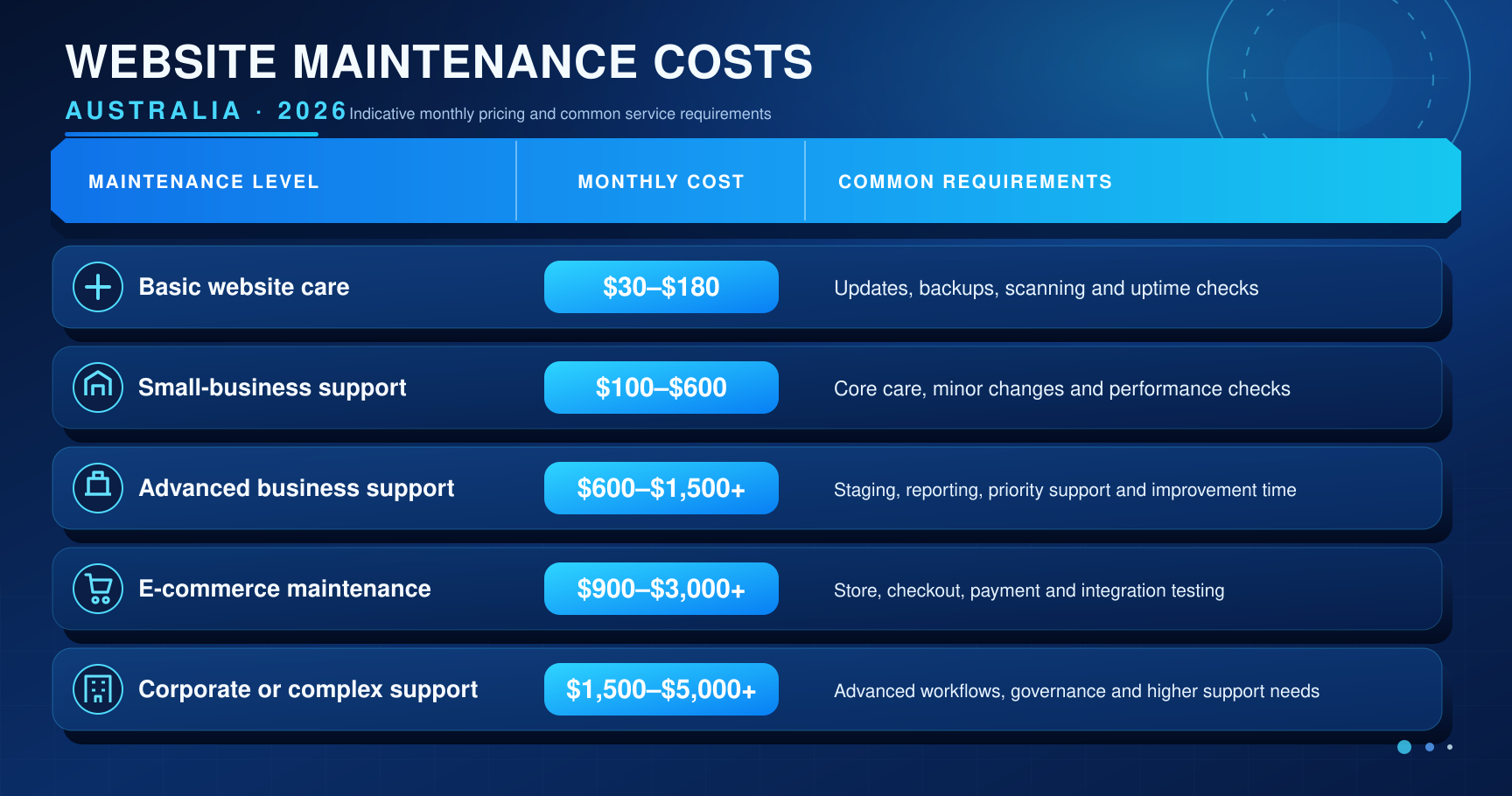
A package at the lower end may depend heavily on automation and include limited technician time. A higher price may reflect staging, manual checks, content changes, detailed reporting or faster support arrangements.
Businesses should confirm whether GST, hosting, premium licences and emergency repairs are included. These items may remain separate even when a package is described as comprehensive.
What Should a Website Maintenance Package Include?
A maintenance package should explain which tasks will be completed, how often they will occur and what happens when a problem is found. The agreement should also show any monthly support or content allowance.
The available website maintenance service includes different combinations of WordPress updates, uptime monitoring, SSL validation, backups, vulnerability scanning, content changes and reporting. Inclusions and backup frequency vary between its Standard, Business and Premium levels.
A practical plan may include:
- CMS, theme and plugin updates
- Website and database backups
- Uptime, SSL and security monitoring
- Form, link and performance checks
- A defined allowance for minor content changes
Businesses should ask whether updates are tested before deployment. Staging and rollback procedures may be particularly important when the website includes payments, bookings, memberships or business-critical integrations.
Factors That Affect Website Maintenance Pricing
Website Size and Complexity
A small information website generally requires less work than an online store containing hundreds of products, customer accounts and payment features. More templates and functions create more items that need testing after updates.
Complexity can matter more than page count. A compact booking site connected with several external systems may require greater technical oversight than a large but static information website.
Website Platform and Software
WordPress maintenance can include the core platform, themes, plugins, hosting environment and database. Shopify, Wix and other managed platforms control more infrastructure, but businesses still need application, content and functionality checks.
Custom websites may require a developer familiar with the original code or framework. Missing documentation and unsupported technology can increase investigation and repair costs.
Integrations and E-commerce Functions
Online stores need testing across product pages, checkout, payments, transaction emails and shipping functions. CRM, booking, membership and accounting integrations add dependencies beyond the website itself.
A third-party provider may change an API, authentication method or subscription condition. The maintenance agreement should explain whether integration repairs are included or treated as separate development work.
Security and Recovery Requirements
A simple brochure website may need routine monitoring and backups. A website collecting personal information or processing payments may require stricter access controls, more frequent backups and a clearer recovery procedure.
Routine maintenance may include security scanning without covering malware removal or incident response. Businesses needing extra monitoring or recovery support can assess website security services as a separate requirement.
Content and SEO Work
Some plans cover technical maintenance only. Publishing articles, replacing images or building new pages may use a separate allowance or hourly rate.
Technical maintenance supports website reliability but does not replace active search marketing. Keyword research, content planning and broader optimisation should be assessed under a separate SEO services strategy.
Monthly Packages, Hourly Support or In-House Maintenance?
A monthly package can suit an active business website that needs predictable monitoring and support. The agreement should clarify whether unused content or support time carries into the next month.
Hourly assistance may suit a stable, low-risk website requiring occasional work. Australian commercial guides place standard ad hoc development support at approximately $90 to $200 per hour, with some estimates reaching $250 for specialist or urgent work. These are market observations, not verified IT Company Australia rates.
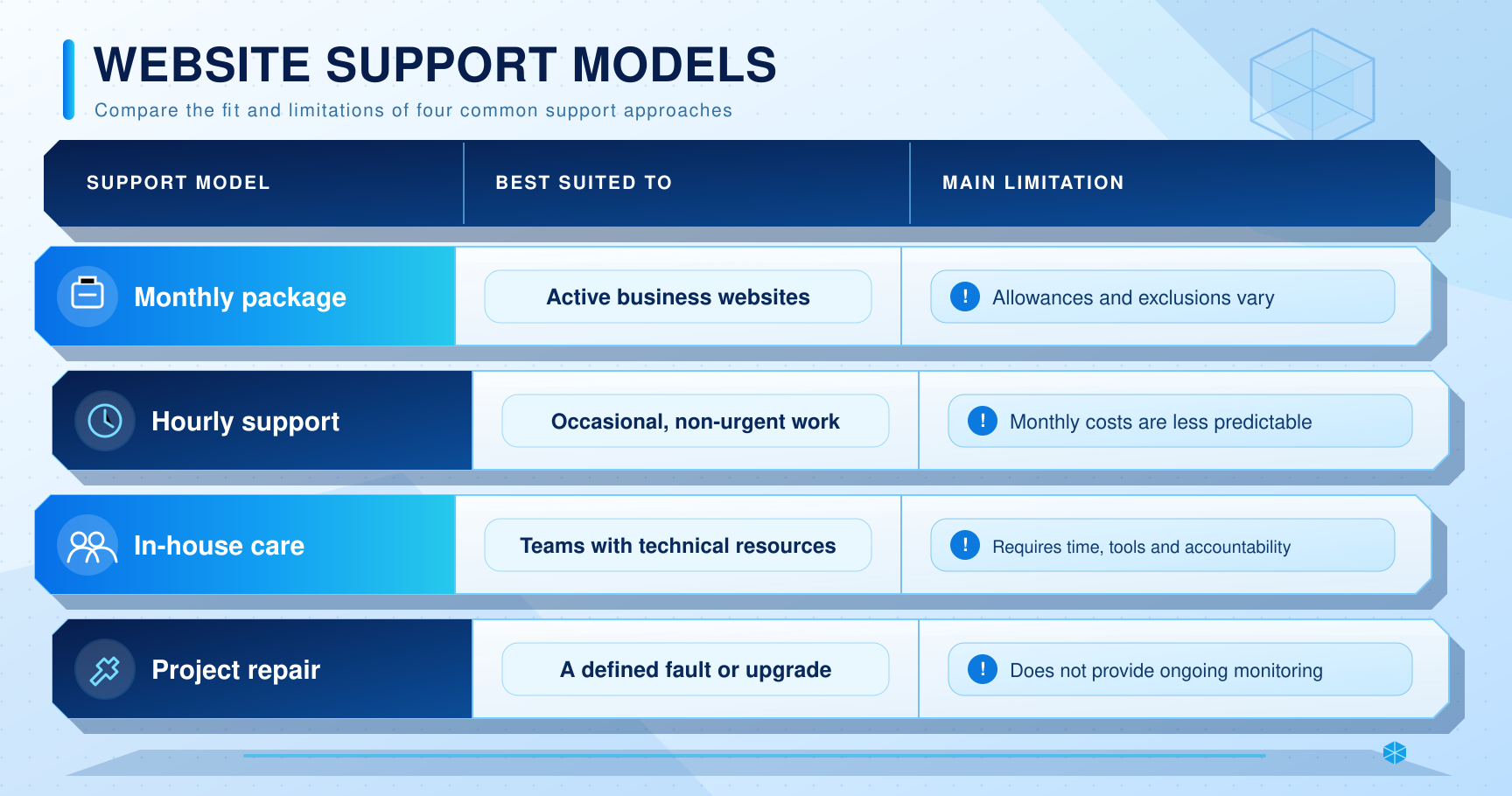
In-house work may reduce supplier fees, but the business still needs suitable skills, access controls and backup procedures. Assigning maintenance to an employee without time or training can create a false sense of protection.
Hosting and Maintenance Are Different Costs
Web hosting stores the website and makes it accessible online. Maintenance covers the updates, testing, monitoring and technical work required to keep that website operating.
A hosting plan may include server backups, SSL or infrastructure security without covering CMS updates, broken forms or content changes. In the same way, a maintenance provider may charge separately for hosting, domains and premium software licences.
Businesses can compare Australian web hosting services when preparing the total operating budget. Published hosting features should not be presented as website maintenance inclusions unless the selected agreement expressly combines both services.
The annual website budget may need to include:
- Website maintenance
- Web hosting and domain renewal
- Premium plugins or application licences
- Specialist security and recovery work
- Major content or development changes
Local Website Maintenance Across Australia
Businesses that prefer a location-based point of contact can view the approved map for ITCompany Sydney. Before selecting support, confirm whether maintenance is delivered remotely, onsite or through a combination of both.
Businesses searching for ITCompany Melbourne should confirm response arrangements and whether emergency work falls within normal support hours. Most updates and monitoring can occur remotely, but any requirement for onsite assistance should appear in the written scope.
A business considering ITCompany Brisbane support should document its website platform, hosting provider, existing faults and important integrations. This information helps determine whether routine maintenance is sufficient or additional development is required.
Organisations reviewing ITCompany Perth availability should ask about support hours and escalation procedures. Time-sensitive arrangements become more important when a website processes enquiries, bookings or transactions outside eastern-state business hours.
How to Compare Website Maintenance Quotes
Businesses should compare scope before comparing monthly prices. A low-cost automated plan and a managed support service may use similar package names while providing very different levels of work.
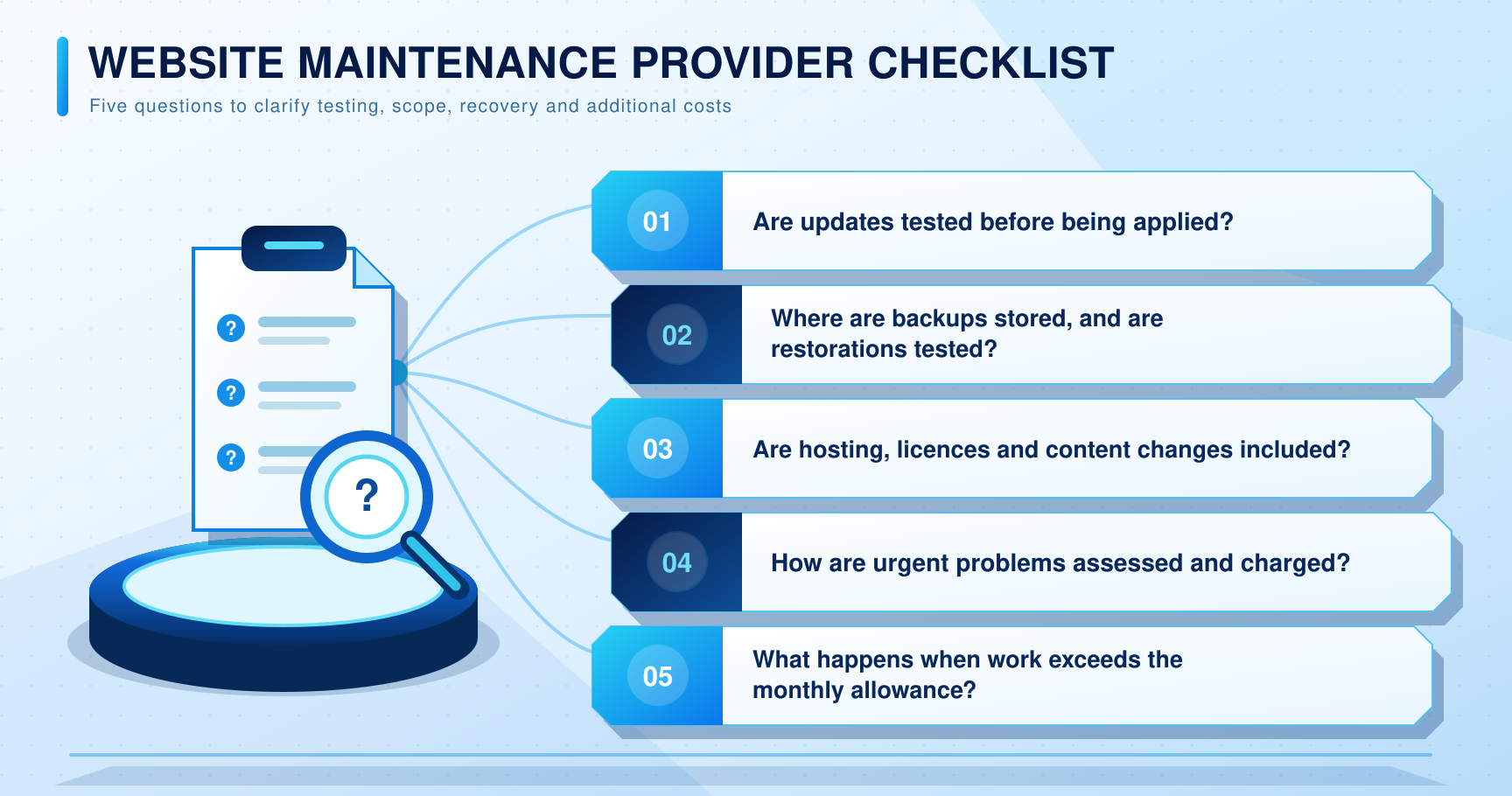
The business should retain suitable access to its domain, hosting, CMS and backups. Ownership and transition conditions should be documented before the service begins.
Common Website Maintenance Pricing Mistakes
Selecting the Lowest Price Without Checking Inclusions
A low monthly fee may cover automatic updates without manual testing or repairs. Businesses should compare responsibilities, support allowances and exclusions rather than package names.
Assuming Hosting Covers Website Maintenance
Hosting can keep a server online without maintaining the website application. Confirm whether software updates, form testing, content support and repairs sit outside the hosting plan.
Buying More Support Than the Website Needs
A small information site may not require enterprise monitoring or large content allowances. The plan should match the website’s current complexity and commercial importance.
Ignoring Emergency Repair Conditions
Some plans detect problems but charge separately to resolve them. Response targets, hourly rates and after-hours conditions should be clear before a serious incident occurs.
Treating Backups as Complete Protection
A backup is useful only when it remains accessible and can be restored. Businesses should ask about backup location, frequency, retention and restoration testing.
Forgetting Software Renewal Costs
Premium themes, plugins and integrations may renew annually. The agreement should show who owns each licence and who is responsible for renewal.
Reducing Maintenance Costs Without Increasing Risk
Businesses can reduce unnecessary maintenance work by choosing supported software and removing unused plugins or integrations. Every additional component introduces another update, licence and potential compatibility issue.
Content changes can be submitted in organised batches rather than through frequent small requests. Staff accounts should also be reviewed so former users are removed and active team members receive only the permissions required for their roles.
Cost reduction should not involve removing backups, software updates or account security. Australian Signals Directorate guidance recommends multi-factor authentication, automatic software updates and regular backups for small businesses.
Quick Facts
| Question | Direct answer |
|---|---|
| What is the broad monthly range? | Around $30 to $5,000+, depending on complexity |
| What might a small business pay? | Commonly around $100 to $600 per month |
| Are hosting and maintenance identical? | No, they are separate services |
| What should basic care cover? | Updates, backups, monitoring and functional checks |
| Do e-commerce sites usually cost more? | Yes, because more functions require testing |
| Is hourly support suitable? | Yes, for occasional, lower-risk work |
| What may cost extra? | Repairs, licences, hosting and major content work |
| Should backups be tested? | Yes, restoration should be verified |
Frequently Asked Questions
How much should a small business pay for website maintenance?
Many Australian pricing guides place small-business website maintenance between approximately $100 and $600 per month. The final amount depends on the platform, website functions, support allowance and security requirements.
Does a website require maintenance every month?
Most business websites benefit from monthly oversight. Backups, uptime checks and security monitoring may operate more frequently, depending on how often the website changes.
Is hosting included in maintenance?
Not always. Some providers combine hosting and maintenance, while others price them separately. Request an itemised quote showing hosting, maintenance, licences and extra support.
What does WordPress maintenance include?
WordPress maintenance commonly covers core, theme and plugin updates, backups, security checks, uptime monitoring and form testing. Advanced packages may add staging, performance work and content changes.
Can a business handle maintenance internally?
Yes, when someone has suitable skills, time and access. The business still needs reliable backups, monitoring, security controls and a documented recovery process.
Why does e-commerce maintenance cost more?
An online store contains more functions to test, including products, checkout, payments, shipping and customer emails. Technical failures can also interrupt revenue directly.
Are website repairs included?
That depends on the agreement. Minor changes may fit within a monthly allowance, while malware removal, major upgrade conflicts and new development may require separate quotes.
How often should backups run?
Backup frequency should reflect how often important data changes. An active store may require frequent backups, while a mostly static information site may need them less often.
Final Thoughts
The website maintenance cost Australia businesses should budget for depends on website complexity, operational risk and support expectations. A small information site may need modest monthly care, while an online store or integrated corporate platform requires more testing and monitoring.
Price alone does not show whether a package offers suitable value. Businesses should compare update processes, backup testing, security monitoring, content allowances and repair exclusions before selecting a provider.
The total operating budget should also account for hosting, domains, premium licences and specialist repairs. Clear ownership, reporting and escalation arrangements help prevent important tasks from being overlooked.
To discuss the website platform, current condition and required support level, contact IT Company Australia. The initial discussion should focus on technology, business-critical functions and support expectations rather than a predetermined package.
