

A fast and reliable website is essential for doing business online. Australian customers expect websites to load quickly, online stores to work smoothly and digital services to remain available when they need them.
Shared hosting can be a practical starting point for a small website. However, it may become limiting as website traffic, products, applications and business requirements grow.
This is why many organisations are moving to professional VPS hosting services. A Virtual Private Server provides more control, predictable resources and room for growth without the cost of using an entire dedicated server.
Choosing the best VPS hosting is not only about finding the cheapest plan. You should also consider website performance, server security, technical support, scalability, backups and server location.
This guide explains how to compare the best VPS hosting Australia solutions and choose one that matches your website and business needs.
What Is VPS Hosting?
VPS stands for Virtual Private Server.
A physical server can be divided into several separate virtual environments. Each VPS receives an allocated amount of CPU, RAM and storage.
This is different from shared hosting, where many websites use the same pool of server resources. If one website on a shared server uses too many resources, it may affect the performance of other websites.
A VPS still shares physical hardware with other virtual servers. However, each virtual environment operates separately and has its own allocated resources.
This can give your website better stability, more control and greater flexibility. For growing Australian businesses, virtual private server hosting provides a useful middle option between shared hosting and dedicated hosting.
Why Are Businesses Moving to VPS Hosting?
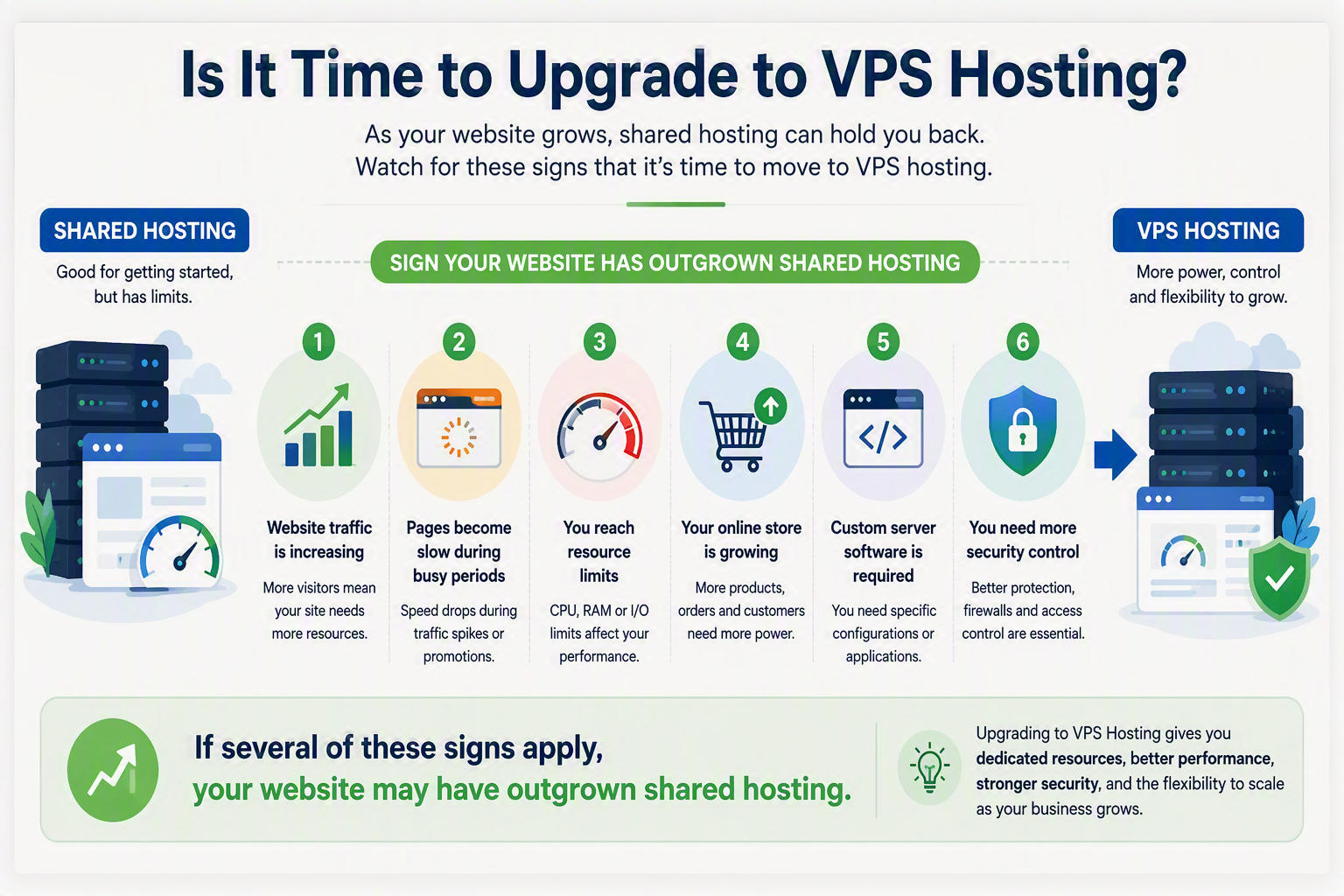
A website usually needs more resources as it grows. An ecommerce store may add more products and customers, while a service business may attract more visitors through SEO, social media or paid advertising.
Shared hosting may become restrictive when traffic increases or the website needs custom software, better security controls or specific server configurations.
This is where VPS services become useful.
A suitable VPS can help a website remain stable during busy periods. It can also make it easier to increase processing power, memory and storage when the business grows.
Modern best VPS services may include NVMe storage, automated backups, performance monitoring, DDoS protection and flexible resource upgrades. However, the exact features vary between plans and VPS hosting providers.
The right VPS also depends on the business. An unmanaged server may suit an experienced development team, while a managed VPS may be more practical for a business without an internal server specialist.
What Makes the Best VPS Hosting Provider?
The best VPS hosting provider should offer a suitable balance of speed, security, support, scalability and transparent pricing.
Begin by reviewing the CPU, RAM, storage and bandwidth included in the plan.
CPU processes requests made to the website or application. A busy ecommerce website, large database or complex business application may require more virtual CPU cores.
RAM helps the server run databases, website software and active processes. If the VPS does not have enough RAM, the website may slow down or become unstable during busy periods.
Storage holds website files, databases, applications and other information. NVMe storage can provide faster access to data than older storage technologies, but you should also check whether the plan has enough space for future growth.
Bandwidth controls how much data can move between the server and its visitors. Check whether the provider has monthly transfer limits or charges for additional usage.
The best VPS hosting companies clearly explain what each plan includes. Be cautious with plans that claim to provide unlimited resources without explaining fair-use policies or technical restrictions.
The provider should also allow your business to increase its resources without a complicated migration or extended interruption.
Speed and Performance
Website speed affects how customers interact with your business. A slow website may cause visitors to leave before they submit an enquiry, explore a service or complete a purchase.
The best VPS server hosting plans generally provide modern processors, sufficient RAM, fast storage and reliable network connections.
However, server resources are only one part of website performance. Images, plugins, scripts, caching, databases and website code can also affect loading times.
Google’s Core Web Vitals measure real-world loading performance, responsiveness and visual stability through LCP, INP and CLS. Google recommends good Core Web Vitals as part of creating a strong overall page experience. [developers…google.com], [developers…google.com]
A powerful VPS will not automatically repair a poorly optimised website. Hosting should work with professional website design to deliver a fast, mobile-friendly and easy-to-use experience.
Businesses should test website performance before and after moving to a VPS. This helps identify whether the migration has improved server response, loading speed and website stability.
VPS Security and Business Protection
VPS hosting can provide better isolation and more security control than shared hosting. However, using a VPS does not automatically make a website secure.
A secure server still requires software updates, strong passwords, access controls, security monitoring, backups and correct configuration.
When comparing best VPS hosting providers, look for firewall management, DDoS mitigation, malware monitoring, security patching, SSL support and multi-factor authentication.
Businesses that require ongoing protection should consider [ADD-CYBERSECURITY-SERVICE-URL] to identify vulnerabilities and monitor risks across websites, systems and user accounts.
It is also important to understand what the provider manages and what remains the customer’s responsibility.
With an unmanaged VPS, the provider may protect the physical infrastructure and network. The customer may still be responsible for software updates, user permissions, server settings, monitoring, website maintenance and backups.
A reliable provider should explain these responsibilities clearly before you purchase a plan.
Backups and Recovery
Regular backups can help a business recover from a failed update, accidental deletion, website error or security incident.
Before choosing a VPS plan, ask how often backups are created, where they are stored and how long they are retained.
Backups should ideally be stored separately from the main server. If the server experiences a serious failure or security incident, a backup stored in the same environment may also be affected.
You should also find out whether backup restoration is included. Some VPS hosting providers include automated backups but charge an additional fee to recover files or restore the complete server.
A backup is only valuable when it can be recovered successfully. Businesses should test their restoration process instead of waiting until an emergency.
Managed vs Unmanaged VPS Hosting
One of the most important decisions is whether your business needs managed or unmanaged VPS hosting.
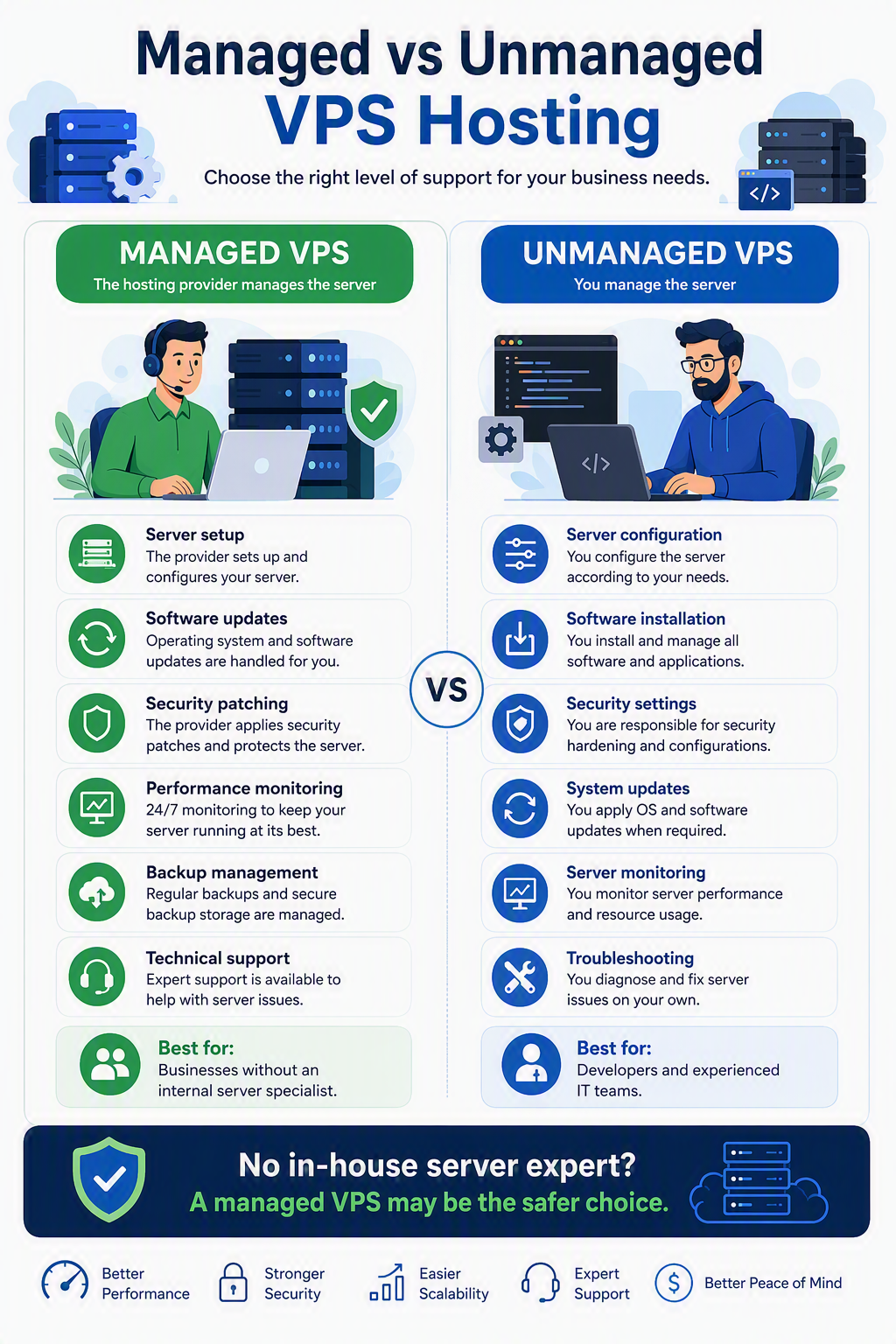
With managed VPS hosting, the provider handles many server administration tasks. Depending on the plan, this may include server setup, operating system updates, security patching, performance monitoring, backup management and technical troubleshooting.
Managed VPS hosting Australia is generally suitable for small and medium businesses without an internal server administrator. It usually costs more, but the additional support may save time and reduce technical risks.
With unmanaged VPS hosting, the customer is responsible for configuring, securing, updating and monitoring the server.
An unmanaged VPS may be suitable for developers, system administrators and companies with experienced IT teams. Its starting price may be lower, but the business must consider the time and expertise required to maintain it.
If your team cannot regularly secure and monitor the server, professional [ADD-SERVER-MANAGEMENT-URL] may be the more practical option.
Do not make this decision based only on price. A low-cost unmanaged plan can become expensive if you regularly need external support to fix server problems.
Why Australian VPS Hosting Matters
Businesses searching for the best VPS hosting Australia often prefer servers physically located in Australia.
When someone opens a website, information travels between the visitor’s device and the server. A closer server location may reduce network delay for visitors in Sydney, Melbourne, Brisbane, Perth and other Australian areas.
However, an Australian server does not automatically guarantee a fast website. Performance also depends on the server configuration, network quality, caching, website code, images and third-party scripts.
Confirm the physical location of the data centre instead of relying on broad terms such as “Asia-Pacific hosting”. A company may offer services to Australian customers while operating its servers in another country.
An Australian VPS provider may also offer local business-hours support, AUD billing and easier communication.
Businesses collecting or processing personal information should understand their privacy responsibilities. The Australian Privacy Principles explain how organisations covered by the Privacy Act must manage areas such as collecting, using, disclosing and securing personal information.
Using Australian VPS hosting does not automatically make a business compliant. Privacy compliance also depends on how the business collects, stores, accesses, protects and discloses information.
Best VPS Hosting vs Shared Hosting
Shared hosting and VPS hosting serve different website requirements.
Shared hosting is generally suitable for smaller websites with limited traffic and basic technical needs. It has a lower starting cost and usually requires less server management.
VPS hosting provides allocated resources and greater control. It is better suited to growing business websites, ecommerce stores and online applications.
| Feature | Shared Hosting | VPS Hosting |
|---|---|---|
| Server resources | Shared between websites | Allocated to the VPS |
| Performance | Suitable for smaller websites | Suitable for growing websites |
| Control | Limited | Greater server control |
| Scalability | May be restricted | Resources can usually be increased |
| Management | Usually managed | Managed or unmanaged |
| Cost | Lower | Higher but more flexible |
| Best suited for | Basic websites and blogs | Business websites, stores and applications |
Shared hosting is not always a poor option. If a small website performs well and does not need additional control, moving to a VPS may not provide enough value.
A business should consider upgrading when its website frequently reaches resource limits, becomes slow during busy periods or needs features that are unavailable with shared hosting.
VPS Hosting vs Cloud and Dedicated Hosting
Cloud hosting may use resources from connected infrastructure. Depending on the provider, it can provide flexible scaling and usage-based billing.
The term “cloud hosting” is used differently by different providers. Businesses should review how the service works rather than relying only on its name.
Dedicated hosting gives one customer access to an entire physical server. It may suit demanding applications, large databases and businesses with specialised server requirements.
A dedicated server usually costs more and may require experienced technical management.
VPS hosting is often selected because it provides greater control than shared hosting without the cost of using a complete dedicated server.
Can VPS Hosting Improve SEO Performance?
VPS hosting can support SEO by providing a stable technical environment.
A properly configured VPS may improve server response, support effective caching and help a website manage traffic increases.
However, moving to VPS hosting does not guarantee higher Google rankings.
SEO also depends on helpful content, mobile usability, website structure, internal linking, page titles, backlinks, website security and overall user experience.
Hosting should support your SEO strategy rather than replace it.
A fast server cannot correct poor-quality content, oversized images, confusing navigation or technical website errors. Hosting, website development and SEO should work together.
Are Cheap VPS Hosting Providers Worth Considering?
Some cheap VPS hosting providers offer useful entry-level plans for smaller websites, development environments and businesses with simple requirements.
However, the advertised price may not include everything required to operate the server safely.
Additional fees may apply to backups, server management, control panels, security monitoring, website migration, additional bandwidth and software licensing.
Some cheap VPS providers also advertise a low introductory price that increases when the plan renews.
When comparing low cost VPS hosting, calculate the complete ongoing cost. A slightly more expensive managed plan may offer better value if it includes maintenance, monitoring, backups and responsive technical support.
The best affordable VPS hosting should provide enough resources for your website, clear support arrangements and an easy way to upgrade. It should not create unnecessary business risk simply to offer a lower monthly price.
Which Businesses Benefit from VPS Hosting?
Ecommerce Stores
Online stores need reliable performance when customers search for products, access accounts, add items to a cart or complete payments.
A properly configured VPS can provide more predictable resources during promotions and busy shopping periods. The right plan will depend on the number of products, visitors, customer sessions and transactions.
Professional Service Firms
Law firms, accountants, consultants, healthcare organisations and agencies often rely on their websites for enquiries, bookings and customer communication.
Reliable business VPS hosting can support contact forms, booking platforms, client portals and multiple business websites.
Software and SaaS Companies
Software platforms require consistent processing power, memory and storage. A VPS may provide a flexible environment for applications, databases, APIs and testing projects.
A complex or rapidly growing platform may eventually require more advanced cloud or dedicated infrastructure.
Growing Small Businesses
A VPS can provide the next step when a growing business website outgrows shared hosting.
A managed VPS can be particularly useful when the business needs more resources but does not employ an experienced server administrator.
Moving from Shared Hosting to VPS Hosting
A successful migration begins with a review of your existing website, databases, email accounts, software and resource usage.
Create a complete backup before transferring data. The new VPS should then be configured with the correct operating system, software, security settings and resources.
Test the website before directing visitors to the new server. Contact forms, customer accounts, online payments, emails, redirects and SSL certificates should all be checked.
Keep the old hosting plan active until the new VPS is working correctly.
After the migration, monitor server usage, website speed and technical errors. Confirm that automated backups are running and can be restored.
Frequently Asked Questions
What is VPS hosting?
VPS hosting provides allocated CPU, RAM and storage inside a virtual server. It offers more control and predictable resources than standard shared hosting.
Is VPS hosting better than shared hosting?
VPS hosting is generally better for growing websites that need additional resources or control. Shared hosting may still be suitable for smaller websites with limited traffic.
Can VPS hosting handle high traffic?
A properly selected VPS can handle more traffic than many shared hosting plans. Its capacity depends on CPU, RAM, bandwidth, storage speed, caching and website optimisation.
Is VPS hosting suitable for small businesses?
Yes. VPS hosting can suit small businesses that need more stability, flexibility or room to grow. A basic website may not need a VPS until its traffic or technical requirements increase.
What is managed VPS hosting?
Managed VPS hosting means the provider handles many server administration tasks. These may include setup, updates, security patching, monitoring, backups and technical support.
Can a VPS host several websites?
Yes. A VPS can host several websites if it has enough CPU, RAM, storage and bandwidth. Each website must still be updated, secured and backed up.
Does VPS hosting improve Google rankings?
VPS hosting does not guarantee better rankings. It can support faster server response and website stability, which may strengthen the technical foundation of an SEO strategy.
How much does VPS hosting cost in Australia?
The price depends on CPU, RAM, storage, operating system, management, backups and support. Compare the complete ongoing cost instead of relying only on the introductory price.
How to Choose the Best VPS Hosting in Australia
The best VPS hosting Australia solution should match the real requirements of your website and the technical ability of your team.
Check how much CPU, RAM, storage and bandwidth each plan provides. Confirm the server location, backup schedule, security features, support coverage and renewal price.
You should also decide whether your team can manage the server or whether a managed service would be safer and more efficient.
The best VPS providers explain their services clearly, respond quickly to technical problems and make it easy to increase resources.
Avoid selecting a provider based only on price. The right VPS should support website performance, business continuity and long-term growth.
Find the Right VPS Hosting Solution
If your website is slow, regularly reaches resource limits or requires greater control, it may be time to move from shared hosting to VPS hosting.
A professional hosting assessment can determine the resources, server location, management plan, security controls and backup arrangements your business needs.
Speak with our hosting specialists to find secure, scalable and affordable VPS services for your Australian business.
