

A Sydney business can offer excellent service and still be difficult to discover online. The problem is not always the website. Sometimes the business appears under an outdated phone number, an old address, an inaccurate category, or an incomplete profile across local directories.
Introduction
A well-maintained business directory in Sydney listing helps potential customers understand who you are, what you offer and how to contact you. It can also contribute to more consistent business information across the web.
This guide is for Sydney business owners who want to improve existing directory listings, maintain accurate business information and turn local discovery into measurable enquiries.
It is not a searchable directory of Sydney companies. Instead, it explains how businesses can improve the quality and usefulness of listings they already have or plan to create.
A directory listing can support local visibility. It cannot guarantee a specific Google position. Google states that local results are mainly influenced by relevance, distance and prominence, so directory activity should be treated as one part of a wider local-search strategy.
What Is a Business Directory for Sydney Listing?
A business directory is an online platform that organises business profiles by location, category, or service type.
For a Sydney business, a typical listing may show the business name, telephone number, suburb or service area, website, opening hours, description, category, photos and customer reviews.
The purpose is simple: help people discover and evaluate local providers. That makes a directory different from the business’s own website. Your website is an owned digital property where you control the service information, branding and conversion experience. A directory is a third-party platform with its own rules and profile structure.
A directory is also different from an official government register. ASIC’s Business Names Register is a searchable database showing registered business names and their holders. Its primary purpose is official business-name information rather than local marketing or customer acquisition.
Understanding those differences prevents a common mistake: treating every business profile on the internet as though it performs the same function.
Business Directory vs Google Business Profile vs ASIC Register
The following comparison shows how the main business information channels differ.
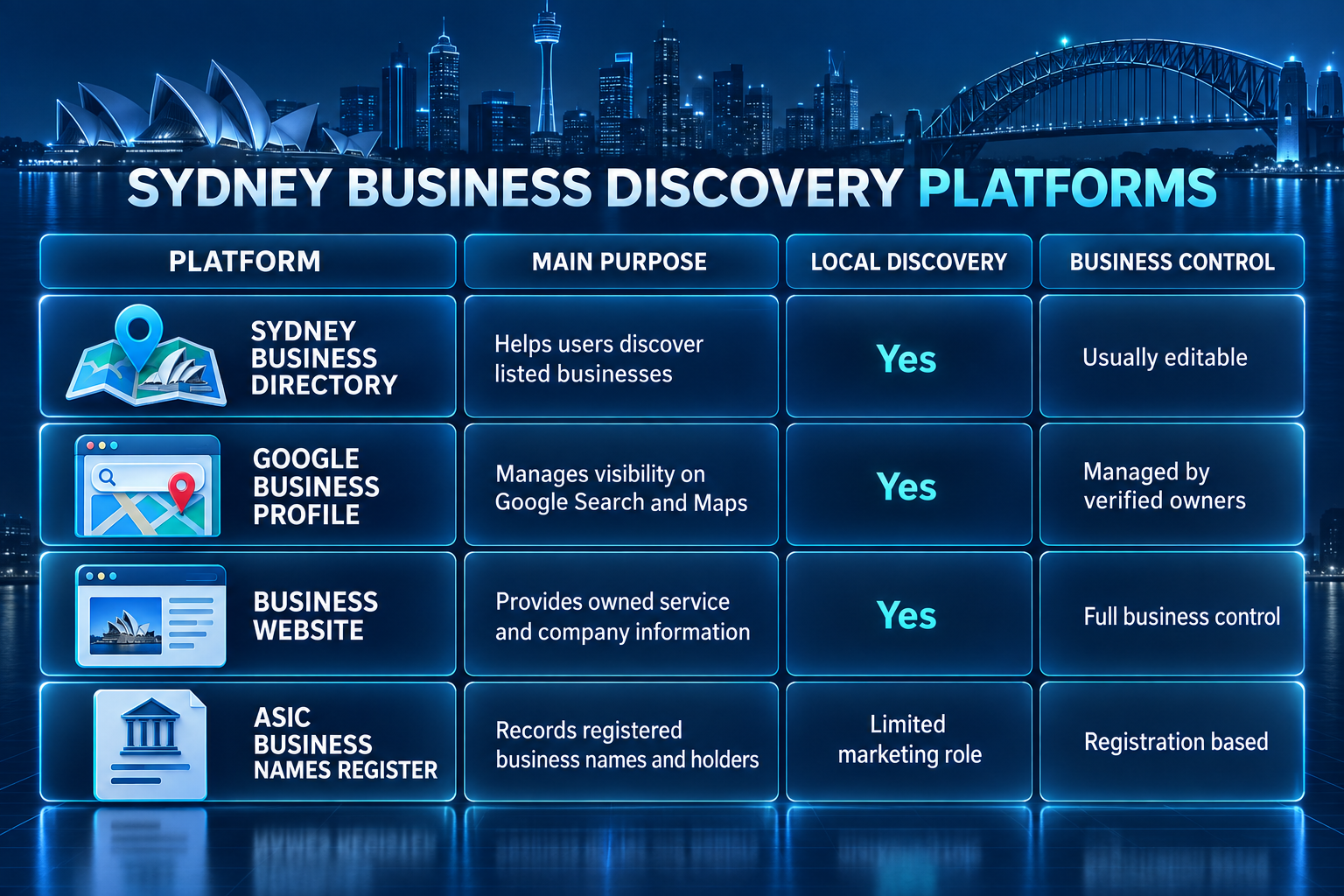
Google Business Profile has a particularly important role because eligible businesses can manage how their information appears on Google Search and Maps. Businesses can update information such as hours, location, contact details and photos through the profile. A local directory should therefore complement these channels rather than replace them.
Why Directory Listings Matter for Sydney Businesses
Directory listings can create an additional route between a local searcher and a business.
Someone searching for an accountant, electrician, web designer or commercial service in Sydney may encounter a directory before visiting the business website. If the listing is accurate and useful, the visitor can move from discovery to further research with less friction.
Consistency also matters. Google explains that local business information can come from several sources. These include publicly available web content, third-party data, users, and business owners themselves.
That does not mean every directory listing directly improves rankings. It means inaccurate information across the web can create an avoidable information-management problem.
A business that has one phone number on its website, another in an old directory, and a third on a legacy profile makes it harder for customers to know which information is current.
Consistent business information may also help search and generative systems understand relationships between a business, its services and its location. However, citations alone do not guarantee rankings or mention in AI-generated responses.
For businesses building a broader strategy around local visibility, the local SEO guide for Australian businesses explore Google Business Profile, reviews, local search and location-focused optimisation in more depth.
11 Ways to Improve Your Business Directory Sydney Listing
Keep Your Business Details Consistent
Start with the information customers depend on most. Your business name, address where applicable, telephone number, website and opening hours should reflect current operations. Consistency is sometimes described as NAP consistency: name, address and phone number. The acronym matters less than the principle.
If a company changes offices or phone systems, older profiles may continue displaying outdated information for years. Customers can then call the wrong number or arrive at an address the business no longer uses.
Keep the genuine trading name rather than adding unnecessary keywords solely to make the listing look optimised. Accuracy should come before optimisation.
Choose the Most Accurate Business Category
A business category helps the directory understand where the listing belongs.
Broad categories can make a profile less useful. A specialist commercial electrician should generally be described according to the actual service rather than selecting unrelated categories simply because they appear popular.
The same principle applies to Google Business Profile. Google advises businesses to provide complete and detailed information, so its systems can better understand how relevant a business is to a local query.
Choose categories that reflect real services. Adding every possible category may create noise instead of relevance.
Write a Useful Sydney-Focused Business Description
A directory description should help a potential customer decide whether your business is relevant. Start with what the organisation does. Then explain the type of customer it serves and the geographic area where those matters.
For example, a commercial IT provider may explain that it supports Sydney organisations with managed technology services. A building contractor may explain the types of projects it undertakes across nominated Sydney areas. Avoid writing a description such as: “Best Sydney business services for Sydney businesses looking for Sydney solutions.” That wording sounds artificial and provides very little useful information. Local relevance should emerge from the actual business context rather than repeated keywords.
Link to the Most Relevant Website Page
A directory listing is often the beginning of the journey rather than the destination. The website page behind the listing should continue with the same topic.
If a person discovers your accounting business under a payroll category, sending that visitor to a detailed payroll service page can provide a clearer next step than sending everyone to a generic homepage.
The same principle applies to local marketing. A business evaluating search visibility may benefit more from a focused SEO services page than a broad company homepage. The destination should match the visitor’s likely intent.
Add Current and Authentic Business Images
Images help people recognise a business before making contact. Useful images may include a storefront, office, team, products, or genuine service activity. The appropriate choice depends on the type of business.
Google recommends business-specific imagery and notes that photos can help customers understand the business when deciding whether to purchase a product or service.
Keep visual information current. A directory profile showing a logo from ten years ago, and photographs from a previous location can undermine an otherwise accurate listing.
Businesses whose directory traffic lands on an outdated website should also consider whether the destination reflects their current brand and customer journey. A modern, mobile-friendly website design can support the experience after a directory click.
Build Genuine Reviews and Respond Professionally
Reviews can help customers decide whether a business appears credible and relevant. The aim should be genuine feedback from real customers, not artificially inflated review counts. Responses matter too. A positive review can receive a brief acknowledgement. A negative review may require a calm response that addresses the issue without publishing private customer information.
Google confirms that reviews and positive ratings can contribute to prominence in local results. It also allows verified businesses to respond to customer reviews. Reviews should nevertheless be viewed as part of the customer decision process rather than a shortcut to rankings.
Remove Duplicate and Outdated Listings
A new directory submission is not always the right first step. Search the directory for your business name, previous names, old phone numbers, and former locations before creating another profile. A duplicate listing can divide reviews and expose different contact information.
Where the platform allows corrections, update or consolidate the listing instead. This becomes particularly important after relocations, mergers, rebranding, or ownership changes.
The objective is one clear current representation of the business wherever practical.
Prioritise Relevant Sydney and Industry Directories
More directory listings do not automatically create more value. A relevant Sydney directory may connect the business with people actively looking for local providers. An industry-specific directory may place the business in front of users who already understand the service category.
A random directory with little connection to Sydney or the business’s industry may generate almost no useful traffic. Evaluate directory relevance through the audience it serves. This is also where directory listings connect with broader SEO. Local citations may form part of an optimisation strategy, but they should complement useful website content, technical quality, and Google Business Profile management rather than replace them.
Businesses that need a wider search framework can review this managed SEO services guide for more detail on ongoing optimisation and reporting.
Align Listings With Google Business Profile
A directory listing and Google Business Profile are different assets, but the core business facts should not conflict. The business name, website, operating hours, location details and service information should remain accurate across both.
Google says businesses with complete and accurate profile information are more likely to appear for relevant local searches. It also uses multiple sources when compiling business information. That makes ongoing maintenance important.
Review directory listings whenever business details change and conduct a broader accuracy audit periodically. Opening hours, phone numbers, service areas, website links, and business categories should always reflect current operations. The goal is not identical to copy everywhere. It is a consistent fact.
Strengthen the Website Behind the Listing
A directory profile can earn the click. The website still has to earn an enquiry. Visitors should arrive on a page that works well on mobile devices and clearly explains the relevant service. Contact options should be easy to find.
The website also becomes more important once the customer relationship moves beyond discovery.
For example, organisations that exchange project files, media or large customer documents may need to decide how those files should be stored and transferred. Businesses assessing that part of their digital workflow can review the differences between FTP and cloud storage for business file transfers.
That supporting topic does not influence whether a directory listing ranks. It demonstrates a broader point: the digital experience after discovery should match what customers need once they engage with the business.
For organisations improving the entire search journey, the 2026 SEO services guide provide additional context on website structure, technical SEO and modern search visibility.
Measure Enquiries Instead of Counting Listings
Directory optimisation should eventually produce evidence. The number of directories containing your business name is not a meaningful commercial outcome by itself.
A business may have four well-maintained listings that send genuine customers to the website. Another business may appear in 100 directories that produce no traffic or enquiries. Focus instead on what happens after discovery.
Referral traffic can indicate whether users are clicking through. Call tracking may help businesses understand where enquiries originate when implemented appropriately. Website analytics can show contact-form submissions and other actions.
The measurement should suit the business. A restaurant may care about bookings and directions. A B2B service company may care more about qualified enquiries. That is how directory optimisation moves from visibility activity to business evidence.
Basic Business Listing vs Optimised Sydney Business Listing
After the 11 improvements, the difference between simply having a listing and actively maintaining one becomes clearer.
A basic listing may give customers enough information to identify a business, but it often stops there. An optimised listing is more complete, more accurate and easier to use, with stronger categories, current contact details, relevant website links and better ongoing maintenance.
The comparison below shows how these two approaches differ in practice.
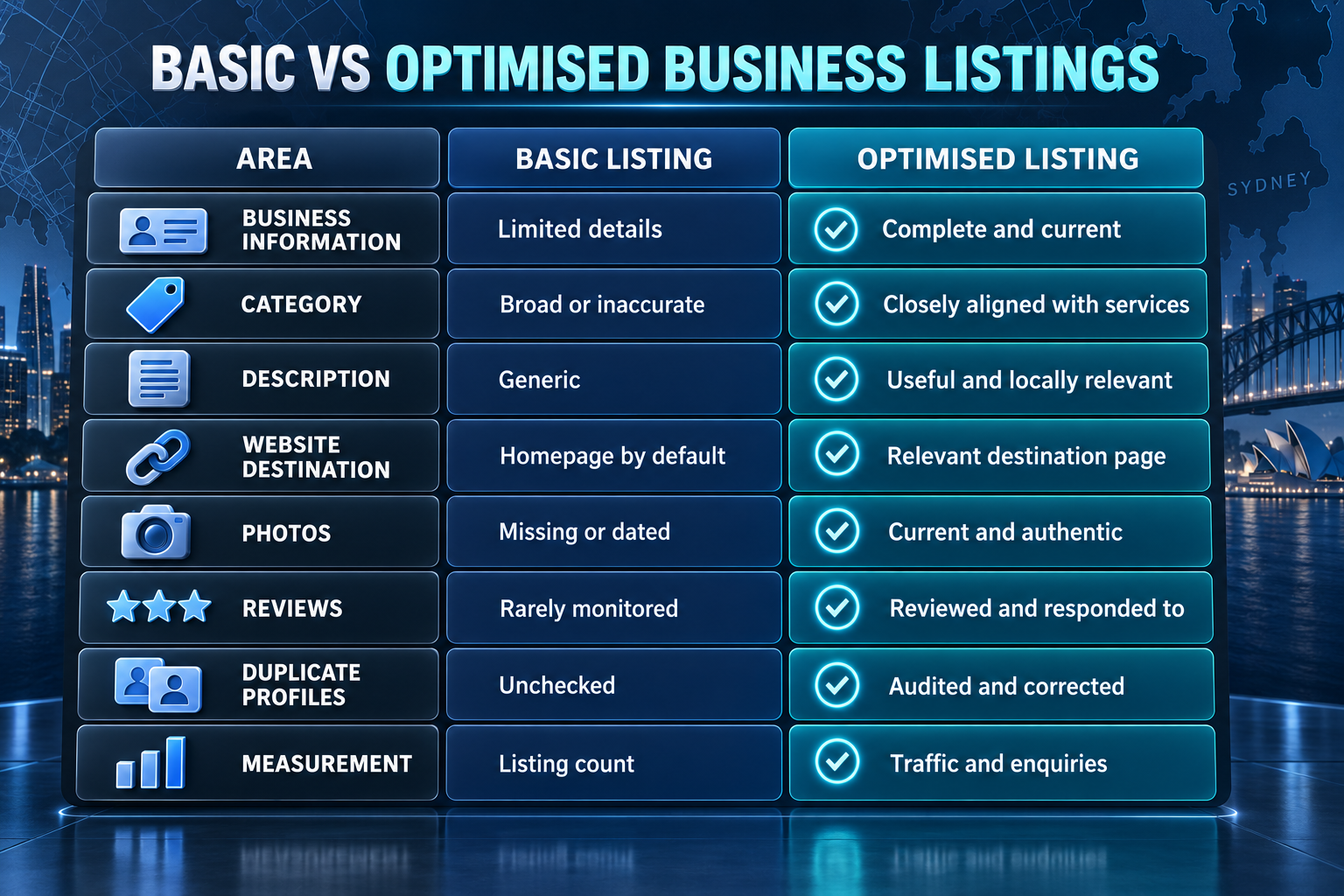
An optimised listing can improve usefulness, accuracy and customer experience.
It does not guarantee a higher position in local search. Google evaluates local results using multiple factors, including relevance, distance, and prominence.
Business Directory Sydney vs Google Business Profile
A business directory Sydney listing and Google Business Profile can both help with local discovery, but they should not be treated as interchangeable.
A directory provides exposure within the directory’s own audience and can create a third-party reference to the business.
Google Business Profile controls business information shown through Google Search and Maps. Eligible business owners can update details such as operating hours, website, phone numbers, location, photos, and customer-facing information.
The business website performs a third role. It is the organisation’s controlled destination for detailed service information, content, calls to action, and conversion.
A simple way to distinguish them is:
- Directory: third-party discovery.
- Google Business Profile: Google Search and Maps presence.
- Website: owned information and customer conversion.
The three work better when core business information remains aligned.
Free vs Paid Business Directory Sydney Listings
Some Sydney directories offer free listings. Others provide paid upgrades or operate entirely through paid packages.
There is no reliable universal AUD price because each directory sets its own model. A free profile may include the business name, contact information, and basic description. Paid options may add enhanced placement, more categories, additional media, enquiry features, or other promotional benefits depending on the platform. Paying a directory listing does not guarantee a higher Google ranking.
Google states that businesses cannot request or pay Google for better local rankings. The commercial question is therefore whether the paid feature creates measurable value for your business. If a $300 listing produces valuable enquiries, it may justify its cost. If a more expensive placement produces no relevant traffic, the upgrade may have little value regardless of how prominent it appears inside the directory.
Pricing reviewed: 15 September 2026. No single directory price is quoted because this article evaluates directory strategy rather than one specific directory provider.
How to Evaluate a Sydney Business Directory
Not every directory deserves the same time or budget. Before creating or upgrading a listing, assess whether the platform genuinely supports customer discovery and accurate business information.
A useful evaluation should consider:
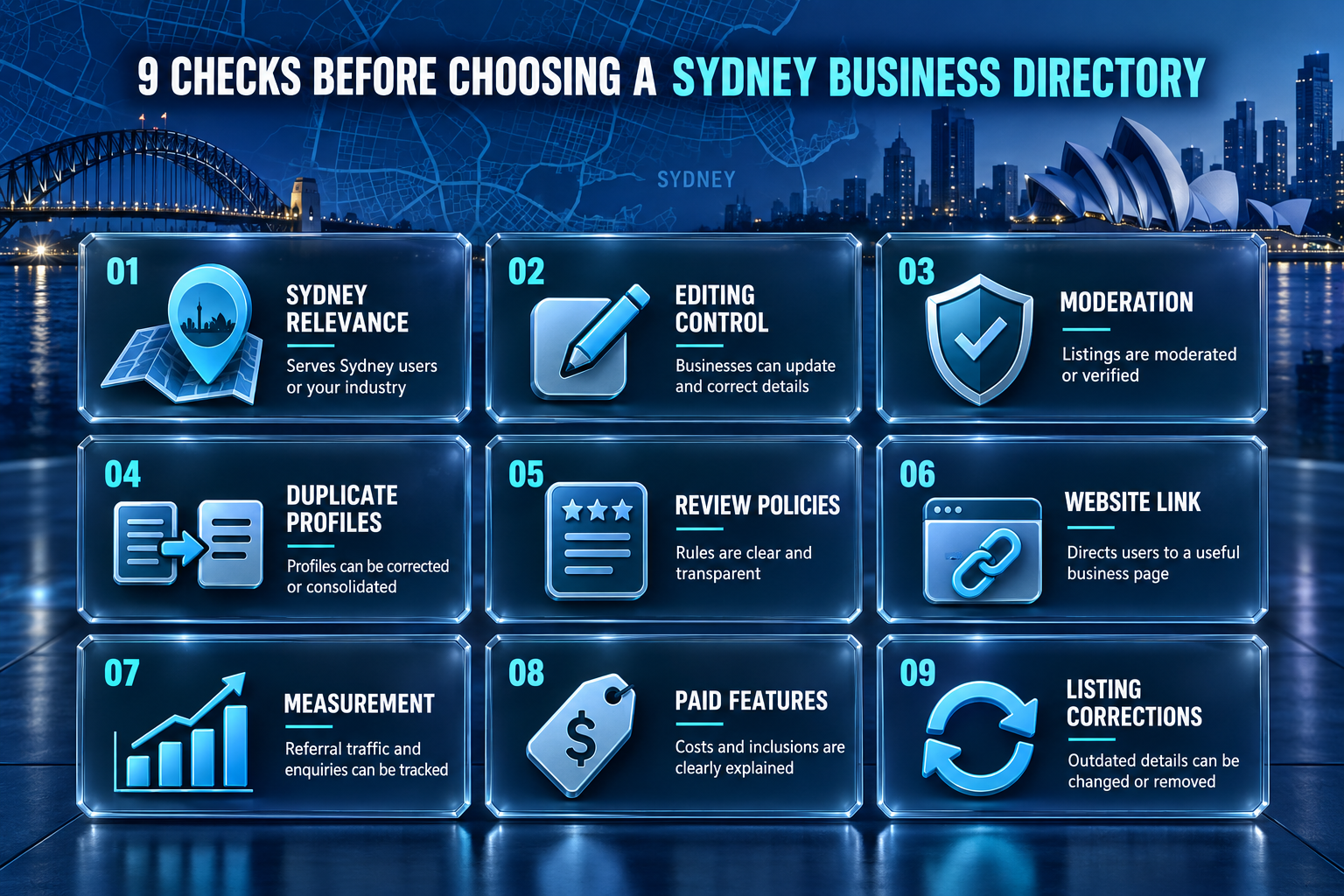
The strongest directory is not necessarily the one with the largest number of businesses. For a Sydney organisation, relevance, accuracy and actual customer activity are more useful measures. Directory quality should also be reviewed over time. A platform that once generated useful referrals may become less relevant. Another may grow in importance within a specific industry. Directory strategy therefore benefits periodic measurement rather than permanent assumptions.
Where IT Company Australia May Fit
IT Company Australia’s current SEO services include local citations, business-profile work, geo targeting, review management and local SEO activities. These services may be relevant when directory of consistency forms part of a broader local-search strategy.
Directory management should still be evaluated alongside website quality, Google Business Profile accuracy, and measurable referral activity. No SEO provider can guarantee a specific local ranking because Google uses multiple factors when determining local results.
ITCompany Australia has been ISO/IEC 27001:2022 certified. For SEO or directory work, certification is better treated as one governance consideration rather than a local-ranking factor or guarantee.
For businesses that need assistance through different Australian contact channels, ITCompany Sydney, ITCompany Melbourne, ITCompany Brisbane and ITCompany Perth are listed through the company’s contact pathway. Location-specific service arrangements should be confirmed directly rather than assumed to be identical.
Frequently Asked Questions
What Is a Business Directory for Sydney Listing?
A business directory in Sydney listing is a third-party online business profile that helps people discover local companies by category, service or location. It commonly includes contact information, website details, descriptions, and other business information.
Do Business Directory Listings Help Local SEO?
Directory listings can support local discovery and information consistency, but they do not guarantee ranking improvements. Google determines local results using several factors, including relevance, distance, and prominence.
Is a Sydney Business Directory the Same as Google Business Profile?
No. A directory is a third-party discovery platform, while Google Business Profile lets eligible businesses manage information displayed through Google Search and Maps.
Should My Business Appear in Several Sydney Directories?
It can be useful to appear in several relevant directories, but quality and accuracy matter more than the raw number of listings. Prioritise platforms that serve your location, industry, or actual customer audience.
How Often Should a Business Directory Listing Be Updated?
Update the listing whenever important business information changes and conduct broader accuracy reviews periodically. Phone numbers, operating hours, website links, locations, service areas and categories should remain current.
Are Paid Sydney Business Directory Listings Worth It?
They can be worthwhile when the directory reaches relevant customers and produces measurable referral traffic or enquiries. Paid placement alone does not guarantee improved Google visibility.
How Can a Sydney Business Improve Local Visibility Beyond Directories?
Combine accurate directory information with a maintained Google Business Profile, useful website content, genuine customer reviews and a broader local SEO strategy. Directory listings work best as one part of a consistent local presence rather than as a stand-alone ranking tactic.
Final Thoughts
A business directory Sydney strategy should not be measured by the number of websites that contain your company name.
The real value comes from accurate information, relevant directory coverage, and listings that help genuine Sydney customers understand the business and take the next step.
Start with the basics. Keep the business name, contact information, and categories accurate. Improve descriptions and images. Review duplicate listings. Connect profiles to useful website pages. Monitor reviews and measure whether directory traffic becomes meaningful for customer activity. Then move beyond basic listing management.
Align directory information with Google Business Profile. Evaluate paid listings using referral value instead of promises of exposure. Review directory quality periodically and make sure the website behind every listing provides a strong next step.
Consistent business information may help search and generative systems better understand a business and its location. It does not guarantee local rankings or AI mentions.
The strongest approach is therefore simple:
Be accurate. Be relevant. Be easy to verify. Make the next customer action clear.
Businesses that want to review local citations, Google Business Profile visibility and website search performance together can use the ITCompany Australia contact page to discuss the scope that fits their current local presence.
