
A Shopify store can look polished, display excellent products and offer fast delivery yet remain difficult to find through organic search. The problem is rarely Shopify alone. More often, collection pages are thin, product information is duplicated, navigation is weak or important URLs receive little internal support.
Introduction
Sydney ecommerce stores face an additional challenge. They may compete with local retailers, large Australian marketplaces and international brands for the same product searches. A broad SEO package can miss the platform-specific issues that affect Shopify collections, products, variants and apps.
Shopify SEO Sydney should therefore connect technical SEO, merchandising, product data, content and conversion measurement. The objective is not simply to send more visitors to the homepage. It is to help suitable customers discover the right collection or product and complete a valuable action.
This guide explains how Sydney Shopify stores can build that system in 2026. It covers architecture, collections, product pages, duplicate URLs, structured data, Merchant Center, mobile performance, local trust, content and reporting.
What Is Shopify SEO Sydney?
Shopify SEO Sydney is the process of improving a Shopify store’s organic visibility for customers in Sydney and wider Australian markets. The work combines conventional ecommerce SEO with Shopify-specific technical, collection, product and content requirements.
A complete Shopify strategy may cover keyword research, information architecture, collection optimisation, product data, internal links and structured data. It should also address redirects, discontinued products, app performance, Merchant Center and conversion tracking.
Sydney relevance should come from genuine business information and customer value. A store should not repeat “Sydney” across every product page when the products and delivery details do not change by location.
IT Company Australia publicly describes its SEO services for Australian businesses as covering ecommerce SEO, category pages, product schema, faceted navigation, internal linking and link building. Confirm every deliverable, limit and reporting responsibility in the written proposal.
Direct Answer
Shopify SEO Sydney improves how shoppers and search engines discover a Sydney ecommerce store. A strong strategy fixes technical barriers, builds useful collection pages, improves product information, strengthens internal links, shares accurate product data with Google and measures organic revenue rather than rankings alone.
In This Guide
This guide explains how to:
- Build a crawlable Shopify collection and product structure
- Improve collection pages without keyword stuffing
- Control duplicate URLs, variants and discontinued products
- Connect structured data with Google Merchant Center
- Measure organic product discovery, conversions and revenue
Shopify SEO Sydney Quick Facts
| Question | Practical answer |
|---|---|
| Who needs Shopify SEO? | Stores that want stronger organic discovery for collections, products and buying guides |
| What should be reviewed first? | Indexation, architecture, collection quality, product data and measurement |
| Where should optimisation start? | With commercially important collections and products that the business can supply |
| When should content be added? | When it helps shoppers compare, choose, use or understand products |
| How should results be measured? | Through impressions, qualified visits, product views, conversions and organic revenue |
| What affects cost? | Catalogue size, theme, apps, markets, content, technical condition and implementation scope |
Why Shopify Stores Struggle with Organic Search
Shopify provides a capable ecommerce platform, but the platform cannot decide which collections deserve priority. Shopify also cannot write distinctive category content, choose commercially useful keywords or correct merchandising decisions.
Stores often grow through repeated product uploads and app installations. Over time, collections overlap, filters create confusing paths and discontinued products leave broken URLs. The store becomes harder for customers and search engines to understand.
SEO problems can also hide inside attractive themes. Large scripts, unnecessary apps and oversized image assets may weaken mobile performance. Product pages may contain manufacturer copy that appears across many competing retailers.
The solution is not to install another SEO app immediately. Begin with evidence from Google Search Console, analytics, Shopify reports and a controlled crawl of the store.
Build SEO Around the Shopify Customer Journey
A customer may begin with a broad category search, narrow the choice through a collection and then compare several products. The store architecture should support that journey without forcing the visitor to rely only on the search box.
Google explains that ecommerce navigation affects how search systems understand relationships between pages. It recommends linking from menus to categories, categories to subcategories and subcategories to products.
This hierarchy also supports customers. A clear structure helps visitors move from a broad need to a suitable product while keeping related options visible.
Search optimisation should therefore connect discovery with merchandising. The pages that deserve stronger visibility should also make sense within the store’s buying journey.
Audit the Shopify Store Before Expanding Content
A Shopify SEO audit should establish which URLs are indexable, canonical and commercially useful. Review products, collections, pages, blogs, redirects, pagination and any URLs created through filters or apps.
The audit should also identify organic landing pages and conversion paths. A collection receiving impressions but no product clicks needs a different response from a product page attracting visits but no sales.
Check whether tracking is reliable before changing the store. Confirm product views, add-to-cart events, checkout activity and completed purchases where appropriate.
Businesses needing a broader starting point can use the Free SEO Audit Australia guide. It explains how technical, content, internal-link and conversion checks support better decisions.
Build a Clear Shopify Site Structure
Shopify uses standard content paths such as /products/, /collections/, /pages/ and /blogs/. The fixed folders are not usually the main problem. The important work is creating clear page relationships and useful handles.
Every important product should be reachable through navigational links. Products available only through an internal search box may be difficult for crawlers to discover reliably.
Top-level navigation should represent the way customers shop. Depending on the store, this may involve product type, intended use, audience, material or another verified buying factor.
Avoid creating a collection for every keyword variation. Each collection needs a clear purpose, useful product range and enough distinction to justify a separate indexable page.
Choose High-Value Shopify Collection Pages
Collection pages often carry stronger commercial opportunity than individual products. A collection can serve a broader search, remain live when stock changes and help customers compare suitable items.
Start with collections tied to available stock and sustainable margins. Search volume matters, but it should not override product availability, fulfilment or business value.
Record each target collection, primary search intent, related terms, featured products and expected customer action. Assign an owner to verify the merchandising and commercial information.
The collection list should remain controlled. Creating many overlapping collections can divide internal links and create several weak pages targeting similar searches.
Key Shopify Pages to Optimise First
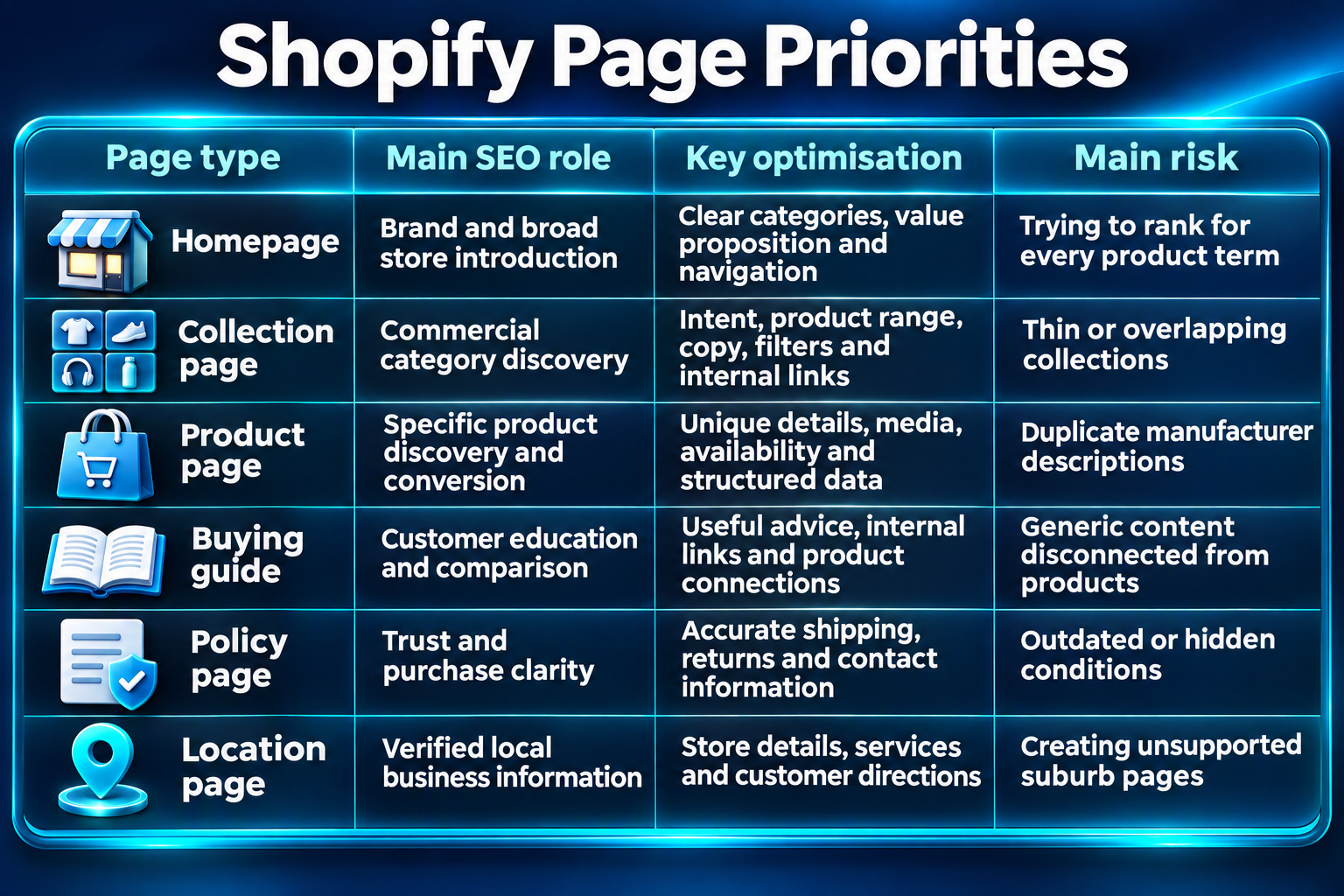
Optimise Shopify Collection Pages for Shoppers
A collection page should help customers understand what the category contains and how to choose. It should not begin with a large block of repetitive SEO text that pushes products below the fold.
Use a concise introduction near the top. Explain the category, product fit and one or two key buying considerations. Longer advice can appear below the product grid or on a linked buying guide.
Collection titles should match customer language. Avoid stuffing Sydney into every heading when the category is available nationally and location does not affect the product.
Use filters carefully. Filters should help shoppers narrow the range, but the SEO team should review whether filtered URLs create unnecessary crawl paths or duplicate pages.
Connect Collections with Relevant Subcollections
Broad collections may need useful subcategories. A furniture store might separate dining chairs by material or use when customers genuinely shop that way.
Every subcollection should receive clear links from the parent collection. Products should also link back through breadcrumbs or suitable navigational paths.
Do not create a subcollection for a search term alone. The page needs a stable product range and enough customer value to justify ongoing maintenance.
Strengthen Shopify Product Pages
Product pages need more than a name, image and manufacturer description. Customers need clear product details, dimensions, materials, compatibility, availability and delivery information where relevant.
Write original descriptions for commercially important products. Reused supplier copy may appear across many retailers and does little to explain why the product suits a particular customer.
Product images should be useful and compressed appropriately. Include descriptive alternative text that explains the image without turning it into a list of keywords.
Reviews, FAQs and specifications can improve decision-making when they are genuine and properly maintained. Do not mark invented testimonials or unsupported ratings as structured data.
Keep Product Availability Accurate
Search listings can become misleading when the website, structured data and product feed show different prices or stock states. These mismatches can frustrate customers and complicate Merchant Center verification.
Use clear availability values on the live product page. Update feeds promptly when stock changes and review how automated updates handle temporary inconsistencies.
When a product is temporarily unavailable, keep the page useful if the item is expected to return. Show the status clearly and offer suitable alternatives without pretending the item can be purchased.
When a product is permanently removed, decide whether to retain the page, redirect it or return a suitable removal status. The decision should follow demand, backlinks, equivalents and customer value.
Control Shopify Duplicate URLs
Some Shopify themes or apps can create several paths to the same product. Search engines may encounter a direct product URL and another version reached through a collection path.
Canonical tags help identify the preferred version. However, internal links should also point consistently to the intended product URL rather than creating mixed signals.
Duplicate content can also come from product variants, tags, filters and copied descriptions. Not every duplicate URL requires indexation or its own search target.
Review the rendered HTML and internal links after theme or app changes. Do not assume the default implementation remains correct after custom development.
Manage Product Variants Properly
Variants such as size and colour often belong on one product page. This approach consolidates product information and reduces unnecessary near-duplicate pages.
Some stores need separate URLs when variants have distinct demand, imagery, pricing or availability. That decision requires technical and commercial review rather than a universal rule.
Product structured data should reflect the available offer accurately. The visible page, checkout and feed should not contradict one another.
Test variant links from collections, advertisements and Merchant Center. A visitor should reach the intended configuration without losing the wider product context.
Improve Shopify Internal Linking
Internal links help customers discover related products, collections and guides. They also show search engines which pages hold greater importance within the store.
Link from the homepage to priority collections and selected seasonal categories. Link from collections to all products that should be discoverable through browsing.
Buying guides should link to relevant collections and products. Product pages can link to compatibility guides, care instructions or related categories when those resources help the customer.
Google notes that the number and placement of internal links can help it understand relative page importance. Internal linking should therefore follow real merchandising priorities.
Use Shopify Blog Content Strategically
A Shopify blog should support buying decisions, not simply publish high-volume topics. Useful articles can answer product questions, explain comparisons and help customers choose between options.
Map each article to a customer stage. An early-stage guide may explain a problem, while a later-stage comparison can direct readers towards a suitable collection.
Avoid publishing large numbers of generic articles. Thin content can consume editorial time without strengthening product discovery or customer confidence.
A successful article should have a clear next step. Link to the relevant collection, product or guide using descriptive and natural wording.
Share Accurate Product Data with Google
Google recommends adding product structured data to product pages where feasible. Structured data can improve Google’s understanding of price, availability, discounts and shipping information.
Google also recommends submitting product data through Google Merchant Center. A feed gives the store greater control over which products are shared and how quickly data is updated.
Structured data and Merchant Center support different ecommerce experiences. Product information may appear in search rich results, images, product annotations or Shopping surfaces, depending on eligibility and other factors.
Neither method guarantees visibility. The store must maintain accurate product information and follow the requirements for each Google surface.
Shopify SEO, Product Data and Merchant Center
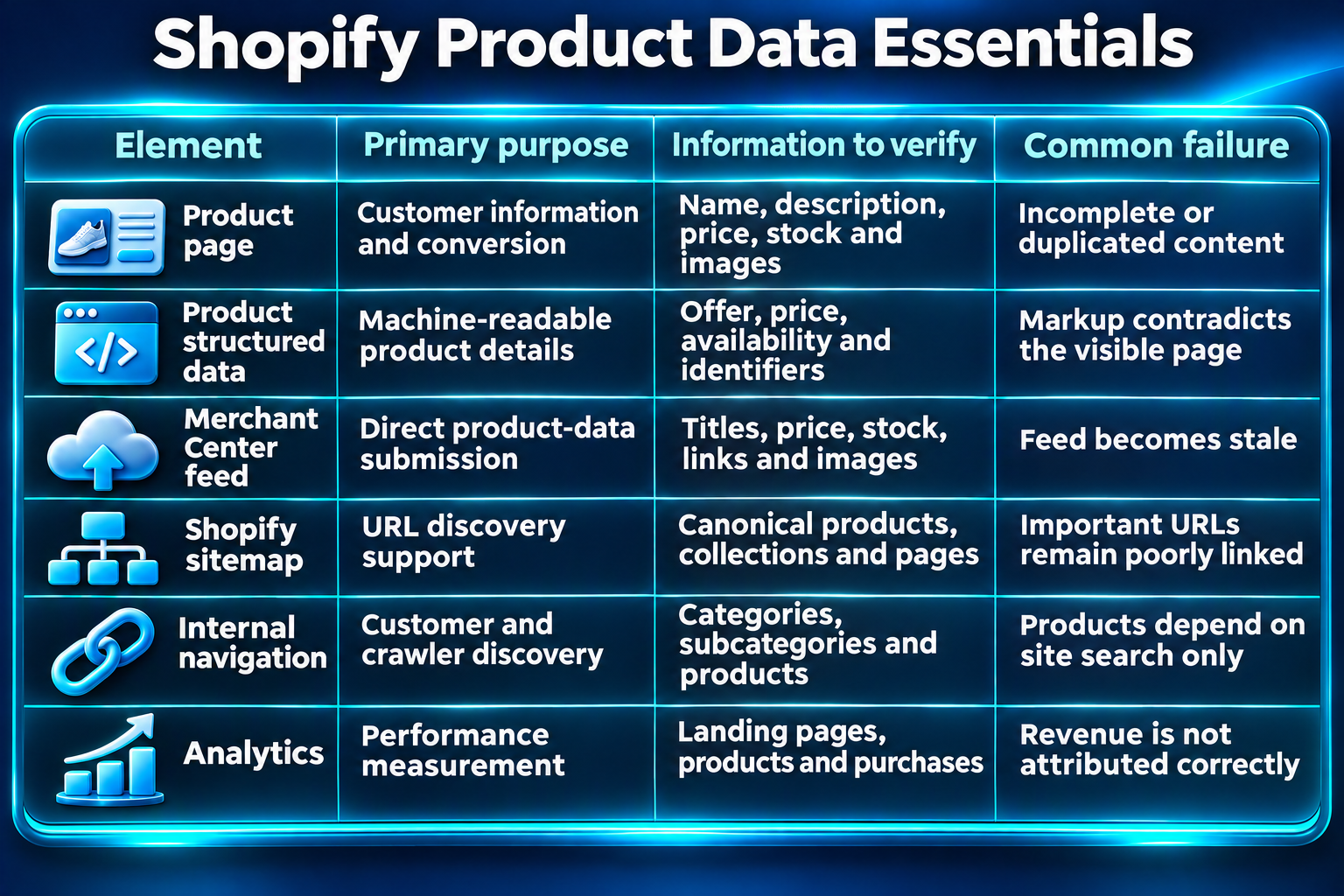
Improve Shopify Theme Performance
Apps can add useful functionality, but each app may introduce scripts, styles and external requests. Over time, a store can become slow even after the visible app block is removed.
Review app usage and business value before removing anything. An app supporting search, subscriptions or customer accounts may be essential, while an unused badge or popup may add unnecessary weight.
Compress product and collection images without making them unclear. Test mobile layouts because Sydney shoppers may discover products while travelling, comparing prices or browsing away from a desktop.
Performance work should cover priority templates. A fast homepage does not prove that collection filters, product galleries and cart interactions perform well.
Improve Mobile Product Discovery
Mobile SEO is not only about responsive design. Shoppers need readable product information, useful filters, stable layouts and tap-friendly buttons.
Test collection filtering on real devices. Confirm that customers can apply, remove and understand filters without losing their current position.
Product image galleries should load efficiently and remain easy to control. Important price, availability and purchase information should not move unexpectedly as the page loads.
Checkout is part of the wider customer journey. SEO may attract the visit, but confusing shipping or payment information can prevent the store from earning revenue.
Build Genuine Sydney Relevance
A Sydney Shopify business may serve customers locally, nationally or internationally. Local SEO should reflect the real operating model rather than force a Sydney reference into every page.
A retailer with a Sydney showroom can publish accurate location, opening, pickup and contact information. A warehouse-only business should not represent the warehouse as a public retail location unless customers can visit.
Delivery information can explain Sydney options when they differ from national shipping. Do not promise same-day or next-day delivery without verified operational capability.
Customer language may include suburb or city terms, but location pages should provide genuine local value. A set of near-identical suburb pages can weaken quality and create maintenance problems.
Shopify SEO for Sydney-Based Retailers
Sydney retailers can connect local and ecommerce journeys when the store supports pickup, showroom visits or local delivery. Product and collection pages should explain those options accurately.
Keep the business name, address, telephone and trading information consistent where a physical location is promoted. Update this information when hours or customer-access arrangements change.
Use Google Business Profile for eligible customer-facing operations. The website should remain the authoritative source for current products, policies and purchase conditions.
End every local journey with a clear action. Customers may need to shop online, check pickup availability, call the store or visit a verified location.
Use Local SEO Only Where It Fits
A Shopify store selling nationally does not need every product page to target Sydney. Broader product searches may offer a better match for the customer and the store’s fulfilment model.
Sydney targeting is more suitable for local pickup, showroom searches, city-specific delivery or products with strong local demand. The supporting page should explain the difference clearly.
IT Company Australia’s SEO services page includes a Shopify SEO Sydney service reference alongside ecommerce, local and technical SEO. Confirm how local intent will be separated from national ecommerce targeting.
The page should not compete with itself through several similar location URLs. Assign one intended purpose to each collection, product, guide and location page.
Connect Shopify SEO with Store Design
SEO cannot compensate fully for confusing navigation or an unsuitable product experience. Store design, merchandising and search visibility should be planned together.
IT Company Australia’s online store setup services cover store design, product listings, mobile layouts, navigation, search and checkout features. Confirm whether SEO migration, structured data and ongoing optimisation are included separately.
The website-design process should preserve important URLs and product data during a rebuild. A visual redesign can damage organic performance when redirects, canonicals or analytics are overlooked.
Use a staging environment or controlled preview for major theme changes. Test collections, products, cart functions, structured data and tracking before publishing.
Handle Shopify Migrations Carefully
Moving to Shopify from WooCommerce, Magento or another platform requires a URL and product-data plan. Old category and product URLs may have rankings, backlinks and customer bookmarks.
Map every valuable old URL to the most relevant new destination. Avoid redirecting unrelated products and categories to the homepage simply to remove errors.
Preserve metadata and content where they remain useful. Check canonicals, sitemaps, structured data, analytics and Merchant Center immediately after launch.
Monitor traffic and indexation by page type. A migration can appear successful overall while one valuable category loses visibility.
Earn Relevant Authority for Shopify Pages
Backlinks can help customers and search engines discover useful collections, guides and resources. They should support strong pages rather than act as a substitute for technical and content quality.
Promotable assets may include buying guides, calculators, original surveys, detailed comparisons and useful tools. The selected asset should connect naturally with a priority product category.
Australian industry publications, suppliers, associations and legitimate partners may provide relevant opportunities. Avoid automated links, unrelated publisher networks and guaranteed-ranking packages.
The Link Building and SEO Services Australia playbook explains how technical SEO, target pages, content assets, promotion and measurement should work as one campaign.
Measure Shopify SEO Through Revenue
Rankings provide context but do not show whether search visibility creates commercial value. Shopify SEO reporting should connect landing pages with product discovery and purchases.
Track collection impressions, organic sessions, product views, add-to-cart actions, checkout activity and completed orders. Review conversion rates by landing-page type where the data is reliable.
Revenue attribution has limitations. Customers may discover a product through organic search, leave and return later through another channel.
Use a consistent reporting model rather than claiming that every sale came from one SEO action. Record technical, content and merchandising changes alongside performance data.
Measure Shopify SEO Performance and Revenue
| Reporting area | Useful evidence | Business question |
|---|---|---|
| Indexation | Indexed collections, products and exclusions | Can Google access the intended pages? |
| Search visibility | Queries, impressions, clicks and landing pages | Are relevant shoppers discovering the store? |
| Collection performance | Sessions, product clicks and conversion rate | Do category pages support product discovery? |
| Product performance | Views, carts, checkout and purchases | Which products convert organic traffic? |
| Product data | Feed status, structured-data errors and mismatches | Is Google receiving accurate product information? |
| Revenue | Organic revenue and assisted conversions | Is SEO supporting meaningful commercial outcomes? |
| Work completed | Technical, content and internal-link changes | What changed and what should happen next? |
Shopify SEO Costs and Timing
Shopify SEO costs depend on catalogue size, collections, theme condition, apps, markets and content needs. A store with 50 stable products requires a different scope from a store with thousands of variants and frequent inventory changes.
Request a written scope separating audit work, implementation, collection copy, product optimisation, structured data, Merchant Center and reporting. Confirm whether development changes are included or only recommended.
There is no responsible guarantee for ranking or revenue. Search-engine processing, competition, stock, pricing and store conversion performance can affect outcomes.
Use staged reviews rather than expecting immediate results from one change. Technical fixes, content updates and external authority may produce effects over different periods.
Common Shopify SEO Mistakes
Optimising Every Product Before Collections
Large catalogues can consume the entire budget when every product receives equal attention. Prioritise collections and commercially important products using demand, margins, stock and customer value.
Creating Collections for Every Keyword
Overlapping collections divide relevance and become difficult to maintain. Build a collection only when it serves a distinct customer need and contains a useful product range.
Copying Supplier Descriptions
Manufacturer copy may appear across several retailers. Write original descriptions for priority products using verified specifications, customer needs and practical benefits.
Installing Too Many Shopify SEO Apps
Apps can automate useful tasks but may add scripts, conflicts or duplicate functionality. Audit existing tools and confirm the business purpose before adding another app.
Ignoring Discontinued Products
Deleting products without a plan can create broken links and lost customer paths. Review each product’s demand, backlinks and replacement options before selecting the response.
Treating Merchant Center as Set-and-Forget
Prices and stock can become inconsistent between the feed and website. Monitor diagnostics and keep product updates aligned with live store information.
Measuring Rankings Without Revenue
A higher position may not produce profitable sales. Connect visibility with product discovery, conversion, order value and stock availability.
Shopify SEO Sydney Checklist
Use this five-step launch checklist:
- Confirm priority collections and products are indexable
- Link products through crawlable category navigation
- Align visible product data, structured data and Merchant Center
- Test mobile collection, product, cart and checkout journeys
- Record organic visibility, conversions and revenue before changes
This checklist is a starting point, not a complete audit. Larger or customised stores may need log analysis, JavaScript review, feed diagnostics and deeper crawl controls.
Frequently Asked Questions
What Is Shopify SEO Sydney?
Shopify SEO Sydney improves a Shopify store’s organic visibility for shoppers in Sydney and relevant Australian markets. It combines collection, product, technical, content, local and product-data optimisation.
Is Shopify Good for SEO?
Shopify provides useful SEO foundations, including editable titles, descriptions, redirects and sitemaps. Results still depend on architecture, content, internal links, product data, performance and competition.
How Much Does Shopify SEO Cost in Sydney?
Cost depends on catalogue size, technical condition, collections, content and implementation needs. Request a written scope because one package cannot reflect every Shopify store.
How Long Does Shopify SEO Take?
There is no universal timeline. Search-engine processing, competition, store history, technical issues, implementation speed and content quality all affect progress.
Should Shopify Product Pages Target Sydney?
Only when Sydney changes the customer need, availability, pickup or delivery offer. National products should not carry forced Sydney references on every page.
Are Collection Pages Important for Shopify SEO?
Yes. Collection pages can target broader commercial searches and help customers compare products. They also provide stable destinations when individual inventory changes.
Does Shopify Create Duplicate URLs?
Themes, collection paths, filters, variants or apps can create multiple URLs or similar content. Canonicals and consistent internal links help clarify preferred pages.
Does a Shopify Store Need Google Merchant Center?
Merchant Center is not mandatory for ordinary organic results, but it increases control over product data and is required for certain Google shopping experiences.
Can Shopify Apps Fix SEO Automatically?
Apps can support metadata, structured data, images and redirects. Apps cannot replace commercial priorities, useful content, technical review or sound measurement.
Can Shopify SEO Guarantee More Sales?
No. SEO can improve organic discovery, but sales also depend on products, pricing, availability, trust, delivery and the customer experience.
Final Thoughts
Shopify SEO Sydney should connect search visibility with real product discovery. Technical fixes matter, but strong collections, accurate product information and clear navigation determine whether customers can find the right option.
Begin with evidence. Audit indexation, site structure, collection performance, product data and conversion tracking before adding content or apps.
Strengthen priority collections and products first. Build useful internal links, maintain accurate structured data and connect the store with Google Merchant Center where appropriate.
IT Company Australia offers SEO, ecommerce design and online-store services for Australian businesses. Request a Shopify SEO assessment and ask for a written scope covering technical SEO, collections, product data, content, local intent and revenue reporting.