
Attracting attention is no longer enough for a consumer-focused business. Customers may discover a brand through search, compare alternatives on social media, read reviews, leave the website and return through an email or advertisement. Every interaction can influence whether that person becomes a customer.
A B2C marketing agency helps connect these interactions around a clear customer journey. Rather than treating search engine optimisation, paid advertising, social media and email as isolated activities, the agency coordinates them to attract suitable prospects, reduce buying friction and support customer retention.
The challenge is not simply generating more traffic. A business needs the right audience, a relevant offer, credible evidence and an easy path to purchase. Without those foundations, increasing website visits can increase marketing costs without producing a corresponding increase in sales.
This guide explains how a B2C marketing agency moves consumers from initial awareness to purchase and repeat business. It also covers agency services, performance indicators, common mistakes, compliance considerations and the questions Australian businesses should ask before appointing a marketing partner.
Direct answer: What does a B2C marketing agency do?
A B2C marketing agency helps a business market products or services directly to individual consumers. It researches customer needs, develops campaign messages, selects suitable channels, generates demand, improves conversion paths and measures results against defined commercial objectives.
In this guide
- How B2C marketing differs from business-to-business marketing
- Which services support each stage of the consumer journey
- How an agency turns awareness and interest into measurable sales
- Which costs, risks and performance measures to review
- How to choose and work effectively with a B2C marketing agency
What Is a B2C Marketing Agency?
A business-to-consumer marketing agency promotes products or services to the people who will personally use or purchase them. Its work often combines customer research, positioning, creative production, digital advertising, search visibility, social engagement, email marketing and conversion optimisation.
B2C campaigns usually address personal needs, preferences or immediate problems. A customer may compare price, convenience, quality, delivery, reputation and perceived value before purchasing. The agency’s role is to identify those decision factors and communicate them clearly across relevant customer touchpoints.
Unlike a supplier that completes isolated marketing tasks, an effective agency should connect activities to a measurable objective. Businesses considering coordinated support can review these digital marketing services for Australian businesses when assessing which channels could support their customer journey.
B2C Marketing Compared With B2B Marketing
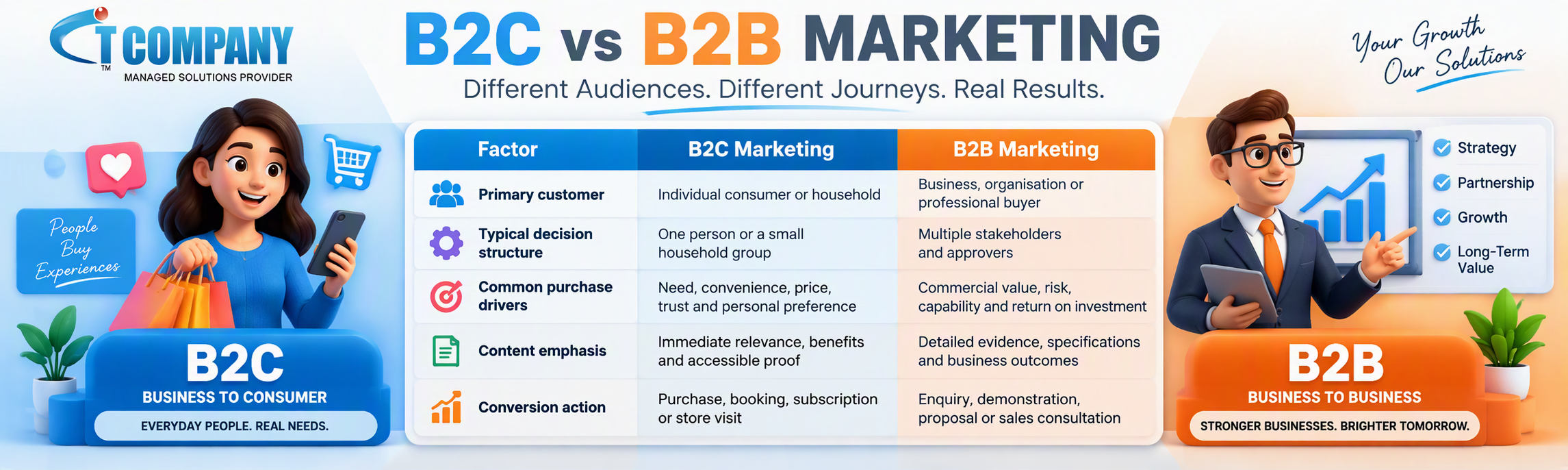
B2C and B2B marketing use some of the same channels, but buyers often make decisions differently. Consumer purchases may involve one person, a shorter evaluation period and stronger emotional or convenience-based factors. Business purchases can involve several stakeholders, formal procurement and longer approval processes.

home improvements or financial products can involve extensive research. A B2C strategy should therefore reflect the real buying process rather than assuming every customer makes a quick decision.
Key Functions of a B2C Marketing Agency
Customer and Market Research
Effective B2C marketing begins with evidence about the audience. An agency may review customer interviews, website search data, sales questions, campaign performance, service enquiries and competitor positioning. The purpose is to understand what customers need and why they may hesitate before purchasing.
Research should produce useful audience segments rather than vague demographic profiles. A segment may reflect a specific problem, buying trigger, budget range, preferred channel or level of product awareness. These details make campaign messages more relevant and improve the quality of testing.
Brand Positioning and Messaging
Consumers need to understand what a business offers, who it serves and why its offer deserves consideration. A B2C marketing agency can refine the value proposition, supporting messages, tone and campaign themes. This gives advertisements, service pages and social content a consistent foundation.
Brand development extends beyond a logo or colour palette. It includes the promises a business makes and the evidence supporting those promises. Marketing teams should avoid unsupported superiority, performance or savings claims because consumer-facing advertising must remain accurate and defensible.
Search Engine Optimisation
Search engine optimisation helps a business appear when consumers actively research a need, product or service. B2C SEO may include technical improvements, keyword research, service-page optimisation, local search content, internal linking and articles that answer questions encountered before purchase.
Search visibility should not be separated from user experience. A page may attract suitable visitors but still underperform if its offer is unclear, its navigation is confusing or its purchase process creates unnecessary steps. SEO and conversion optimisation should therefore share customer and performance insights.
Content Strategy and Production
Content gives customers information needed to progress towards a decision. Depending on the audience, this may include product comparisons, demonstrations, buying guides, videos, FAQs, customer stories and after-purchase advice. Each asset should support a defined stage of the buying journey.
Businesses often publish content without deciding what the reader should understand or do next. A B2C marketing agency creates a content plan around customer questions, commercial priorities and distribution channels. This approach turns content into a connected acquisition asset rather than a collection of unrelated posts.
Paid Advertising and Remarketing
Paid search and social advertising can place an offer in front of relevant consumers. An agency may manage targeting, campaign structure, creative testing, budgets, landing pages and conversion tracking. Paid campaigns can also reveal which messages generate meaningful responses before they are expanded into other channels.
Remarketing can help a business reconnect with previous website visitors, although frequency, consent and privacy handling need careful management. The goal is not to follow every visitor indefinitely. It is to provide a sensible reminder or useful next step to an audience with relevant previous interest.
Social Media Marketing
Social platforms can support awareness, product discovery, community interaction and customer service. A B2C agency may develop content calendars, create posts and videos, manage paid promotion and monitor audience responses. Channel selection should depend on customer behaviour rather than platform popularity alone.
Businesses needing a broader channel plan can use an integrated B2C digital marketing strategy to connect social activity with website visits, email subscriptions and transactions. This prevents engagement metrics from becoming disconnected from commercial outcomes.
Email Marketing and Customer Retention
Email can nurture potential customers and maintain relationships after a purchase. Welcome sequences, abandoned-cart reminders, product education, service reminders and relevant promotions can support conversion and retention. Segmentation helps ensure recipients receive messages connected to their interests or relationship with the business.
Australian businesses must manage commercial electronic messages carefully. Consent, clear sender identification and a functional unsubscribe process are core considerations under Australian spam requirements. Businesses remain responsible for compliant practices when an external agency sends messages on their behalf.
Conversion Rate Optimisation
Conversion rate optimisation focuses on what happens after a consumer arrives on a website or landing page. An agency may assess page hierarchy, calls to action, forms, mobile usability, checkout steps, trust information and page speed. Changes should be based on evidence and tested where practical.
A higher conversion rate does not automatically mean better business performance. Discounts may increase purchases while reducing profitability, and shorter forms may increase enquiries while lowering lead quality. An agency should review conversion data alongside revenue, margin, cancellations and customer value.
The Process: From Leads to Sales
The consumer journey is rarely a perfectly linear funnel. Customers may move between discovery, comparison and decision several times before purchasing. A useful framework still helps a business determine which information and action each stage should support.
How a B2C marketing agency supports the customer journey Stage Customer need Agency activity Useful measurement Awareness Recognise a need or discover an option Search, social, video, display and educational content Relevant reach, engaged visits and new-user quality Interest Understand the offer and its relevance Landing pages, guides, product content and email capture Content engagement, subscriptions and product views Consideration Compare options and reduce uncertainty FAQs, comparisons, demonstrations and genuine reviews Return visits, assisted conversions and enquiry quality Decision Confirm value, trust and purchase conditions Clear offers, transparent terms and conversion improvements Add-to-cart rate, bookings, enquiries and purchases Retention Receive value and decide whether to return Onboarding, email, support content and relevant follow-up Repeat purchases, retention and customer value Stage One: Build Relevant Awareness
The agency identifies where potential customers search, browse or spend attention. Campaigns then introduce the brand in a context connected to a real customer need. Relevant awareness is more valuable than broad reach because it creates a better foundation for later conversion activity.
Stage Two: Turn Attention Into Interest
Once a person responds, the message and destination page must remain consistent. A misleading advertisement may attract clicks but weaken trust when the landing page fails to match the promise. Strong B2C campaigns give customers enough information to understand the offer without unnecessary complexity.
Stage Three: Support Evaluation
Customers often need reassurance before buying from an unfamiliar brand. Clear product information, delivery details, return terms, authentic reviews and accessible support can reduce uncertainty. The agency should identify common objections and address them at the point where customers are most likely to hesitate.
Stage Four: Remove Purchase Friction
Unexpected costs, forced account creation, unclear forms and poor mobile experiences can interrupt an otherwise successful campaign. Conversion optimisation addresses these obstacles. The agency should also confirm that promotions, conditions and availability are communicated accurately before encouraging the transaction.
Stage Five: Encourage Retention and Advocacy
The customer journey continues after the first sale. Helpful onboarding, service updates, relevant recommendations and responsive support can create reasons to return. Advocacy should follow a positive customer experience rather than relying on pressure or incentives that could compromise review authenticity.
What Should a B2C Marketing Agency Measure?
Reports need to connect marketing activity with the outcome the business values. Impressions, reach and clicks provide diagnostic information, but they do not prove that a campaign is profitable. The reporting model should follow the journey from channel exposure to customer and revenue outcome.
Practical B2C marketing performance measures Measure What it indicates Important limitation Conversion rate Percentage of users completing a defined action Must be assessed with value and lead quality Customer acquisition cost Marketing cost associated with acquiring a customer Calculation must include agreed cost categories Average order value Average revenue generated by a transaction Does not show margin or repeat behaviour Repeat purchase rate Proportion of customers who purchase again Suitable evaluation period varies by category Return on advertising spend Tracked revenue compared with advertising spend May exclude agency fees and operational costs Customer lifetime value Estimated value generated across the relationship Requires reliable historical and retention data Attribution also requires care because one platform may claim credit for a sale influenced by several channels. Customers can encounter search results, advertisements, social content and emails before converting. Reports should explain attribution assumptions rather than presenting platform figures as unquestionable revenue evidence.
Why Choose a B2C Marketing Agency?
Access to Specialist Capabilities
B2C marketing may require strategic planning, design, copywriting, advertising, analytics and website expertise. An agency can provide access to several disciplines without the business recruiting a separate employee for every function. This is useful when requirements change across campaigns or growth stages.
Connected Customer-Journey Management
A specialist may optimise one channel without seeing how it affects the wider journey. An agency can coordinate search, social, email, content and website improvements around one outcome. Businesses can explore multichannel digital marketing support when disconnected activities are creating inconsistent messages or reporting.
Additional Campaign Capacity
Product launches and seasonal campaigns can create workloads beyond an internal team’s normal capacity. An agency can support research, production, implementation and reporting during these periods. Responsibilities and approval deadlines still need documentation because outsourcing does not remove internal decision-making requirements.
Structured Testing and Reporting
Marketing improvement depends on disciplined testing rather than constant unplanned change. An agency can document hypotheses, create variants, monitor results and record lessons. Useful reporting should explain what happened, why it matters and which action is recommended next.
Common B2C Marketing Mistakes and How to Fix Them
B2C marketing mistakes, impacts and practical fixes Mistake Likely impact Practical fix Targeting an audience that is too broad Generic messages and inefficient spending Segment customers by need, behaviour and purchase trigger Optimising for traffic alone More visits without more customers Measure qualified actions, sales and acquisition cost Using different messages across channels Confusion and reduced trust Create a shared campaign message and evidence framework Sending customers to weak landing pages Paid clicks fail to progress towards purchase Align each page with the advertisement and customer intent Relying on discounts for every conversion Lower margins and promotion-dependent customers Improve value communication, trust and buying convenience Ignoring retention Repeated acquisition costs and limited customer value Plan onboarding, follow-up and relevant repeat-purchase journeys Accepting unclear agency reports Activity cannot be connected with business outcomes Agree definitions, reporting sources and review criteria B2C Marketing Compliance Considerations in Australia
Consumer marketing must communicate offers honestly. Claims about pricing, savings, performance, availability and customer outcomes should be accurate and supported by reasonable evidence. Businesses should also ensure online reviews are genuine and that important promotion conditions are presented clearly.
Direct marketing can involve the collection and use of personal information. Businesses should understand what information is collected, why it is needed, who can access it and how it is protected. Targeting capability does not remove the need for responsible data handling and transparent customer communication.
Email and message campaigns also require appropriate consent and sender identification, together with a straightforward unsubscribe facility. Engaging an agency does not transfer every compliance responsibility away from the advertiser. Businesses should document consent sources and clarify how suppression and unsubscribe requests are handled.
This section provides general marketing information rather than legal advice. Organisations should obtain professional advice where campaign practices, privacy obligations or promotional conditions require an interpretation of Australian law.
How to Choose the Right B2C Marketing Agency
Start by defining the commercial problem before comparing providers. “We need more marketing” is not a measurable brief. A more useful objective identifies the audience, desired action, current constraint, available budget and evidence that will indicate progress.
Ask each agency how it would investigate the problem before recommending channels. A credible provider should discuss customers, data, margins, website performance, internal resources and tracking. Immediate recommendations without discovery may reflect a standard package rather than your actual situation.
Review the proposed scope line by line. Confirm included deliverables, client responsibilities, meeting frequency, advertising expenditure, additional charges, notice terms and ownership of accounts or creative assets. The business should retain suitable access to its website, analytics, advertising platforms and customer data.
If you are comparing outsourced support models, the guide to outsourcing a digital marketing agency explains capacity, accountability, account ownership and security considerations. Businesses comparing retainers can also review marketing agency packages in Australia.
Questions to Ask Before Signing an Agency Agreement
- Which customer and commercial objective will the first campaign address?
- Which accounts, data, content and creative files will our business own?
- How are agency fees separated from media, production and software costs?
- Which metrics will appear in reports, and how are conversions attributed?
- What happens to access, data and active campaigns when the agreement ends?
How to Work Successfully With a B2C Marketing Agency
Set One Clear Primary Objective
A campaign performs better when stakeholders agree on its main purpose. The objective could be increasing qualified online sales, generating bookings or improving repeat purchasing. Secondary indicators can still be monitored, but they should not compete with the primary outcome.
Share Accurate Business Information
The agency needs reliable details about products, stock, prices, customers, margins, fulfilment and common objections. It cannot create responsible claims from incomplete information. Regular operational updates also prevent campaigns from advertising unavailable services or outdated conditions.
Establish an Approval Process
Nominate people responsible for strategy, legal or compliance review, brand approval and website changes. Agree realistic response deadlines and escalation paths. Clear governance reduces delays while protecting the business from unapproved or inaccurate campaign messages.
Review Performance in Context
Campaigns should be reviewed against agreed objectives and external conditions. Seasonality, price changes, stock limitations, website issues and competitor activity may all influence results. A useful review separates controllable campaign performance from wider operating factors.
Improve the Customer Journey Continuously
A B2C marketing programme should evolve as customer evidence accumulates. Search queries, form submissions, support requests and campaign responses reveal where customers need more clarity. Businesses seeking coordinated optimisation can discuss a custom digital marketing campaign built around their current acquisition and conversion constraints.
Quick Facts About B2C Marketing Agencies
B2C marketing agency quick facts Who uses one? Consumer-focused retailers, ecommerce businesses and service providers What can it manage? Research, SEO, content, advertising, social media, email and conversion optimisation Where does it operate? Across search engines, websites, social platforms, email and other relevant channels When is it useful? When a business lacks specialist skills, campaign capacity or connected reporting What does it cost? Fees depend on scope, channels, creative requirements, media spend and service model Frequently Asked Questions
What services do B2C marketing agencies offer?
B2C agencies may provide customer research, branding, SEO, content production, social media management, paid advertising, email marketing, analytics and conversion optimisation. The correct scope depends on the customer journey and business objective rather than the number of available services.
How can a B2C marketing agency help my business grow?
An agency can help attract suitable consumers, communicate value, remove purchase barriers and improve retention. Growth should be measured through commercial indicators such as qualified conversions, acquisition cost, revenue quality and repeat customer behaviour rather than traffic alone.
How do I choose the right B2C marketing agency?
Choose an agency that investigates your customers, commercial model and existing performance before recommending channels. Compare scope, evidence, reporting, ownership, fees, security practices and exit terms. Avoid providers that guarantee rankings, revenue or other outcomes they cannot fully control.
How long does B2C marketing take to produce results?
The timeframe depends on the channel, starting position, budget and buying cycle. Paid campaigns may generate early response data quickly, while SEO and retention programmes require sustained work. Ask the agency to separate implementation milestones from performance forecasts and guarantees.
How much does a B2C marketing agency cost?
Costs vary according to strategy, channels, content volume, campaign complexity and advertising expenditure. Request an itemised proposal separating management fees, media spend, creative work, software, website changes and taxes. This allows competing proposals to be compared on a consistent basis.
Should a small business hire a B2C marketing agency?
An agency may suit a small business when specialist work exceeds internal skills or available time. The business can retain customer knowledge and approvals while outsourcing defined technical or production tasks. The arrangement should remain affordable relative to margin, capacity and realistic customer demand.
Which marketing channel is best for B2C businesses?
No single channel suits every B2C organisation. Search can capture active demand, social media can support discovery, email can nurture relationships and paid advertising can accelerate testing. Channel selection should follow customer behaviour, economics, tracking capability and the strength of the underlying offer.
Who should own the advertising and analytics accounts?
The business should normally retain appropriate ownership or administrative access to important marketing accounts and data. The agency can receive permissions required for its work. The agreement should document access, security, handover and removal procedures before campaign activity begins.
How should an agency report B2C marketing results?
A report should connect activity with customer and commercial outcomes. It should explain what changed, what improved, what underperformed and what action is recommended. Definitions, data sources and attribution assumptions should remain consistent enough to support meaningful comparison over time.
Can a B2C agency guarantee sales?
A responsible agency should not guarantee sales because results also depend on price, demand, product quality, availability, competition and operational delivery. It can commit to an agreed process, defined deliverables, transparent reporting and evidence-based optimisation within the factors it controls.
Conclusion
A B2C marketing agency can do more than generate attention. Its most valuable role is connecting customer insight, campaign messages, channel activity and website experience into a practical path from discovery to purchase. That path should also support retention rather than ending at the first transaction.
The right partner will define objectives, investigate customer behaviour, protect account visibility and report outcomes with appropriate context. Businesses should compare agencies on strategic fit, implementation capability, transparency and ownership arrangements, not simply on the number of posts or campaigns included.
IT Company Australia offers digital, website, hosting, automation and managed technology solutions for Australian organisations. Review the available services and discuss which marketing activities align with your audience, internal capabilities and growth priorities.
Related Reading