
Sensitive business information can leave a cloud environment through a simple email, shared link or file upload. Protecting it requires visibility into where the data is stored, how it moves and when its use becomes risky.
Introduction
Data Loss Prevention (DLP) is a security approach that identifies sensitive information and controls how it is accessed, copied, shared or transferred. It helps protect customer records, financial information, employee data, intellectual property and other confidential business content.
Cloud applications allow Australian employees to work and collaborate from almost anywhere. However, they also make it easier to send business files to personal accounts, create public sharing links or upload confidential content to unauthorised applications and AI tools.
Cloud DLP solutions for Australian businesses apply data-protection policies across Microsoft 365, email, cloud storage, collaboration platforms and supported software-as-a-service applications. Depending on the level of risk, a solution may warn the user, restrict sharing, block a transfer, quarantine content or alert the security team.
This protection is important because antivirus software and firewalls may not recognise unsafe actions performed by legitimate users. DLP examines the information itself, who is using it, where it is being sent and whether the action conflicts with the organisation’s security policies.
This guide compares cloud DLP solutions for Australian businesses, including their security coverage, compliance considerations, pricing factors and suitability for different business environments.
What Are Cloud DLP Solutions?
Cloud DLP solutions are security tools and operating processes that identify sensitive information and apply rules to its use across cloud environments. They extend data loss prevention beyond the traditional office network to Microsoft 365, Google Workspace, cloud storage, collaboration tools and other SaaS platforms.
For example, a DLP policy may recognise Australian tax file numbers, payment-card data, health records, payroll information or documents labelled “Confidential”. Depending on the risk and context, the platform may warn the user, request a business justification, restrict external sharing, quarantine a message or alert the security team.
Cloud DLP is designed to reduce inappropriate disclosure and transfer. It is not the same as cloud backup, which creates recoverable copies after deletion, corruption or ransomware, and it does not replace identity security, endpoint protection or staff awareness.
What a Cloud DLP Platform Actually Does
A capable platform discovers where sensitive information exists, classifies it, monitors how users and applications handle it, applies a defined response and records events for review. The result still depends on policy design. Technology supplies visibility and enforcement; the organisation must supply business context, ownership and accountability.
Why Cloud DLP Is Important for Business Security
Data no longer stays inside one office network. Employees in Sydney, Melbourne, Brisbane, Perth and regional locations may work across corporate laptops, personal mobiles, Microsoft Teams, SharePoint, OneDrive, email and specialist SaaS applications. Contractors and external partners add another layer of legitimate access that still needs boundaries.
The risk is not limited to cybercriminals. Excessive permissions, unmanaged devices, misdirected email, public sharing links and oversharing with generative AI can expose information without malware. An authorised employee may create a serious data incident through a mistake, a compromised account or deliberate misuse.
Traditional security controls may confirm that a user and device are permitted to access a service yet still fail to recognise that the user is sending sensitive information to an unsafe destination. Cloud DLP adds this missing data context by examining the content, identity, device, destination and action before deciding whether to allow, warn, restrict or block.
DLP protects data at rest in cloud repositories, data in motion through email, sharing and uploads, and data in use when it is copied, printed, edited or transferred from an endpoint. This visibility helps reduce accidental disclosure, unauthorised data extraction and insider risk while creating evidence for investigation.
IT Company Australia’s guide to cybersecurity threats facing Australian small businesses explains how these risks can combine. DLP is especially valuable for businesses handling customer records, employee information, intellectual property, financial documents, health data or regulated identifiers.
How Cloud DLP Protects Data
Strong DLP follows information at rest in repositories, in motion through email or uploads, and in use on endpoints or within applications. A policy that protects SharePoint but ignores browser uploads, USB transfers or unmanaged cloud apps leaves predictable gaps.
Detection can combine sensitive-information types, exact data matching, document fingerprints, labels, user identity, device status and destination risk. Enforcement should be proportional: a low-risk event may show a coaching message, while a high-confidence transfer involving sensitive records may be blocked and escalated. This protects data without turning DLP into a daily obstacle.
Businesses already using Azure, AWS or several SaaS platforms may need policy coordination beyond a single productivity suite. IT Company Australia’s cloud management services can help align cloud configuration, access control, monitoring and governance with the chosen DLP model.
Cloud DLP Solutions Compared
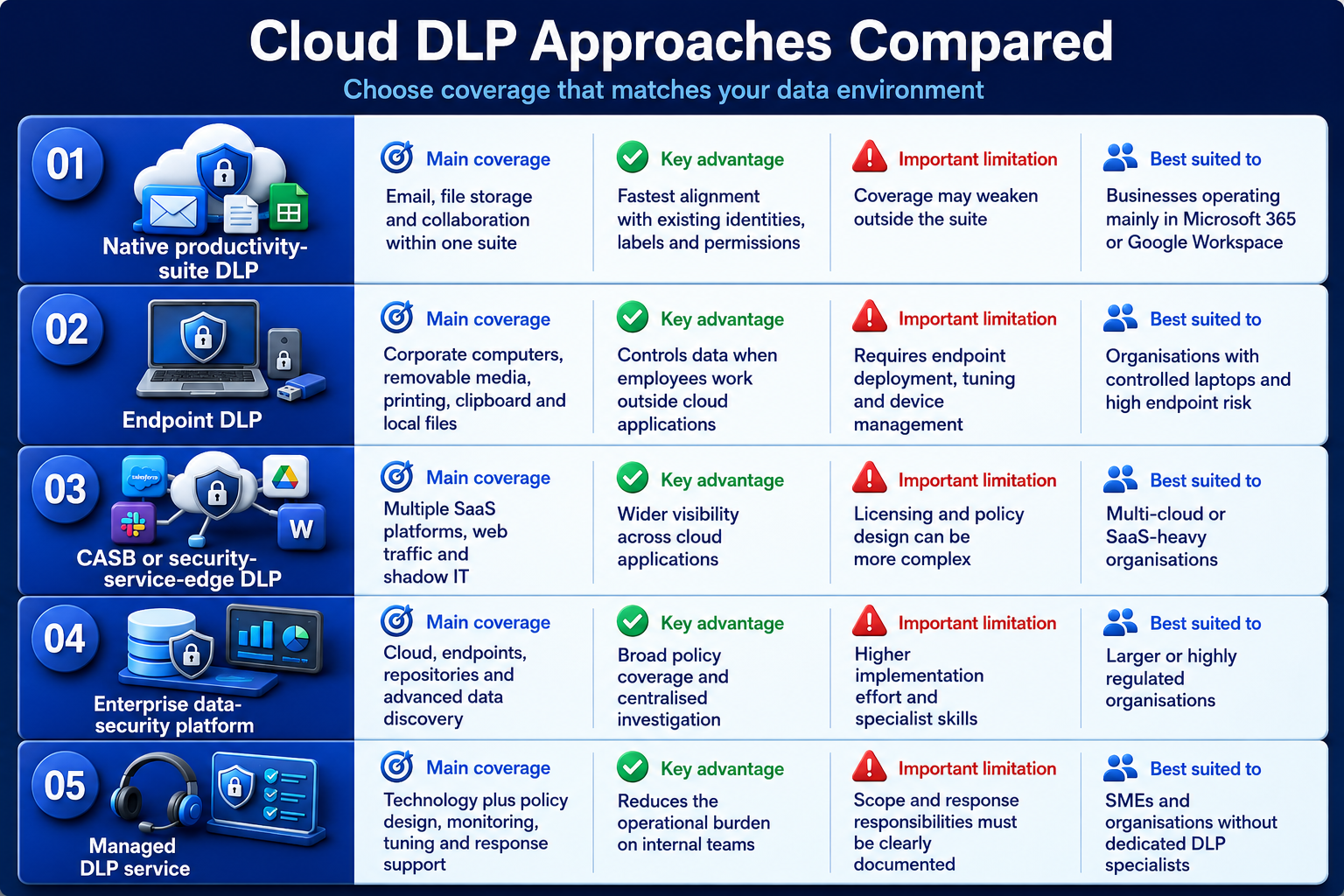
The right solution depends less on the number of advertised features than on where the organisation’s data lives and how employees use it.
Which DLP Approach Is the Best Fit?
A Microsoft-centred business should first assess the controls already available in its licensing. Microsoft states that core Purview DLP capabilities can cover Exchange Online, SharePoint Online and OneDrive for Business under eligible plans, while advanced options expand classification, insider-risk and endpoint capabilities. IT Company Australia can help evaluate licensing and deployment through its Microsoft 365 solutions.
A business using several cloud platforms may need a broader CASB, SSE or data-security platform. A professional-services firm with controlled laptops and strict document-handling rules may prioritise endpoint DLP. A smaller organisation may receive more value from managed DLP because monitoring, policy tuning and incident review are as important as the licence itself.
Cloud DLP Pricing in Australia
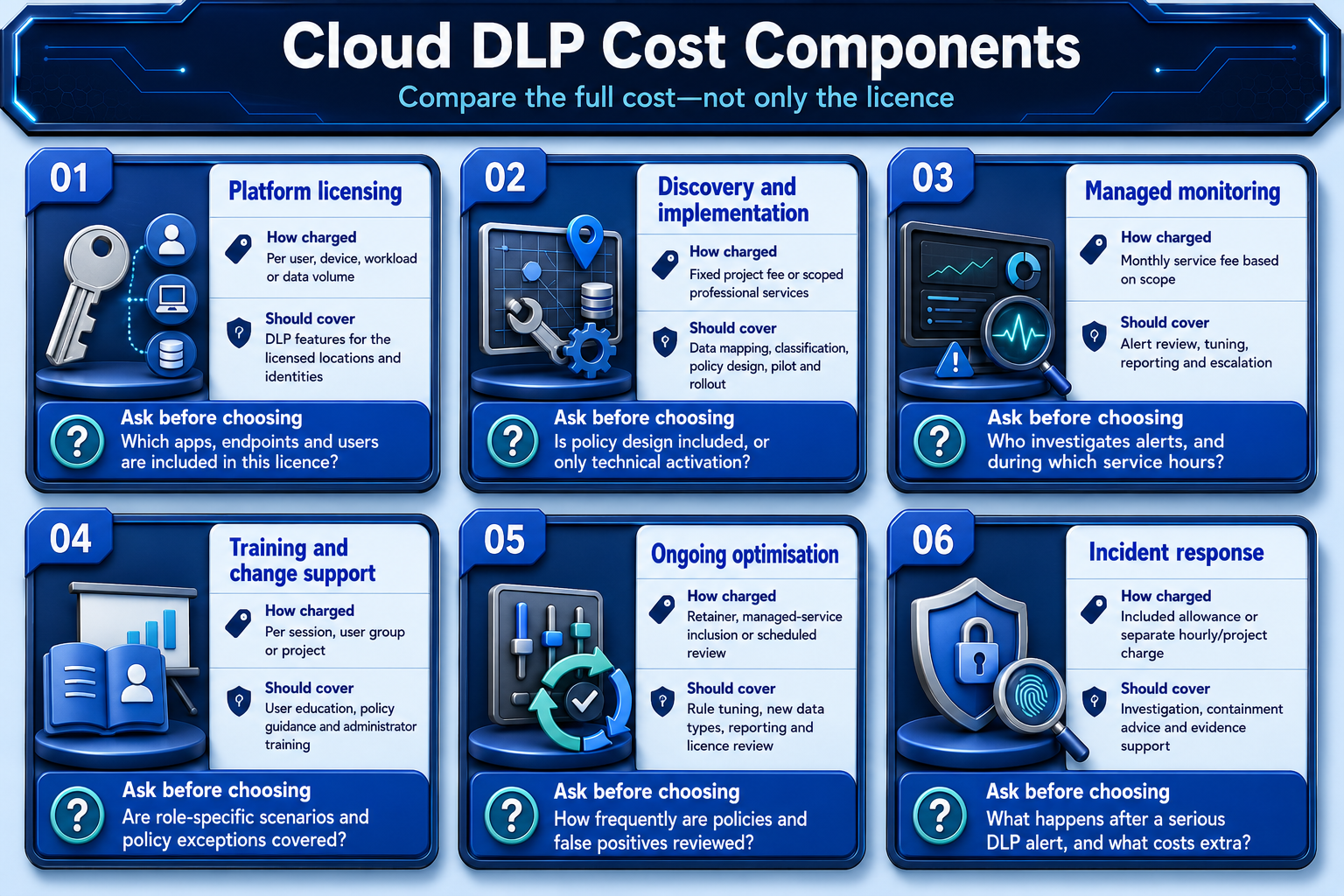
Cloud DLP pricing is usually based on protected users, devices, workloads or data volume. The cheapest licence is not necessarily the lowest-cost deployment because poorly designed rules create false positives and alerts that no one investigates.
Microsoft publishes useful Australian reference points. As of September 2026, the Microsoft Purview Suite for Microsoft 365 Business Premium is listed at AU$15 per user per month, paid yearly, excluding GST, and requires Business Premium. Microsoft lists the enterprise Purview Suite add-on at AU$18 per user per month, paid yearly and excluding GST, with eligible E3 licensing required. Prices and entitlements can change, so verify the current Microsoft Purview pricing before publishing a proposal.
The Cost That Is Often Overlooked
The largest hidden cost is often internal effort. Someone must approve classification rules, identify data owners, review exceptions and decide how alerts are handled. Before requesting quotations, document users, devices, priority applications, sensitive-data categories, service hours and response expectations so providers can quote comparable scopes.
Cloud DLP and Australian Compliance
DLP can support privacy and security obligations, but no product makes an organisation compliant by itself. Policies must reflect the information held, applicable legislation, contractual duties and sector-specific requirements.
Under Australian Privacy Principle 11, an APP entity must take reasonable steps to protect personal information from misuse, interference, loss and unauthorised access, modification or disclosure. These steps include technical and organisational measures and should reflect the sensitivity and volume of information held. See the OAIC’s APP 11 guidance.
The Notifiable Data Breaches scheme may require regulated entities to notify affected individuals and the OAIC when a breach is likely to cause serious harm. DLP logs can help establish what information was involved, which user acted and where the data went. They do not replace governance, access management, appropriate retention, training, a breach-response plan or legal assessment.
A Practical DLP Implementation Plan
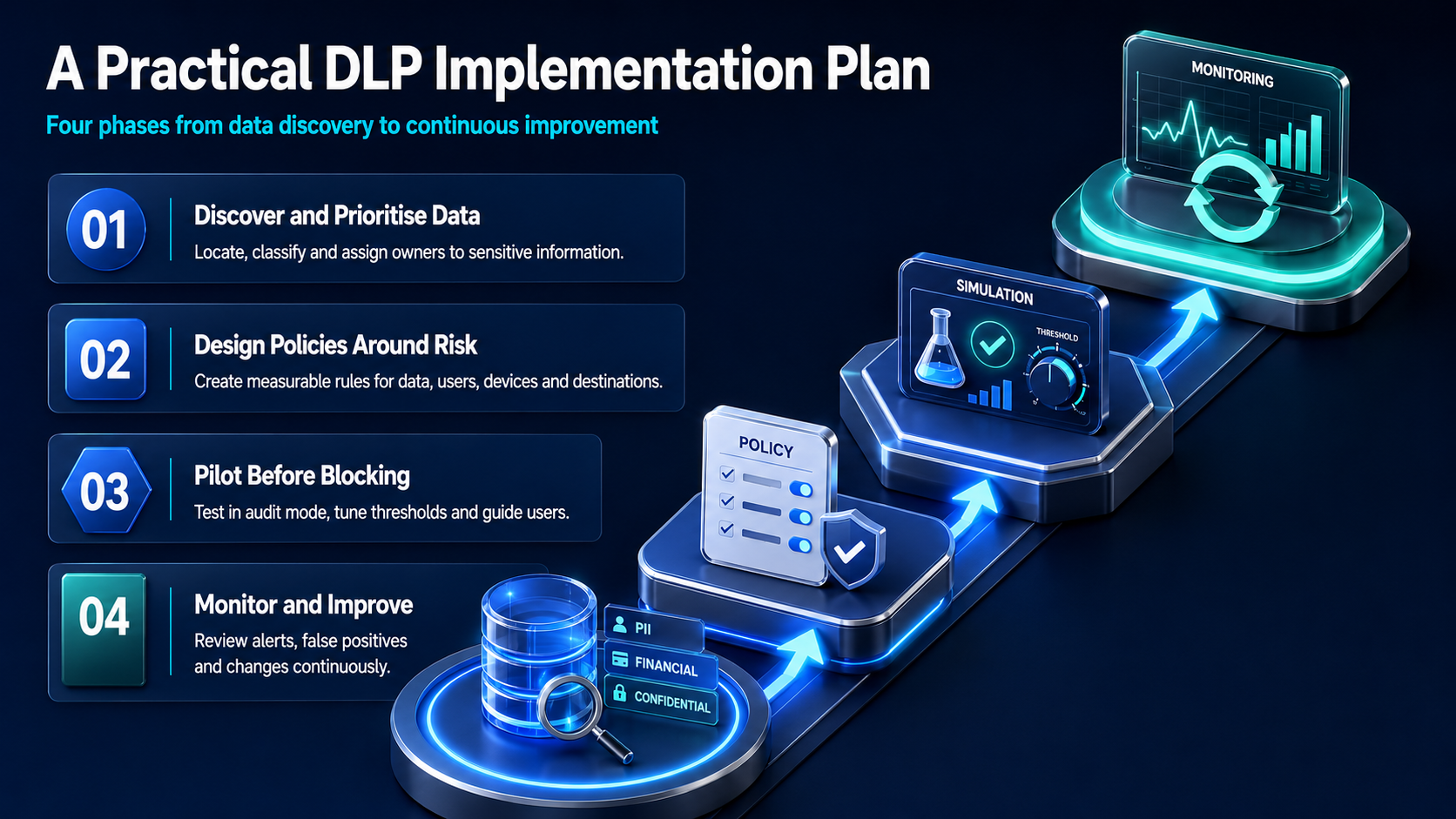
The most reliable deployments begin with the business’s data and workflows, not a library of aggressive default rules.
Phase One: Discover and Prioritise Data
Identify where sensitive information is created, stored and shared. Begin with a manageable classification model such as Public, Internal, Confidential and Highly Restricted. Define examples and an owner for each category, prioritising information whose exposure could create legal, financial, operational or reputational harm.
Phase Two: Design Policies Around Risk
Translate requirements into specific scenarios. “Protect confidential data” is too broad. “Warn when tax file numbers are emailed externally, block transfers to personal webmail and alert security above an agreed volume” is measurable and testable.
Controls should consider the data, user, destination, device and volume. Establish an exception process for legitimate work and record who can approve it. Email remains a major path for accidental disclosure, so DLP should be coordinated with business email security rather than managed as a separate silo.
Phase Three: Pilot Before Blocking
Run new policies in audit or simulation mode. Review match accuracy and legitimate processes that would be interrupted, then adjust thresholds before enabling blocking. Use policy tips to explain the reason for a rule and provide a safer alternative.
Phase Four: Monitor and Improve
DLP is an operating process, not a one-time installation. Review high-risk events, false positives, overrides, unresolved alerts and new cloud applications. Retest after licensing changes, migrations and major workflow updates.
Organisations without a dedicated security operations function can combine DLP with managed IT services to assign responsibility for monitoring, escalation, reporting and continuous improvement.
Our Data Protection Objectives
IT Company Australia’s DLP approach should be judged by measurable business such as website maintenance services outcomes rather than the number of policies enabled. The core objectives are:
- Visibility: Identify priority data, its locations, owners and normal movement.
- Prevention: Reduce accidental disclosure and unauthorised transfer without obstructing legitimate work.
- Accountability: Define who reviews alerts, approves exceptions and leads incident escalation.
- Compliance support: Produce useful controls and evidence aligned with privacy, contractual and industry requirements.
- Continuous improvement: Tune policies as the organisation, threat landscape, cloud estate and use of AI change.
Information security governance should also be considered when assessing a DLP provider. Our information security management system is certified to ISO/IEC 27001:2022, which provides a framework for identifying risks, managing controls and reviewing security processes. The certification applies to our management system; each client’s compliance requirements still depend on its own data, systems, processes and legal obligations.
Why Choose IT Company Australia?
A DLP project crosses identity, email, endpoints, cloud configuration, licensing, incident response and staff behaviour. IT Company Australia can assess the environment, identify priority information, review licensing, design practical policies and connect alerts to an operating process. This is useful for SMEs that need specialist capability without a full-time data-security team. The engagement can begin with an assessment and pilot, then expand where evidence supports stronger controls.
Questions to Ask Before Choosing a Provider
Ask the provider to demonstrate how its solution will handle real workflows. Confirm the protected applications, endpoints and users; who approves policies; how exceptions are managed; who investigates alerts; and what reporting is delivered. Request a responsibility matrix and document exclusions such as unmanaged browsers, personal cloud storage, USB devices, macOS endpoints or specialist SaaS platforms. Success should be measured through useful coverage, response times and false-positive reduction not the number of rules activated.
Frequently Asked Questions
What are cloud DLP solutions for Australian businesses?
Cloud DLP solutions discover sensitive information in cloud services, monitor how it is used and apply policies to reduce accidental or unauthorised disclosure. Depending on the platform, controls may cover email, file sharing, collaboration tools, browsers, endpoints and SaaS applications.
Does Microsoft 365 already include DLP?
Eligible Microsoft plans include different levels of Purview data loss prevention. Coverage and advanced features depend on the licence. Businesses should review the exact entitlements for Exchange, SharePoint, OneDrive, Teams, endpoints and AI use before purchasing add-ons. IT Company Australia’s guide to maximum email security in Office 365 provides additional context for protecting the email channel.
How much does cloud DLP cost in Australia?
Costs may include per-user or per-device licensing, initial discovery, policy design, implementation, staff training, monitoring and incident response. Microsoft’s published Australian Purview add-on prices provide one reference point, but multi-cloud and managed services usually require a scoped quotation. Compare total operating cost, not licence price alone.
Is DLP the same as cloud backup?
No. DLP reduces inappropriate use or transfer of sensitive data, while backup creates recoverable copies after deletion, corruption or ransomware. Many organisations need both. IT Company Australia’s cloud backup solutions address recovery, while DLP focuses on preventing and investigating disclosure.
Does DLP guarantee Privacy Act compliance?
No. DLP can support reasonable security measures, record policy events and reduce disclosure risk, but compliance also depends on governance, lawful handling, access control, retention, training and incident response. Obtain legal advice for obligations specific to your organisation and sector.
Can DLP prevent insider threats?
DLP can detect or restrict risky actions by authorised users, including unusual downloads, personal email transfers and uploads to unsanctioned services. It cannot remove all insider risk. Effective protection also requires least-privilege access, identity security, logging, management processes, maintenance of website and fair, documented employee policies.
Will DLP block legitimate work?
Poorly tuned DLP can interrupt normal tasks. A well-designed deployment begins in audit mode, tests rules with representative users, applies proportional actions and provides an exception process. Policy tips and user education can correct low-risk behaviour without unnecessary blocking.
How long does DLP implementation take?
Timing depends on the number of users, applications, devices, data types and approval processes. A focused Microsoft 365 pilot can be faster than a multi-cloud, multi-endpoint rollout. The provider should separate discovery, design, simulation, pilot and enforcement so the business can review evidence at each stage.
Final Thoughts
Cloud DLP is most effective when it connects information protection with the way people work. The correct platform should discover priority data, control the highest-risk channels, give employees useful guidance and produce alerts that someone is responsible for reviewing.
For Australian organisations, the buying decision should balance coverage, compliance support, operational effort and total cost. Start with the information that would cause the greatest harm if exposed, pilot a small number of precise policies and expand based on evidence.
Before selecting a product, document your sensitive data, cloud applications, user groups, compliance requirements and incident-response expectations. If you need help turning those requirements into a practical roadmap, explore IT Company Australia’s managed cyber security services and request an assessment of your current cloud data controls.
