
Technology spending rarely becomes expensive because of one spectacularly bad purchase. More often, costs accumulate through duplicated licenses, inconsistent device standards, fragmented suppliers, forgotten renewals and equipment that costs more support than expected.
Introduction
That is where information technology procurement services can create value. Rather than treating every laptop, software subscription or cloud service as a separate buying decision, structured procurement connects technology expenditure with requirements, budgets, supplier management, security and lifecycle planning. For this article, cost control does not mean buying the cheapest product. It means reducing avoidable expenditure while ensuring technology remains fit for purpose, supportable and financially predictable.
For Australian businesses in 2026, that distinction is increasingly important as IT budgets stretch across physical equipment, Microsoft 365, cloud consumption, cybersecurity products and recurring Software as a Service subscription.
What Are Information Technology Procurement Services?
Information technology procurement services help organisations control how technology is specified, sourced, purchased, licensed and managed across its useful life.
The scope can include:
- hardware and software sourcing;
- licensing and subscription management;
- supplier and quote comparison;
- warranties and lifecycle planning;
- deployment coordination and asset records.
The important distinction is between buying technology and managing technology expenditure.
Purchasing ends when a transaction is completed. Procurement considers whether the product was necessary, whether an existing product could meet the same need, how the purchase affects other systems, and what the organisation will spend after acquisition.
IT Company Australia’s current IT procurement service covers hardware and software sourcing, licensing, vendor management, bundling, warranty support and lifecycle management. Its live service page also describes Australia-wide fulfilment and support for distributed workforces.
For cost-focused procurement, a useful decision framework is:
Requirement → Commercial evaluation → Approval → Deployment → Lifecycle control
The objective is not to add bureaucracy to every purchase. It is applying enough control to prevent technology decisions from creating unnecessary recurring costs.
Why IT Procurement Matters for Australian Businesses in 2026
The modern IT budget is increasingly fragmented.
One department may purchase software directly. Another renews the SaaS platform automatically. Finance pays cloud invoices. IT manages Microsoft licensing. Individual teams may order devices from different suppliers.
Every transaction can appear reasonable on its own while the combined technology estate becomes expensive. Procurement governance gives the organisation a consolidated view of what it owns, what it pays for, and which contractual commitments are approaching renewal.
Security also belongs to the procurement decision. ASD’s Guidelines for procurement and outsourcing, first published and last updated on 3 September 2026, states that cyber supply-chain risk management should be considered when procuring operating systems, applications, IT equipment and services. Its guidance covers risks across design, delivery, installation, operation, maintenance and decommissioning, and stresses supplier security and transparency. That makes IT procurement a financial-control function and, increasingly, a risk-management function.
Ad Hoc Purchasing vs Cost-Governed IT Procurement
The difference becomes clearer when procurement is viewed as an operating model rather than an ordering service.
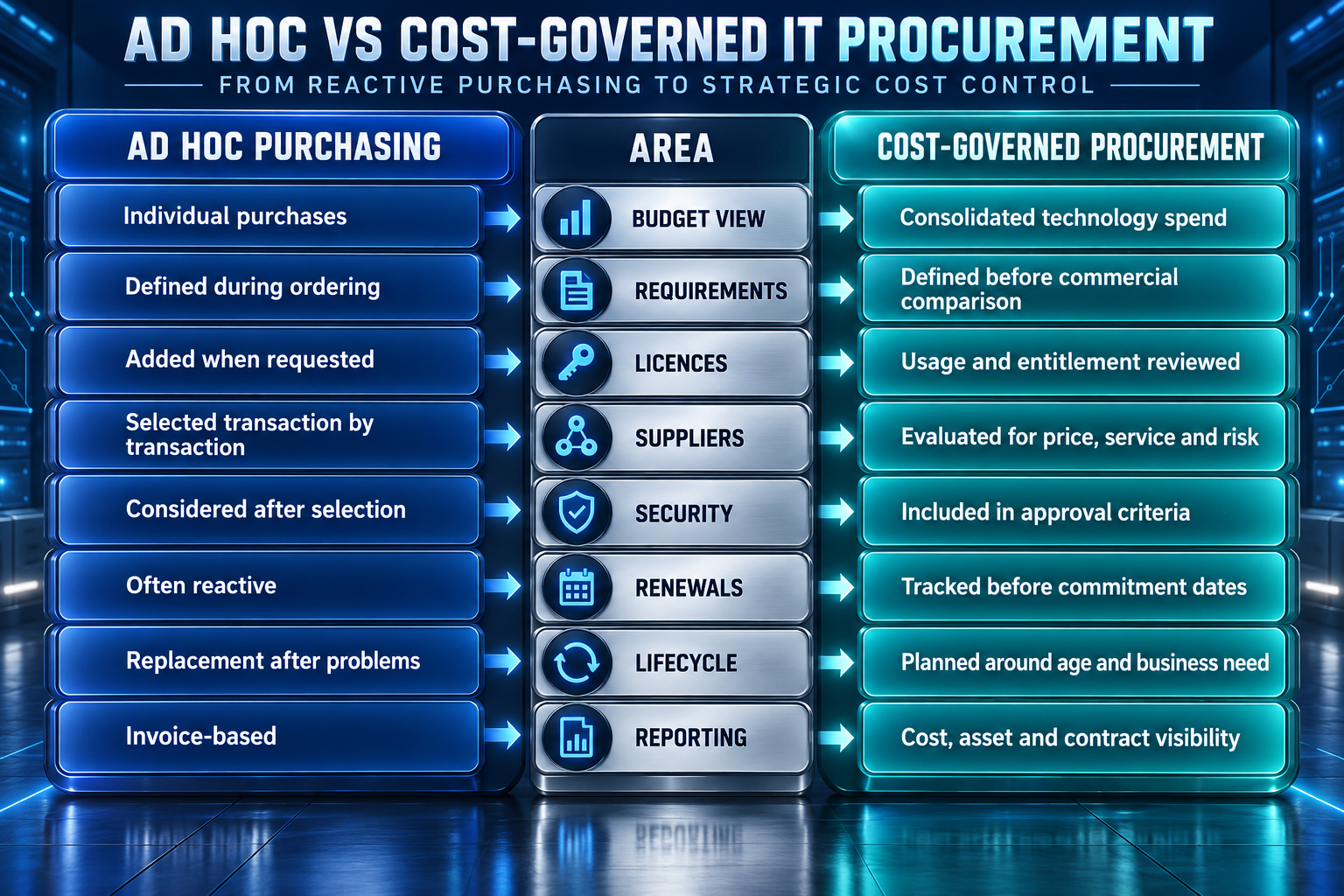
Ad hoc purchasing can still be appropriate for trivial, low-risk purchases. The financial value of structured procurement increases as the number of users, subscriptions, suppliers and locations grows.
7 Ways Information Technology Procurement Services Can Control IT Costs
Establish an IT Spend Baseline Before Approving New Purchases
Cost control is difficult when a business cannot see its existing technology commitments. Before approving new expenditure, procurement should establish what the organisation already owns, leases or subscribes to. That includes physical assets, software subscriptions, cloud commitments, warranties and important supplier contracts.
This baseline can uncover spending that would otherwise remain hidden. A department requesting a new collaboration platform may already have similar functionality within Microsoft 365. A laptop request may be avoidable if a recently returned device can be reassigned.
A spend baseline also improves forecasting because finance can distinguish recurring technology commitments from genuine new investments.
Where procurement operates alongside managed IT services, asset information, support history and technology planning can help determine whether a purchase is necessary or whether an existing resource can be reused. The current managed-services page includes infrastructure, cloud and broader technology management functions. This changes procurement from approving requests to actively manage demand.
Compare Total Cost of Ownership Before Comparing Discounts
The purchase price explains what technology costs today.
Total cost of ownership, or TCO, considers what it can cost during the period the business expects to use it. For hardware, the calculation may include accessories, freight, configuration, warranty, support, repairs, and replacement. For software, it can include subscriptions, implementation, integrations, administration, upgrades, and future renewal costs.
Cloud technology requires similar discipline. A migration may reduce physical infrastructure expenditure while introducing recurring compute, storage, network and management costs. IT Company Australia’s cloud management service specifically lists cost management, rightsizing and cloud optimisation among its current capabilities.
That is why the strongest rule belongs here: The lowest purchase price is not necessarily the lowest total cost.
A device that costs $200 less but needs earlier replacement can erase its original saving. A cheaper software tier can become more expensive if required capabilities later need separate products. TCO gives businesses a more defensible financial comparison than discounts alone.
Purchase Price vs Total Cost of Ownership (TCO)
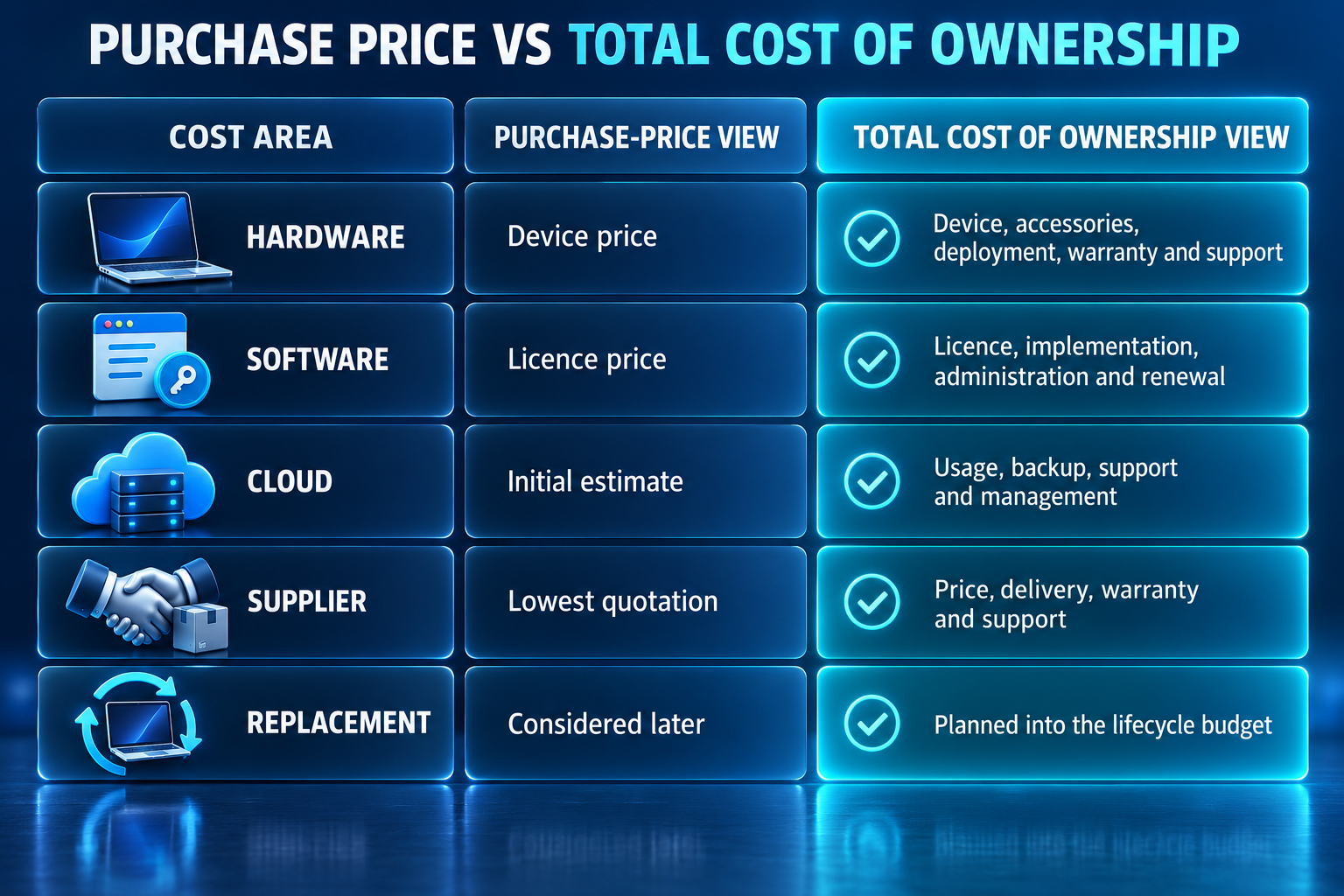
TCO does not predict every future expense. It provides a more realistic framework for comparing technology options by including costs that may continue after the initial purchase. The relevant cost categories will vary depending on the product, service and operating environment
Treat Software Licenses as a Recurring Cost Portfolio
Licensing creates a different procurement problem because spending can continue indefinitely without another purchasing decision.
An employee joins and receives several subscriptions. Another change’s role but retains premium licenses. A third leaf and some subscriptions remain active. Across dozens or hundreds of users, small inefficiencies become persistent operating costs. Procurement should therefore reconcile licenses with active users, required features, and renewal dates.
Microsoft 365 demonstrates why this matters. The current Microsoft 365 service lists different Business Basic, Business Standard and Business Premium options with different feature sets and published annual prices. The objective is not automatically downgrading every user. An employee who requires desktop Office applications, additional management capabilities or advanced security may genuinely need a different license from someone using browser-based productivity tools.
Cost control comes from role-based entitlement, not blanket standardisation. Renewal management matters, too. If a contract renews automatically before usage is relicensed the business can lock itself into another billing cycle for capacity it no longer needs.
Simple Microsoft 365 Licensing Cost Example
The current IT Company Australia Microsoft 365-page lists Business Standard at AUD 213.11 per user/year and Business Premium at AUD 375.08 per user/year.
Consider an Australian business with 20 Microsoft 365 users. If all 20 users were assigned Business Premium at AUD 375.08 per user/year, the annual license cost would be AUD 7,501.60. If eight users genuinely required Business Premium while the remaining 12 were appropriately matched to Business Standard at AUD 213.11 per user/year, the annual cost would be approximately AUD 5,557.96. The illustrative difference is AUD 1,943.64 per year, or AUD 5,830.92 over three years, assuming the published prices remained unchanged. This does not mean organisations should automatically move users to lower-cost plans. License selection should reflect each employee’s required applications, administration, security features, and business responsibilities.
Manage Suppliers as a Portfolio, Not a Series of Quotes
Supplier management affects costs long after purchase.
A low device price may be less attractive if delivery is unreliable, warranty claims are difficult or replacement stock disappears halfway through a rollout. Australian procurement therefore needs to consider commercial terms alongside operational consequences.
Some business purchases may qualify for Australian Consumer Law protections. According to the ACCC’s guidance on consumer rights and guarantees, a product or service bought for business use can be covered by consumer guarantees when it meets certain conditions, including where it costs less than $100,000 including GST, subject to relevant exceptions.
Consumer guarantees are also different from manufacturer or extended warranties. The ACCC’s guidance on warranties explains that warranties are additional promises and do not replace applicable consumer-guarantee rights.
Procurement records should still capture manufacturer warranties, supplier contacts and proof of purchase because these affect how quickly equipment can be repaired or replaced. Supplier concentration requires balance as well. Consolidating purchasing with fewer suppliers can simplify billing and improve volume visibility. Excessive dependence on one supplier, however, can create availability and pricing risk.
The right model gives the business enough supplier control to negotiate effectively without creating an unnecessary single point of dependency.
Make Security and Supportability Procurement Requirements
A technology purchase can save money initially and create expensive remediation later if the product is difficult to secure or support.
Support status should therefore influence purchasing approval. Equipment and software that remain within vendor-supported versions are generally easier to maintain than products approaching end of life. Security requirements may also include encryption, multi-factor authentication support, device management compatibility, and administrative controls.
ASD’s September 2026 procurement guidance specifically recommends considering cyber supply-chain risks and the security record, transparency and responsibilities of suppliers when procuring IT equipment and services. This is particularly relevant for outsourced or managed services because supplier access can become part of the organisation’s risk profile.
Where procurement uncovers broader security requirements, managed cyber security services may provide a separate control layer covering network, endpoint, identity and threat-monitoring concerns. The two activities should remain distinct: procurement chooses suitable technology; security operations govern and protect its use.
Security due diligence can therefore prevent future spending that arises from buying unsuitable technology in the first place.
Standardise Technology Where Variation Adds Cost but Little Value
Standardisation is one of the most practical ways to reduce support complexity. That does not mean forcing every employee onto the same laptop. A stronger model creates a limited number of approved technology profiles.
A general office user, mobile professional and high-performance employee may each have different requirements, while still drawing from a controlled catalogue.
This reduces unnecessary variations in chargers, docks, drivers, operating systems, and replacement stock. Support teams also become more familiar with recurring configurations, which can simplify diagnosis and deployment.
Server purchases deserve the same discipline. Infrastructure decisions should reflect expected workloads, support processes, and maintenance requirements rather than being made independently of the operating environment.
Where server administration forms part of the lifecycle, server management can connect infrastructure with monitoring, patching, backups, and ongoing management. The live service page currently publishes those functions across its server-management offering.
Standardisation creates the greatest value when exceptions remain possible but must be justified by a genuine workload requirement.
Manage Renewals and Replacement as Future Liabilities
A procurement decision has a future date attached to it. Hardware will reach the end of its useful life. Warranties have expired. Software subscriptions are renewed. Vendors discontinue products.
Those events should be forecast rather than discovered unexpectedly. Lifecycle records allow a business to identify replacement clusters before they become budget shocks. Twenty laptops approaching retirement next year can be planned into the budget now rather than becoming twenty urgent purchases later.
The same principle applies to software. Renewal calendars create time to review users, renegotiate contracts, or evaluate alternatives before the organisation is committed to another term.
IT Company Australia’s existing hardware and software procurement guide covers product suitability, deployment, warranties and technology lifecycle in greater detail. The new cost-governance focus here is different: the aim is to turn those lifecycle events into predictable financial decisions rather than unplanned expenditure.
Good lifecycle procurement therefore produces a forecast, not just an asset to register.
Purchase Price vs Lifecycle Cost for Australian Businesses
Australian decisionmakers often receive quotations that make the acquisition price highly visible while leaving later costs less obvious.
The second comparison puts those costs side by side.
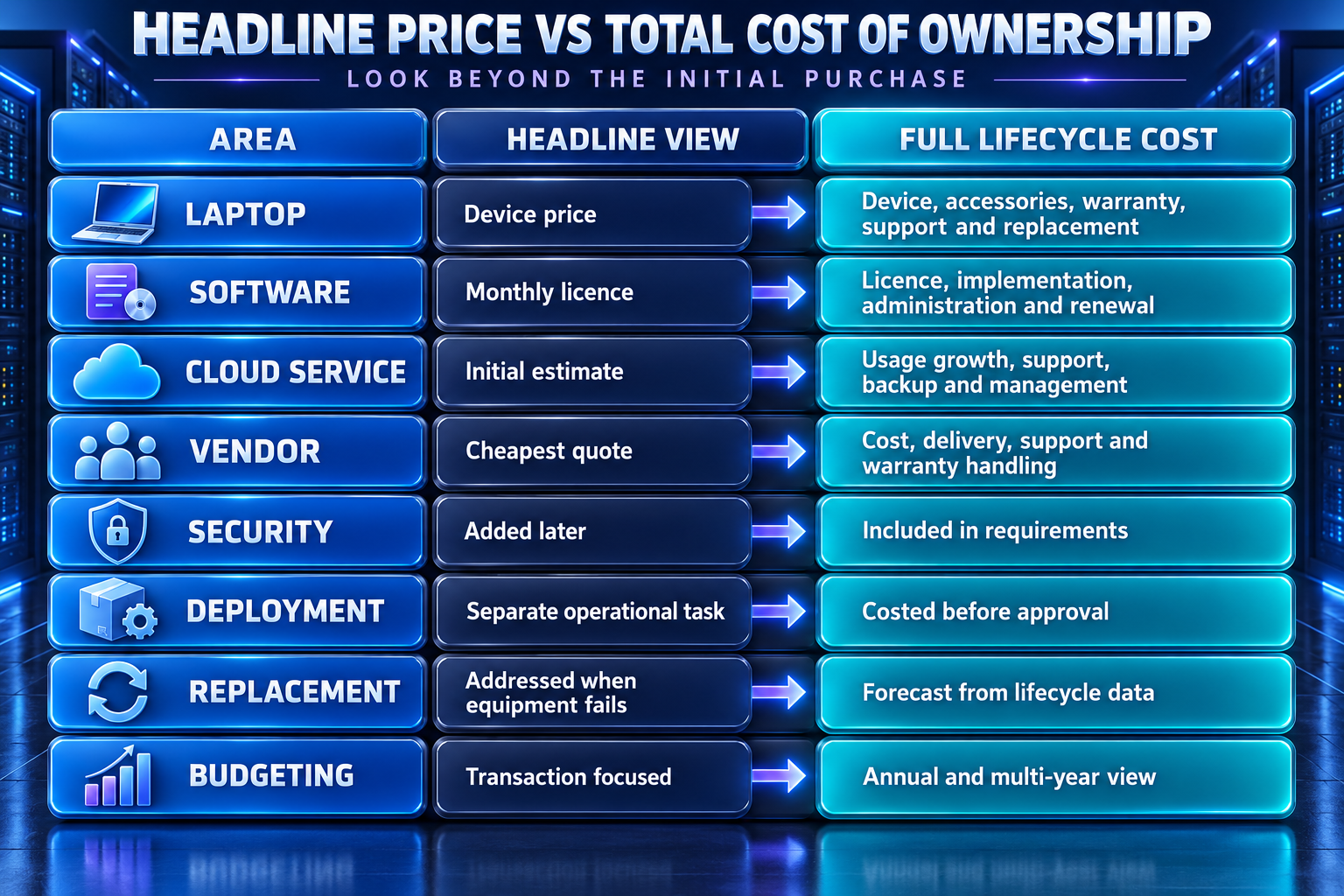
GST should be treated consistently when evaluating quotations. GST treatment depends on the business’s circumstances and tax documentation, so businesses should obtain accounting advice where necessary rather than treating procurement guidance as tax advice.
This keeps financial comparison useful without turning the technology decision into a tax calculation.
How Are Information Technology Procurement Services Priced in Australia?
There is no reliable single price for information technology procurement services because procurement scope varies considerably.
A five-device purchase may require little more than sourcing and delivery. A multi-location rollout may involve specification, vendor negotiation, software licensing, configuration, asset registration, deployment scheduling, and lifecycle reporting.
IT Company Australia’s current IT procurement page describes end-to-end sourcing, licensing, vendor management, warranty support and lifecycle services but does not currently display one fixed complete procurement-service fee in the live page retrieved for this review.
Procurement proposals should therefore separate product and service costs.
Hardware, software licenses, and freight may appear as acquisition costs. Configuration, deployment, project work, extended support or asset-management activities may be included, bundled or separately charged depending on the provider.
GST treatment should also be explicit. The most useful comparison is a realistic annual or lifecycle figure that reflects both the products being acquired and the work required to make them operational.
How to Compare Information Technology Procurement Service Providers
Procurement providers should be compared using the same requirement set.
Otherwise, one proposal may appear cheaper simply because it excludes configuration, warranty coordination, or deployment.
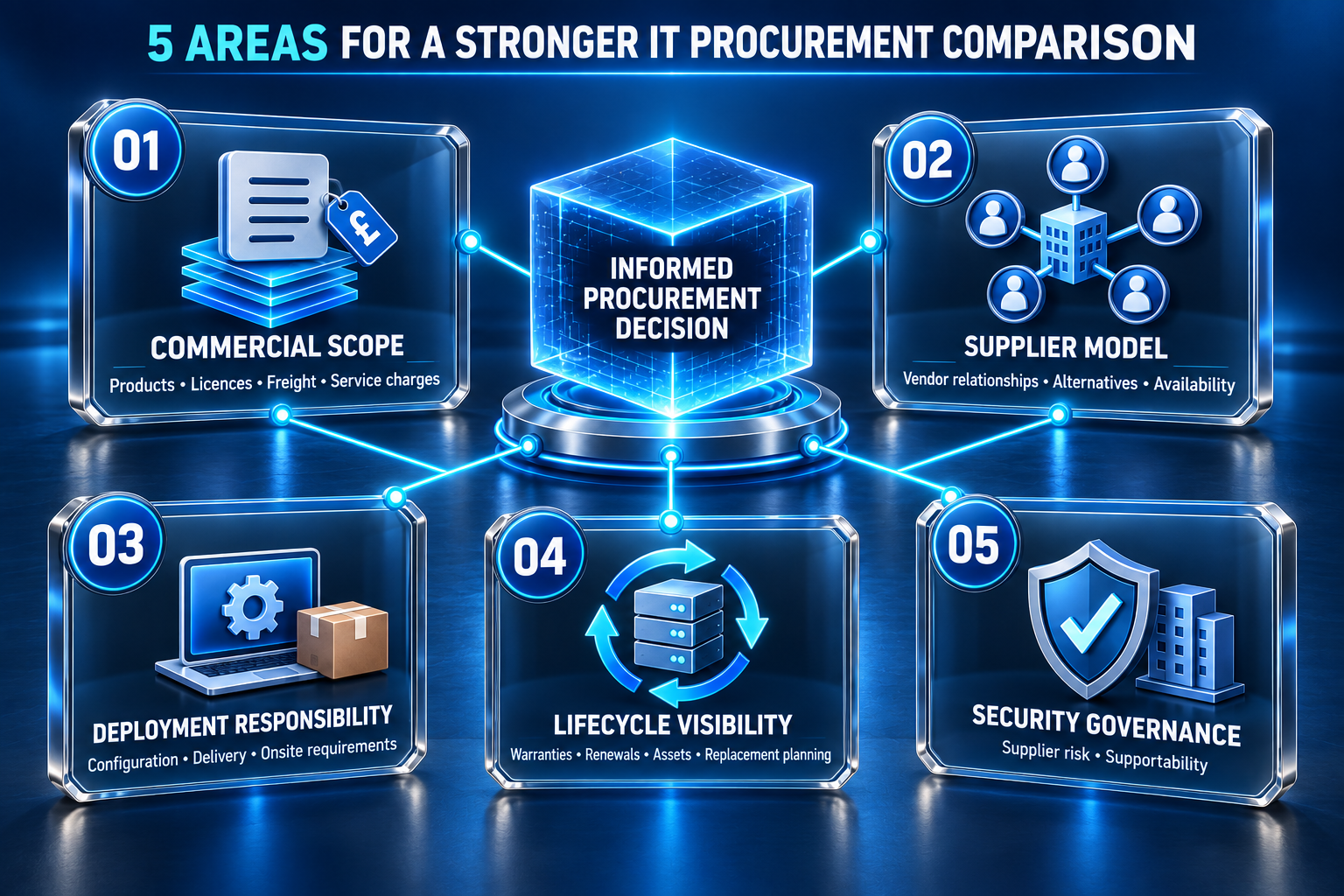
Provider reporting should become more detailed as procurement volume grows. A business buying technology across multiple departments should be able to see material purchases and renewals without reconstructing the position from dozens of invoices.
Location also affects fulfilment. Businesses using ITCompany Sydney, ITCompany Melbourne, ITCompany Brisbane or ITCompany Perth can use the listed Australian contact pathways for procurement enquiries. Stock availability, delivery timeframes, onsite deployment and support arrangements should still be confirmed for each requirement rather than assumed to be identical nationally. IT Company Australia’s current Contact page lists all four locations.
Businesses comparing procurement within a wider technology strategy can also review how IT services companies in Australia are evolving in 2026, particularly where supplier selection needs to align with cloud, cybersecurity and managed-service planning.
A good procurement provider should make technology expenditure more transparent before, during and after purchase.
Where IT Company Australia May Fit
IT Company Australia’s current procurement offering covers hardware and software sourcing, licensing, vendor management, bundling, warranty support, lifecycle management and distributed-device procurement.
That scope may suit organisations seeking to consolidate purchasing and lifecycle administration, but buyers should assess it using the same standards applied to other providers: suitability, commercial transparency, vendor choice, deployment responsibilities, warranty handling and lifecycle visibility.
Integration with cloud, Microsoft 365, managed IT, servers and cybersecurity can also matter when the purchased technology needs to fit an existing support model.
IT Company Australia has been ISO/IEC 27001:2022 certified. Certification can be considered alongside service scope, supplier responsibilities, contractual terms and other procurement due-diligence requirements.
Certification can support providers due to diligence. It does not guarantee that every product’s choice is automatically secure, compliant, or commercially optimal.
Frequently Asked Questions
What Are Information Technology Procurement Services?
Information technology procurement services help organisations plan, source, purchase and manage technology products and services. Depending on scope, that can include requirements analysis, hardware, software licenses, supplier management, warranties and lifecycle planning.
How Can IT Procurement Help Control Costs?
IT procurement can reduce avoidable expenditure by improving spending visibility, controlling licenses, comparing lifecycle cost, managing suppliers, and forecasting renewals and replacements. Savings depend on the organisation’s current environment and purchasing patterns.
What Is the Difference Between IT Purchasing and IT Procurement?
IT purchasing is the transaction used to acquire a product or service, while procurement is the broader process surrounding requirements, supplier evaluation, commercial approval, lifecycle cost and ongoing management.
Is Direct IT Purchasing Cheaper Than Using a Procurement Service?
Direct purchasing can be cost-effective for simple, well-understood requirements. Procurement support becomes more valuable as device volumes, software licensing, suppliers, locations and deployment responsibilities become more complex.
How Should Software Licensing Be Managed?
Licenses should be matched to current users, roles, and required functionality, then reviewed before renewal. Businesses using Microsoft products can compare current Microsoft 365 options as part of that entitlement review.
Should Cybersecurity Be Part of IT Procurement?
Yes. Security, supplier risk and product supportability should influence technology approval because these factors can create operating and remediation costs after purchase. Procurement does not replace cybersecurity operations, but it can prevent unsuitable technology from entering the environment.
What Should Australian Businesses Compare in IT Procurement Quotes?
Quotes should be compared against the same scope, including products, licenses, freight, GST treatment, configuration, deployment, warranties, and ongoing services. Comparing only headline product prices can hide meaningful differences in responsibility and lifecycle cost.
Final Thoughts
Technology cost control begins before an order is placed and continues long after the product arrives.
Effective information technology procurement services give Australian businesses greater visibility across demand, total ownership cost, licenses, suppliers, security requirements, standardisation and lifecycle commitments. The seven strategies in this guide all support the same principle: procurement should help an organisation understand the financial consequences of a technology decision before those consequences become fixed costs.
That is what separates cost governance from ordinary purchasing. Businesses that want to compare device, software, licensing, supplier and lifecycle requirements can review IT Company Australia’s IT procurement service and contact the team for a scope based on their actual technology environment.
