
A security weakness does not need to look dramatic to create business risk. An outdated internet-facing service, forgotten server, vulnerable application component or poor configuration may remain unnoticed until someone actively looks for it.
Introduction
That is the purpose of vulnerability assessment services. They help organisations identify weaknesses; understand which findings matter most, assign remediation, and verify whether corrective action has worked.
For Australian businesses, that process has become increasingly relevant. ASD’s Australian Cyber Security Centre reported that publicly reported Common Vulnerabilities and Exposures increased 28% during 2024–25, while the average self-reported cost of cybercrime per business report reached $80,850, up 50% overall.
Those figures do not mean every vulnerability becomes a breach. They do show why waiting for a security incident before examining exposure is a poor risk-management strategy.
Vulnerability is a weakness. Risk depends on where that weakness exists, how exposed it is, whether exploitation is practical, what system it affects, and what controls already reduce the impact.
This guide moves from that basic distinction into asset discovery, authenticated scanning, prioritisation, remediation ownership, retesting, and continuous vulnerability management.
What Are Vulnerability Assessment Services?
Vulnerability assessment services examine systems for security weaknesses and turn the findings into a structured view of risk. A scanner is often part of the process, but the complete service should go further than producing a raw list of technical findings.
Depending on scope, an assessment may examine:
- Networks and infrastructure such as servers, endpoints, network devices, and internet-facing systems.
- Websites and applications for outdated components, exposed services, and configuration weaknesses.
- Cloud and remote-access environments where public exposure or insecure configuration increases risk.
- Known software vulnerabilities that can be matched against installed versions and available fixes.
That is the first important distinction: scanning produces findings; assessment adds context. IT Company Australia’s live vulnerability scan service currently describes scanning across servers, networks, applications and endpoints, together with risk identification and remediation guidance.
Authenticated vs Unauthenticated Assessment
Assessment depth also depends on how the scanner interacts with the environment.
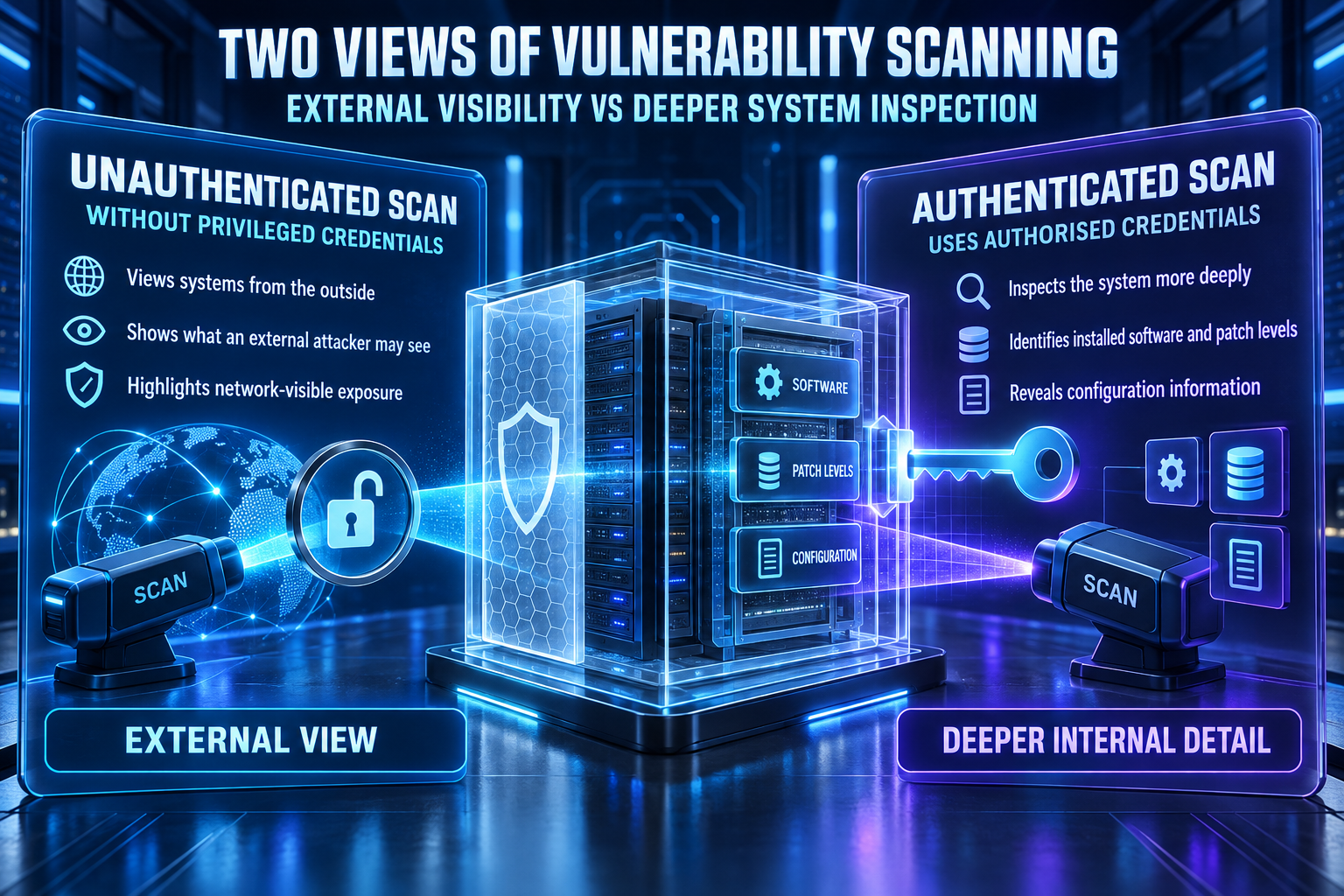
Neither approach automatically replaces the other.
External exposure matters because internet-facing weaknesses can be reachable directly. Authenticated assessment provides deeper internal visibility. A well-defined scope should state which approach applies to which assets.
What Should a Useful Vulnerability Assessment Produce?
A useful vulnerability assessment should produce an asset-aware findings register, validated risks, remediation priorities, responsible owners, target dates, accepted exceptions and retesting results. That output is far more useful than hundreds of scanner alerts with no explanation of which findings threaten important business systems.
The operating model is straightforward:
Discover → Assess → Prioritise → Remediate → Retest
The final two stages are critical. Finding a weakness does not reduce risk by itself.
Why Vulnerability Assessment Matters to Australian Businesses in 2026
Modern Australian businesses operate across more technology than a traditional office network. An organisation may rely on Microsoft 365, cloud platforms, websites, remote access, business applications, employee laptops and third-party integrations at the same time. Each additional system creates another configuration, software version, and access path that needs to remain visible.
ASD reported a 28% increase in publicly reported Common Vulnerabilities and Exposures during 2024–25. The same annual threat report highlighted vulnerable devices and software as recurring opportunities for malicious actors. The problem is not simply that vulnerabilities exist. Every organisation will eventually encounter them. The real challenge is deciding which vulnerabilities deserve action first.
A critical-looking scanner alert on an isolated test system may present less immediate business risk than a moderately rated vulnerability affecting an internet-facing system that stores customer information. That is why vulnerability assessment needs to move beyond severity labels.
Vulnerability Assessment vs Scanning vs Penetration Testing
The terms are often used interchangeably, but they represent different levels of security work.
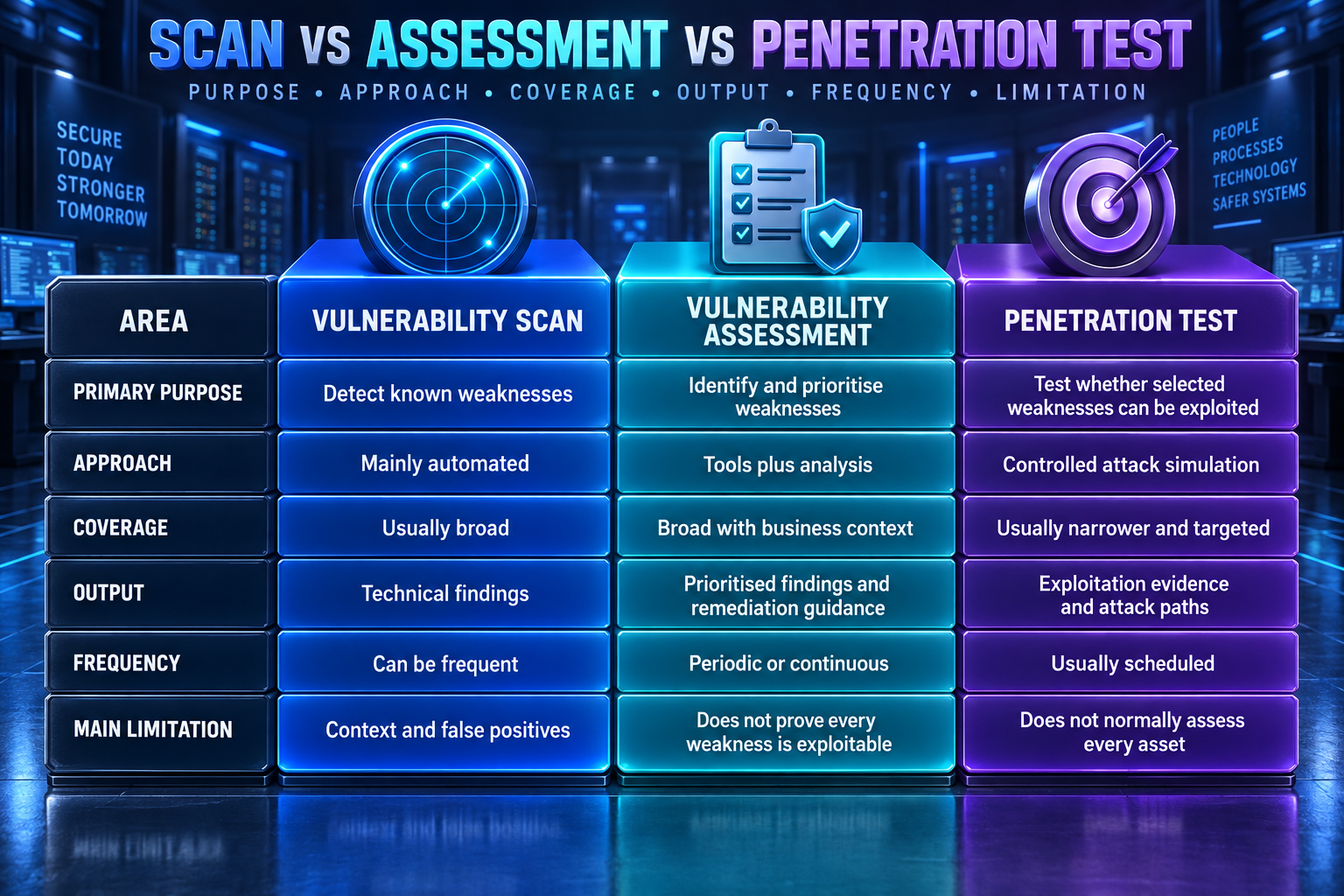
A scan is useful for repeatable coverage. An assessment interprets the findings and determines their relevance. A penetration test investigates whether selected weaknesses can be exploited under an agreed test scope.
They are complementary activities rather than competing labels. The strongest distinction is this: A vulnerability assessment asks what should be fixed first. A penetration test investigates how selected weaknesses could be used in practice.
10 Ways Vulnerability Assessment Services Can Reduce Cyber Risk
Discover Assets Before They Become Blind Spots
A business cannot protect systems it does not know exist. Old servers, test environments, forgotten public IP addresses, and unsupported software can remain connected long after their original purpose disappears. Asset discovery creates the foundation for vulnerability management because the assessment scope can be compared with the technology the business actually uses.
ASD’s Essential Eight assessment guidance recommends automated asset discovery to support later vulnerability-scanning activities and specifically notes that unknown assets should be investigated.
For Australian SMEs, this matters particularly when technology has accumulated gradually through cloud migrations, remote work and different suppliers. The useful outcome is not simply a device count. It is a clearer record of systems that need security ownership.
Find Outdated Software and Exposed Services
Known vulnerabilities often become dangerous because affected systems remain unpatched or unsupported. A vulnerability assessment can identify software versions, open network services and systems that may be approaching or past vendor support.
ASD’s Essential Eight guidance recognises vulnerability scanning as one method for identifying missing patches and unsupported technology. It also recommends using current vulnerability information when assessing risk.
Where servers are part of the environment, ongoing server management can connect assessment findings with patching, system maintenance and recurring vulnerability reporting. The current service page includes security scans, vulnerability reporting and patching options across its published plans.
This is where discovery starts becoming actionable. A report that identifies an outdated service but does not assign responsibility for fixing it leaves the business exposed.
Separate External Exposure from Internal Weaknesses
External and internal assessments answer different questions. External testing examines systems visible from outside the organisation. That can include internet-facing servers, websites, remote-access services, and other public interfaces.
Internal assessment looks at weaknesses that may matter once someone has gained access to the network or is already an authorised user.
Authenticated scans can provide deeper internal information because authorised credentials allow the assessment tool to inspect software versions, patch status, and configuration details. Unauthenticated scans provide a different perspective by showing what may be visible without privileged access.
For more complex environments, useful coverage often requires both. This distinction prevents an organisation from concluding that a clean external scan means its entire internal environment is free from vulnerabilities.
Prioritise Findings Using Business Risk
Not every scanner alert deserves the same response. Technical severity is important, but it should be one input rather than the only input.
A practical remediation priority should consider technical severity, evidence of active exploitation, internet exposure, asset criticality, likely business impact and existing compensating controls. That is a decision framework, not a mathematical formula.
CISA’s Known Exploited Vulnerabilities catalogue specifically recommends using evidence of vulnerabilities exploited in the wild as an input to vulnerability-management prioritisation. This changes the conversation from “How many critical findings do we have?” to “Which weakness creates the most meaningful risk for this organisation?”
For example, an internet-facing vulnerability affecting a customer system may deserve rapid attention even when another system carries a higher numerical severity score.
Severity describes vulnerability. Priority reflects the business context.
Connect Assessment Results with Patch Management
Detection and remediation should not exist as separate workflows.
Once a vulnerability is validated, the organisation needs to determine whether a vendor patch, software upgrade, configuration change or compensating control is appropriate.
ASD’s Essential Eight guidance explains that network-based vulnerability scanners can help identify service versions and assess patching status. Importantly, it also warns that scanners may not detect every vendor’s mitigation, including required configuration changes. That limitation matters.
Scanning is evidence, not complete security assurance.
Patch deployment also needs change management. Updating a business-critical application without testing can create availability problems of its own. A mature remediation process therefore balances security urgency with operational impact, testing requirements and rollback planning.
Assess Websites and Applications Separately
Business websites and applications deserve specific attention because they are often internet-facing.
A standard network scan can identify many infrastructure weaknesses, but application security can involve additional issues such as outdated components, insecure configuration, and software-specific vulnerabilities.
A business website may also combine a content management system, plugins, hosting environment, and third-party services. Each layer can change over time.
IT Company Australia’s website security service currently includes malware scanning, monitoring, backup and other website-protection features. Vulnerability assessment should nevertheless avoid an unrealistic promise: automated scanning cannot identify every application logic problem or every security flaw. High-risk applications may require deeper manual review or penetration testing.
Include Cloud and Remote-Access Systems
The network perimeter has become harder to define.
Employees may connect from home; applications may sit in cloud platforms, and business information may be spread across SaaS systems and hosted infrastructure. A vulnerability assessment that looks only at devices physically located in the office can therefore miss important exposure.
Cloud workloads, remote access gateways, and internet-facing services should be considered according to the organisation’s architecture. The assessment should also recognise its limits.
Vulnerability scanners are useful for technical weaknesses, but they do not automatically identify every identity problem, excessive permission, stolen credential or risky business process. Those issues may require broader managed cyber security services covering identity, network security, endpoint protection and incident readiness. IT Company Australia’s current service page includes those areas as part of its broader security scope. That separation keeps the assessment realistic rather than presenting it as a complete cybersecurity solution.
Turn Findings Into a Remediation Plan
A security report becomes useful when someone owns the next action. Assessment, remediation and retesting should therefore be treated as separate responsibilities.
- Assessment identifies and validates weaknesses.
- Remediation involves applying patches, changing configurations, upgrading software, removing unnecessary services or implementing compensating controls.
- Retesting checks whether the selected fix actually resolved the original finding.
The organisation should know which party owns each stage. A managed assessment provider may deliver remediation guidance without performing the actual changes. Another provider may include remediation assistance within the service. The contract should make that distinction explicit. A useful remediation register should contain enough information for management to track the issue through to closure rather than simply marking it “assigned”.
IT Company Australia’s earlier guide on how vulnerability assessments protect businesses provides introductory context on the role assessments play in broader security planning. The new priority is to move beyond awareness into accountable remediation.
Retest Instead of Assuming the Fix Worked
A closed support ticket is not security evidence. A patch can fail to install. A configuration change can be incomplete. A system can be restored from an older image and reintroduce the same weakness.
Closing a ticket does not prove that vulnerability has disappeared.
Retesting checks the affected system after remediation and records whether the finding remains. It can also reveal whether the fix affected related systems or whether another control is still required. This is particularly useful for management reporting because it distinguishes between vulnerabilities that were merely assigned and vulnerabilities that were demonstrably resolved.
The organisation can then retain evidence of what changed, when it changed, and whether the remediation was successful.
Move From Point-in-Time Assessment to Vulnerability Management
A vulnerability assessment is a snapshot. The environment keeps changing immediately afterwards.
New software is installed. New vulnerabilities are disclosed. New cloud services are deployed. Employees connect to new devices. Vendors release updates. That is why mature organisations increasingly treat assessment as part of a vulnerability-management lifecycle rather than as a once-a-year exercise.
The cycle includes asset discovery, scanning, validation, prioritisation, remediation, and verification.
The assessment frequency should reflect exposure and rate of change rather than a universal calendar rule. A rapidly changing internet-facing environment may need far more frequent scanning than a stable, isolated system.
Broader managed IT services can connect vulnerability findings with infrastructure operations, patching, monitoring and ongoing support where those responsibilities sit within the contracted scope. The mature objective is not producing more vulnerability reports. It is reducing the time between finding a meaningful weakness and verifying that the risk has been addressed.
How Much Do Vulnerability Assessment Services Cost in Australia?
There is no credible universal price for vulnerability assessment services because assessment scope can vary significantly.
A small external scan of several public systems is fundamentally different from an authenticated assessment covering hundreds of endpoints, servers, cloud workloads, websites and internal network segments.
IT Company Australia’s current vulnerability service page does not publish one fixed AUD price for a complete assessment. A scoped quote is therefore more accurate than creating an unsupported Australian market average.
The main cost drivers generally include the number and type of assets, internal and external scope, authenticated scanning requirements, cloud infrastructure, application coverage, manual validation, reporting depth, remediation assistance, and retesting.
The quote should also state whether GST is included or excluded. Most importantly, the assessment price should be separated from remediation cost. A provider may identify weaknesses and provide recommendations while infrastructure changes, software upgrades, or application fixes are charged separately.
Retesting may also be included, optional, or separately priced. Comparing proposals therefore requires the same agreed scope for every provider. A cheaper assessment that covers half the environment is not equivalent to a more comprehensive service.
Self-Managed vs Managed Vulnerability Assessment for Australian Businesses
Australian businesses have different internal capabilities. A dedicated security team may operate scanning and remediation effectively in-house, while an SME may benefit from external expertise.
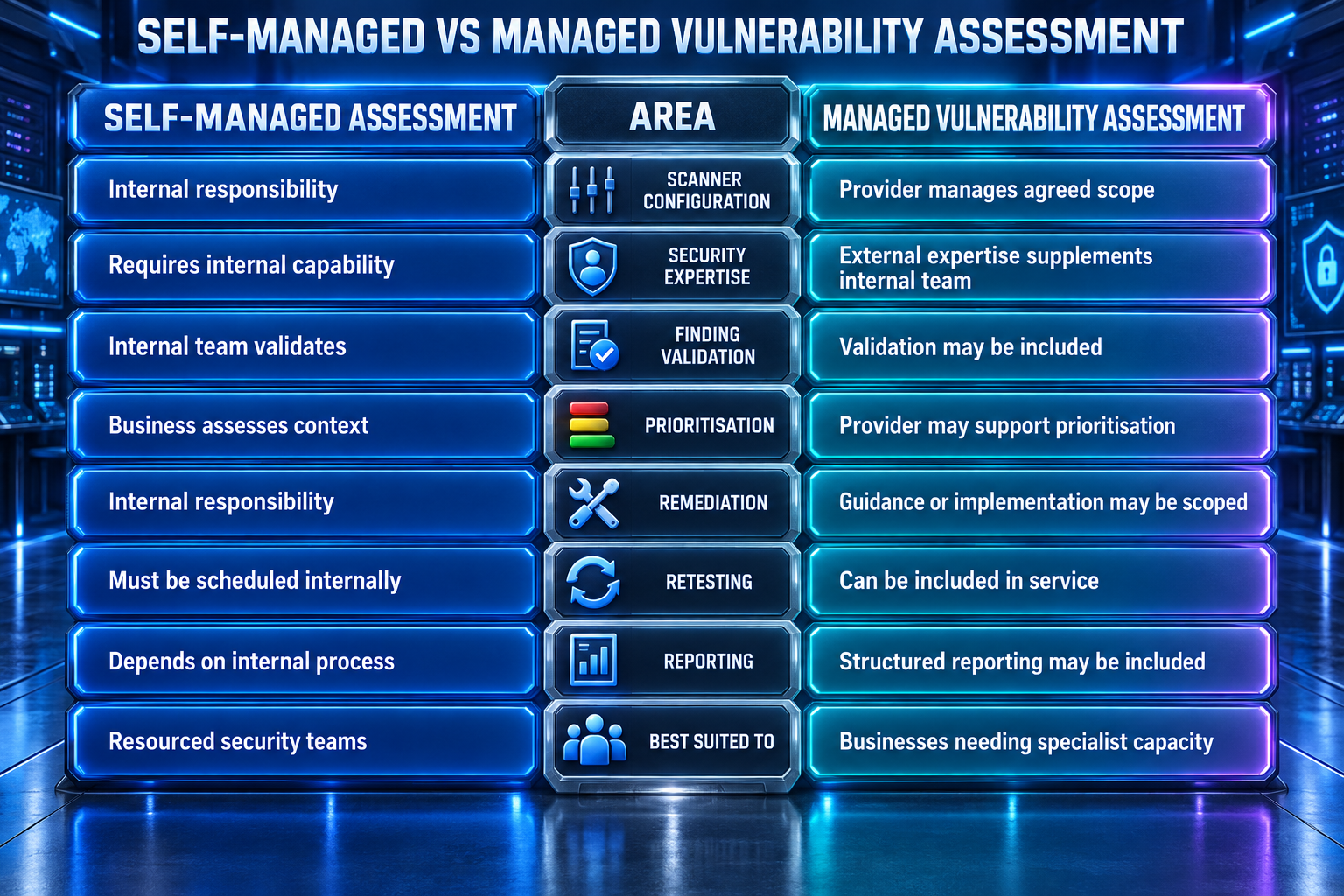
Managed does not automatically mean better.
An organisation with skilled internal security staff, suitable tools and disciplined remediation processes may manage vulnerability assessment effectively.
External support becomes more valuable when internal capacity is limited, independent validation is useful, or the technology environment is too broad for one internal team to assess consistently.
How to Compare Vulnerability Assessment Service Providers
Service evaluation should concentrate on coverage and accountability rather than the scanner brand alone.
Five areas deserve particular attention:
- Scope: Confirm networks, endpoints, websites, cloud systems and authenticated versus unauthenticated coverage.
- Validation: Establish whether findings are reviewed for false positives and business relevance.
- Prioritisation: Check whether reporting incorporates exposure, exploitability, and business criticality.
- Remediation ownership: Document whether the provider advises, implements or only reports fixes.
- Retesting: Confirm whether resolved findings are verified and how closure is recorded.
That short list avoids an important purchasing mistake: assuming every provider delivers the same service because both use the term “vulnerability assessment”.
The report format also matters. A technically detailed report can be useful for engineers but insufficient for management. Strong reporting should show the affected asset, finding, severity, business relevance, recommended treatment, assigned owner, and current remediation status.
For Australian organisations with teams in several locations, service access and coordination should also be confirmed. Businesses contacting ITCompany Sydney, ITCompany Melbourne, ITCompany Brisbane or ITCompany Perth can use the current contact pathways for enquiries, while assessment scope, onsite requirements, scheduling and location-specific availability should be confirmed rather than assumed. The live Contact Us page currently lists all four locations.
Businesses needing a broader understanding of common threat exposure can also review ITCompany Australia’s guide to cybersecurity threats facing Australian small businesses. A provider should ultimately make the assessment easier to act on, not simply produce a larger document.
Vulnerability Assessment, the Essential Eight and Compliance
Vulnerability assessment can support cybersecurity frameworks, but it should not be presented as automatic compliance.
ASD’s Essential Eight assessment process includes vulnerability-scanning evidence within controls relating to asset discovery, application patching and operating-system patching. It also makes clear that assessment methods have different evidence of quality and that scanners have limitations.
That means a vulnerability scan can contribute useful evidence without proving that every Essential Eight requirement has been satisfied. The same principle applies to broader compliance programs. One technical assessment cannot automatically establish compliance with the Privacy Act, ISO standards, PCI DSS, or an industry-specific obligation.
Compliance normally depends on a wider combination of technical controls, governance, documentation, processes, and evidence. This distinction is important for Australian decisionmakers because vulnerability assessment should be positioned as risk evidence, not as a compliance certificate.
For teams developing their own review process, IT Company Australia’s existing vulnerability assessment checklist can provide additional background on the types of security areas that may warrant attention.
Where IT Company Australia May Fit
IT Company Australia’s current Vulnerability Scan Service describes coverage across servers, networks, applications and endpoints, together with identification of security flaws, misconfigurations and outdated software.
That scope may suit organisations looking for external vulnerability assessment support, but suitability should still be tested against the same criteria used for any provider: asset coverage, authentication method, reporting quality, validation, remediation responsibilities and retesting.
Its broader cyber-security and managed IT services may also be relevant where discovered vulnerabilities need to connect with patching, server management, or wider security controls.
IT Company Australia’s service governance includes an information security management system certified to ISO/IEC 27001:2022. Customers should still assess the certification scope, contracted services and their own compliance obligations.
The practical test is whether the engagement produces usable evidence and accountable next steps. A scan that discovers weaknesses has value. An assessment that helps the organisation prioritise, remediate and verify them has substantially more operational value.
Frequently Asked Questions
What Are Vulnerability Assessment Services?
Vulnerability assessment services identify and evaluate security weaknesses across agreed systems, networks, applications, and devices. They commonly combine automated scanning with validation, prioritisation and remediation guidance.
What Is the Difference Between Vulnerability Assessment and Vulnerability Scanning?
Vulnerability scanning mainly detects known weaknesses, while vulnerability assessment adds analysis and risk context. Assessment should help determine which findings matter most and what remediation should follow.
How Is Vulnerability Assessment Different From Penetration Testing?
A vulnerability assessment identifies and prioritises weaknesses, while penetration testing attempts controlled exploitation within an agreed scope. Penetration testing is generally deeper and narrower, while vulnerability assessment can provide broader visibility.
How Often Should an Australian Business Conduct a Vulnerability Assessment?
There is no universal frequency; assessments should reflect the organisation’s exposure, rate of change, contractual requirements, and risk. Major platform changes, new internet-facing systems, cloud migrations, significant deployments, and remediation work can all create reasons for reassessment. ASD’s Essential Eight guidance sets out specific scanning frequencies for certain controls and maturity levels, but those requirements should not be treated as a universal timetable for every business assessment.
How Much Do Vulnerability Assessment Services Cost in Australia?
Cost depends on asset count, environment complexity, authentication requirements, internal and external scope, applications, cloud workloads, validation, reporting and retesting. Businesses should request quotes against the same defined scope and confirm GST treatment.
Does a Vulnerability Assessment Make a Business Compliant?
No. Vulnerability assessment can support security and compliance evidence, but it does not automatically establish compliance with the Essential Eight, Privacy Act, ISO standards or another framework.
What Happens After Vulnerabilities Are Identified?
Findings should be validated, prioritised, assigned to an owner, remediated or formally treated, and then retested where appropriate. Businesses considering professional support can review the current vulnerability scan service to compare assessment scope and remediation support.
Final Thoughts
The value of vulnerability assessment services is not the number of vulnerabilities they find. The value comes from identifying the right assets, distinguishing meaningful exposure from noise, prioritising risk, assigning remediation, and confirming that fixes work.
For Australian businesses in 2026, that distinction is increasingly important as technology estates expand across cloud services, remote access, websites, endpoints and traditional infrastructure.
Three principles summarise the entire process. Vulnerability is not the same as a breach. Scanning is evidence, not complete security assurance. Closing a ticket does not prove that vulnerability has disappeared.
Effective assessment turns those principles into an operating process: discover assets, assess weaknesses, prioritise business risk, remediate what matters, and verify the outcome. Businesses that want to define an assessment around their actual infrastructure rather than a generic scan can contact ITCompany Australia to discuss asset scope, assessment depth, reporting, remediation responsibilities and retesting.
